SFPMA

SFPMA Industry Articles | news, legal updates, events & education! 

Find Blog Articles for Florida’s Condo, HOA and the Management Industry. 

Did you know? Transactional law involves drafting and negotiating contracts to protect your interests. Learn more about this essential legal service at Katzman Chandler.

Did you know? Transactional law involves drafting and negotiating contracts to protect your interests. Learn more about this essential legal service at Katzman Chandler.

  • Posted: Aug 22, 2023
  • By:
  • Comments: Comments Off on Did you know? Transactional law involves drafting and negotiating contracts to protect your interests. Learn more about this essential legal service at Katzman Chandler.

Transactional Services with Katzman Chandler

The team’s decades of combined legal experience provide the Katzman Chandler family of clients with cutting edge solutions to routine issues, as well as novel and/or complex legal matters faced by our Community Association clients and their voluntary Boards of Directors.


Our Transactional Attorneys are often relied upon by the media, as well as public policy makers, to sort out issues relating to the Community Association lifestyle. Each member of the Transactional Team brings a unique skill set and perspective to this diverse practice and understands how best to assist Boards in functioning in an age of ever growing state regulation and changing legal requirements.

Our Transactional Legal Services for Associations involve a combination of several specialty areas including, but not limited to, Real Property Law, Corporate Law, Litigation, Contract Law, and Insurance Law. Whether we are reviewing your contracts, amending your documents, rendering a bank loan opinion or enforcing your Community’s covenants against violators; our ultimate goal remains the same – to deliver information, counsel and answers in an easy to understand format with personalized service and attention to detail that you can rely on time and again.

Tags: , ,
REMBAUM’S ASSOCIATION ROUNDUP | The Community Association Legal News You Can Use

REMBAUM’S ASSOCIATION ROUNDUP | The Community Association Legal News You Can Use

  • Posted: Aug 14, 2023
  • By:
  • Comments: Comments Off on REMBAUM’S ASSOCIATION ROUNDUP | The Community Association Legal News You Can Use

Jeffrey Rembaum, Esq. is a  Board Certified Specialist in Condominium and Planned Development Law and a community association lawyer with the law firm Kaye Bender Rembaum, in its Palm Beach Gardens office. His law practice consists of representing condominium, homeowners, and cooperative associations, developers and unit owners throughout Florida. He can be reached by email at JRembaum@KBRLegal.com or by calling 561-241-4462.

Guns in the Clubhouse: What Can a Community Association Do?

The right of the people to carry and bear arms without governmental infringement is a right which stems from both the United States Constitution and the Constitution of the State of Florida. The State of Florida recently adopted new gun legislation, effective July 1, 2023, which allows the everyday citizen to carry a concealed weapon without first obtaining a concealed weapons permit. This raises interesting questions for community associations such as, is the right to carry a concealed weapon absolute? Can a community association adopt a rule that prohibits the carrying of concealed weapons in the clubhouse or other common area facilities?

Before we get too far in our analysis, it is important to point out that the intent of this article is not to advocate for gun control or the right to carry. Rather, the intent of this article is to examine the rulemaking authority of a board of directors of a community association to prohibit concealed weapons in the clubhouse and other common areas. In short, is it possible for a community association to adopt such a rule? Yes, subject to the cautions and explanations explained below. Is the adoption of such a rule risk free? No!

As the starting point, in order for a board-made rule of this nature to have validity, we must examine whether it violates either the United States Constitution or the Constitution of the State of Florida. As to when constitutional protections apply within a community association, this is an interesting question. In prior cases, courts have found that recorded covenants restricting home ownership based on race will subject the covenants to a constitutional examination, and in the end, such covenants were deemed to violate the equal protection clause of the Fourteenth Amendment to the United States Constitution.

Another method by which courts may find application of constitutional protections to community associations is if there is significant governmental action associated with the community association. For example, an argument would exist that if a community association were built with federal monies, the covenants of such a community association would be subject to all the protections afforded by both the United States Constitution and the Constitution of the State of Florida. Often, multiple community associations that exist within a sprawling master association are built in community development districts (CDD). The CDD is a quasi-governmental entity established to govern and control what would otherwise be the common areas of the master association. The creation of the CDD allows many of the hard costs associated with the community’s build-out, such as the roads and drainage systems, to be immediately passed on to the first-time home buyers. By utilizing a CDD, long-term bonds can be issued, which are paid back through ad valorem tax obligations allowing the costs to spread out over a significantly longer period of time. As quasi-governmental entities, constitutional protections which limit powers of government would likely apply to CDDs. Therefore, should a CDD adopt rules to prohibit concealed weapons in the common areas, such a rule would likely be found to violate constitutional protections. However, the same analysis is not applicable if the community association itself adopted such a rule.

It should be remembered that courts have long held that owners give up certain individual rights and liberties when living in a community controlled by a community association. In 2002 the Florida Supreme Court held, in Woodside Village v. Jahren, 806 So. 2d 452 (Fla. 2002), that certain individual rights must be compromised when one chooses to live in a condominium association (and by analogy, in a homeowners’ association, too). But, on occasion courts have found that certain constitutional protections apply within a community association; however, such application is somewhat rare.

Thankfully, we do have some limited guidance. In 1989 the Florida Supreme Court held, in Quail Creek POA v. Hunter, 538 So. 2d 1288 (Fla. 2d DCA 1989), that neither a homeowners’ association’s recording of its covenants in the public records, nor the enforcement of its covenants in state court, created a sufficient nexus to evidence “state action” such that the First Amendment and the Fourteenth Amendment of the United States Constitution would apply. By analogy, such logic could be applied to defending the right of a community association to adopt a rule prohibiting concealed weapons in the clubhouse. Thus, there is no reason to believe that such arguments would not also apply to the application of the Second Amendment of the United States Constitution within community associations. That said, it would not at all be surprising for an owner to challenge such a rule; so, any association that adopts such a rule should be prepared to be a possible test case, which could have national implications associated with it.

Let us assume that the board understands and accepts such a risk and is ready to move forward to adopt a rule prohibiting the carry of concealed weapons in the clubhouse. Certainly, we recommend that counsel for the association be consulted prior to adopting these types of rules. For the purposes of our analysis, let us also assume that the community association at issue does not have a sufficient nexus to the federal or state governments that would, in and of itself, render such a rule unconstitutional. Under these circumstances, the analysis can then shift to the ordinary rulemaking criteria necessary to withstand judicial challenge, as follows:

      1. Does the board have the necessary rulemaking authority set out in the governing documents or by statute to adopt such a rule?
      2. Does the rule conflict with any rights afforded by governing documents of higher priority, whether they are considered express or implied rights?
      3. Is the rule reasonable? Reasonableness is difficult to define, but case law provides that the rule must be rationally related to a legitimate association objective. The rule cannot be arbitrary or capricious.
      4. Does the rule contravene existing laws or compelling public policies?
      5. Was the rule adopted in a procedurally correct manner that is provided by both the governing documents and existing law?

Of course, even if the association adopts such a rule, enforceability is an entirely different issue. Assuming the association is not using some type of full body scanner, then so long as the possessor of the concealed weapon does not brandish the weapon, and thus it remains fully concealed, no one will be the wiser. In addition, such a rule would not apply to certain individuals who have an absolute right to carry a concealed weapon, subject to very few limitations, such as an off-duty police officer.

As an aside, just because a person may not need to have a concealed weapon permit to carry a concealed weapon, this does not mean that the still-available concealed weapon permit does not have value. It certainly does when it comes to traveling outside the State of Florida to one of the many states, over 26, that have reciprocity with Florida, meaning that the other states recognize Florida’s concealed weapons permit. With that in mind, obtaining a concealed weapons permit may still make sense.

While a properly drafted rule prohibiting guns in the clubhouse stands a decent chance of validity, remember that even if your association

i) fully analyzes whether it has any type of federal governmental nexus which would provide for clear application of constitutional protections and such analysis is answered in the negative, ii) meets the rule adoption criteria listed above, and iii) consults with the association’s lawyer who helps draft such a rule, the association could still find itself as a defendant in a lawsuit seeking to have such a rule invalidated by the court.

MAKE SURE YOUR DOCS DON’T COST YOU MONEY  By Eric Glazer, Esq.

MAKE SURE YOUR DOCS DON’T COST YOU MONEY By Eric Glazer, Esq.

MAKE SURE YOUR DOCS DON’T COST YOU MONEY

By Eric Glazer, Esq.

Let’s start with what some of you already know……..foreclosures are on the rise.  Incredibly, this is happening before huge special assessments are kicking in for many of you and before mandatory reserves go into effect.  If foreclosures are already on the rise, what’s going to happen when special assessments and reserves take hold of most communities?

If a bank forecloses on either a home in an HOA or on a unit in a condominium, the association is likely to take a huge financial hit if that home or unit is also delinquent to the association.  When a bank forecloses on a property, most of the time that bank winds up becoming the owner of that property because nobody bids against the bank at a foreclosure sale.  For example, if an owner fails to pay the mortgage, the bank eventually forecloses and gets a final judgment against the owner for the amount of the delinquency plus interest and attorney’s fees.  The judge sets an auction date.  At the auction, the bank usually bids the amount of their final judgment, there are no other bids and the bank winds up owning the property.

Now that the bank owns the property, do they have to pay all of the assessments that are owed to the association on that home or condominium unit?  Not even close.  The law states that the bank would only have to pay the lesser of:

  • One year of assessments or;
  • One percent of the original mortgage debt;

So, let’s say the bank is foreclosing on a $300,000.00 mortgage.  One percent of that mortgage is $3,000.00.  Let’s say the assessments are $600.00 per month.  One year of assessments is $7,200.00.  Therefore, at most the bank is responsible for $3,000.00 and not $7,200.00 and this is even if the prior owner has not paid for several years.  There can be $15,000.00 in delinquent assessments owed on the unit —the bank would still only have to pay $3,000.00 at most.

Here’s where the association can really get stung.  If the governing documents let the bank off the hook and state that the bank does not have to pay anything if they wind up foreclosing and owning the property.  Even though the law would require the bank to pay $3,000.00 in the above example, the association’s governing documents may allow the bank to pay zero!  SO……………MAKE SURE YOUR GOVERNING DOCUMENTS DO NOT CONTAIN SUCH A PROVISION AND IF THEY DO – AMEND IT IMMEDIATELY BEFORE FORECLOSURES IN YOUR COMMUNITY POSSIBLY BECOME ROUTINE!  DON’T LET THE BANKS OFF THE HOOK!

Next week we’ll talk about what happens when a third party buys the property at a foreclosure sale and not the bank.  You definitely will want to find out the good and the potential for disaster.


You can read more articles from Eric Glazer on his Blog. 


Tags: , ,
NEW LAW MAKES IT CLEAR THE ASSOCIATION MUST MAKE THE REPAIRS. BUT SUPPOSE MONEY IS TIGHT AND THE DOCS ARE RESTRICTIVE?

NEW LAW MAKES IT CLEAR THE ASSOCIATION MUST MAKE THE REPAIRS. BUT SUPPOSE MONEY IS TIGHT AND THE DOCS ARE RESTRICTIVE?

  • Posted: Jul 27, 2023
  • By:
  • Comments: Comments Off on NEW LAW MAKES IT CLEAR THE ASSOCIATION MUST MAKE THE REPAIRS. BUT SUPPOSE MONEY IS TIGHT AND THE DOCS ARE RESTRICTIVE?

NEW LAW MAKES IT CLEAR THE ASSOCIATION MUST MAKE THE REPAIRS. BUT SUPPOSE MONEY IS TIGHT AND THE DOCS ARE RESTRICTIVE?

NEW CONDO LAW MAKES IT CLEAR THAT THE CONDO MUST MAKE THE REPAIR

By Eric Glazer, Esq.

I get so many calls and e-mails each week about whether the condominium or the unit owner is responsible to fix something that’s broken.  Florida Statute 718.113 was recently amended and here’s what it says:


(1)   Maintenance of the common elements is the responsibility of the association, except for any maintenance responsibility for limited common elements assigned to the unit owner by the declaration. The association shall provide for the maintenance, repair, and replacement of the condominium property for which it bears responsibility pursuant to the declaration of condominium.


That kind of clarifies it, doesn’t it?  The association shall provide for the maintenance, repair, and replacement of the condominium property for which it bears responsibility pursuant to the declaration of condominium.  Notice the word shall is used.  In simple terms, shall means must.  So there is no argument……if the declaration says the association is responsible, the association must repair it.

But suppose the association does not have money to make the repair?  Now what?  The association can certainly special assess right?  But suppose the docs place a limit on the amount of the special assessment or require a unit owner vote to approve a special assessment and the unit owners won’t vote in favor of it?  Now what can you do?

Of course you may be able to borrow money.  Florida’s not for profit statute allows condominiums to borrow money.  So, the condo is in the clear right?  Not so fast.  Suppose the condo docs require a vote of the owners in order for the condo to borrow money and the owners won’t vote in favor of a loan?


How can the condominium make the repairs it is required by law to make if it can’t assess or borrow?

So here is this attorney’s opinion.  I don’t care about any language in a declaration that prevents an association from passing an assessment in order to make mandatory repairs.  The board can and must pass the assessment in order to comply with their statutory obligation to repair and maintain the common property.

On the other hand, if the governing documents do not prevent an association from borrowing money, the association certainly can.  However……if the governing documents will not allow the association to borrow money unless a certain number of the owners approve, the association cannot borrow unless the owners vote to approve.  No bank will approve a loan if the governing documents require the owners to vote in order to borrow, and the vote has not been obtained.  Get legal advice if you need money and you feel tied up by your docs.


Tags: ,
ANOTHER NEW LAW:  HB 437 — FLAGS, TURFS AND BOATS

ANOTHER NEW LAW:  HB 437 — FLAGS, TURFS AND BOATS

ANOTHER NEW LAW:  HB 437

By Eric Glazer, Esq.

I can’t tell you how may fights I have been involved in regarding flags other than the U.S. flag flying above someone’s home and the fact that someone put down fake grass or stored a boat, that nobody can see, in their backyard.  Well, here’s a new statute that solves both of those problems:

Florida Statute 718.113

If any covenant, restriction, bylaw, rule, or requirement of an association prohibits a homeowner from displaying flags permitted under this paragraph, the homeowner may still display one portable, removable United States flag or official flag of the State of Florida in a respectful manner up to two of the following, and one portable, removable flags official flag, in a respectful manner, not 48 larger than 4 1/2 feet by 6 feet:, which represents

  1. The United States flag.
  2. The official flag of the State of Florida.
  3. A flag that represents the United States Army, Navy,  Air Force, Marine Corps, Space Force, or Coast Guard., or
  4. A POW-MIA flag.
  5. A first responder flag. A first responder flag may incorporate the design of any other flag permitted under this paragraph to form a combined flag. For purposes of this subsection, the term “first responder flag” means a flag that recognizes and honors the service of any of the following: a. Law enforcement officers as defined in s. 943.10(1).
  6. Firefighters as defined in s. 112.191(1).
  7. Paramedics or emergency medical technicians as those terms are defined in s. 112.1911(1).
  8. Correctional officers as defined in s. 943.10(2).
  9. 911 public safety telecommunicators as defined in s. 401.465(1).
  10. Advanced practice registered nurses, licensed practical nurses, or registered nurses as those terms are defined in s. 464.003.
  11. Persons participating in a statewide urban search and rescue program developed by the Division of Emergency Management under s. 252.35.
  12. Federal law enforcement officers as defined in 18 U.S.C. s. 115(c)(1), regardless of any covenants, restrictions, bylaws, rules, or requirements of the association.

In addition, in an HOA, the homeowner may erect a 20 foot flagpole on any portion of their property and fly the U.S. flag and any of the flags mentioned above.

Florida Statute 720.3045 now states:

Regardless of any covenants, restrictions, bylaws, rules, or requirements of an association, and unless prohibited by general law or local ordinance, an association may not restrict parcel  owners or their tenants from installing, displaying, or storing any items on a parcel which are not visible from the parcel’s frontage or an adjacent parcel, including, but not limited to, artificial turf, boats, flags, and recreational vehicles.

I’m getting ready for lots of fights regarding visibility of boats as boat owners will look to save the costs of monthly storage.

Tags: ,
Is There Liability for Dangerous Wild Animals in Your Community?

Is There Liability for Dangerous Wild Animals in Your Community?

Is There Liability for Dangerous Wild Animals in Your Community?

by JEFFREY REMBAUM, ESQ., KAYE BENDER REMBAUM

With the ever-increasing development in Florida, especially in South Florida, we are once again reminded that we live in close proximity to a number of native, exotic, invasive, and at times dangerous wild animals.

Tragically, and all too recently, in St. Lucie County an 85-year-old woman died while trying to rescue her dog from an alligator. Whether her community association will be held liable will largely depend upon what the association knew and when they knew it regarding the existence of alligators within the association’s property.

Simply put, if there is a foreseeable zone of risk, then the association’s members should be made aware of it. Phrased differently, where the association, acting by and through its board of directors, is aware or should reasonably be aware of a dangerous animal within association property, then there is a duty to act. Such action should minimally include notice to the entire community, and for those situations where reoccurrence is a likely possibility, then posting signs could be warranted, too.

What can and should happen when your community association is confronted with that unexpected wild animal that causes a disturbance or, even worse, the wild animal has become a source of imminent danger to the members of the association or their guests? Guidance is presented from Hanrahan v. Hometown America, LLC, 90 S.3d 915 (Fla. 4th DCA 2012), decided on June 20, 2012, by Florida’s Fourth District Court of Appeal. In this case, the personal representative of a deceased resident, Ms. Hanrahan (Hanrahan), sought damages for the negligent death of Mr. Hanrahan, who died from fire-ant bites sustained on the common areas of Pinelake Gardens and Estates, a mobile home park (Pinelake Gardens).

By way of background, Mr. Hanrahan was walking his dog in the common area of Pinelake Gardens known as the “Preserve.” Mr. Hanrahan claimed that he brushed up against a bush, at which point the fire ants gained access to his body. Mr. Hanrahan attempted to wash the fire ants off of his body but collapsed on the shower floor. He died two days later. During the trial, the Pinelake Gardens community manager testified that she was not aware of any resident in Pinelake Gardens being exposed to or attacked by fire ants on the premises, nor was she aware of any fire ants in the area of Pinelake Gardens where the incident allegedly occurred. She testified that Pinelake Gardens regularly contracted with an exterminator to spray insecticide, which included killing ants (not specifically fire ants). She further testified that maintenance employees would treat observed ant mounds with granules and would contact the exterminator if there was anything out of the ordinary observed.

The trial court ruled in favor of Pinelake Gardens. The trial court determined that Pinelake Gardens was not on sufficient notice of a fire-ant infestation at the area of the alleged incident, and therefore did not have a duty to Mr. Hanrahan to guard against the fire ants or otherwise take action in this situation. As a result, Hanrahan appealed. On appeal, Hanrahan claimed that the trial court improperly determined whether Pinelake Gardens could foresee the specific injury that actually occurred, instead of, as Hanrahan claimed, whether Pinelake Gardens’ conduct created a “foreseeable zone of risk.”

The general rule in regard to wild animals in Florida, as explained by the appellate court citing another case, Wamser v. City of St. Petersburg, 339 So.2d 244 (Fla. 2d DCA 1976), is that

…the law does not require the owner or possessor of land to anticipate the presence of, or guard an invitee against harm from, animals “ferare naturae” (which is a common law doctrine where wild animals are considered owned by no one specifically but by the people generally) unless such owner or possessor harbors such animals or has introduced wild animals to the premises which are not indigenous to the locality.

The Wamser case involved a shark attack, in which the city did not have any knowledge of prior shark attacks and therefore did not have any foreseeability of the possibility of shark attacks nor a duty to guard against shark attacks. As in Wamser, the appellate court in Hanrahan v. Hometown America, LLC, ruled that there was no evidence in the record to show Pinelake Gardens had any knowledge of a “ferae naturae” attack in the alleged area. The appellate court held that the presence of the fire ants was not caused by any act of Pinelake Gardens and that Pinelake Gardens did not harbor or introduce them. Furthermore, Pinelake Gardens regularly attempted, by maintenance staff and exterminators, to treat the ant mounds and other manifestations of fire ants. To add a further caveat to its ruling, the appellate court quoted from another fire-ant case, State of Texas, Nicholson v. Smith, 986 S.W,2d 54 (Tex. App. 1999), in which it was stated:

…we do not say a landowner can never be negligent with regard to the indigenous wild animals found on its property. A premises owner could be negligent with regard to wild animals found in artificial structures or places where they are not normally found; that is, stores, hotels, apartment houses, or billboards, if the landowner knows or should know of the unreasonable risk of harm posed by an animal on its premises and cannot expect patrons to realize the danger or guard against it. [emphasis added]

Thus, in the end, the appellate court ruled that there was no evidence that Pinelake Gardens knew or should have known of the unreasonable risk of harm posed by the fire ants. Even though the Hanrahan case concerned fire ants, the case could be applied by analogy to any number of wild animals that you could encounter in your community association, including, without limitation, alligators.

When it comes to injuries caused by wild animals, the board of directors should examine whether there is a foreseeable zone of danger. The question is not whether an injury occurred (as strict liability does not exist), but rather was it foreseeable that an injury could occur? If so, then the board has a duty to act. Remember, the basic rule is that if the association is aware of a dangerous animal or if it is foreseeable that a dangerous wild animal could be within the lands governed by the association, then the association has a duty to act. Importantly, please be certain to discuss the situation with the association’s legal counsel for proper guidance.

 Jeffrey Rembaum, Esq. of Kaye, Bender, Rembaum attorneys at law, legal practice consists of representation of condominium, homeowner, commercial and mobile home park associations, as well as exclusive country club communities and the developers who build them. Mr. Rembaum is a Certified Specialist in Condominium and Planned Development Law. He is the creator of ‘Rembaum’s Association Roundup’, an e-magazine devoted to the education of community association board members, managers, developers and anyone involved with Florida’s community associations.  His column appears monthly in the Florida Community Association Journal. Every year since 2012, Mr. Rembaum has been selected to the Florida Super Lawyers list and was also named Legal Elite by Florida Trends Magazine. He can be reached at 561-241-4462.
Tags: ,
PENNY WISE POUND FOOLISH  By Eric Glazer, Esq.

PENNY WISE POUND FOOLISH By Eric Glazer, Esq.

PENNY WISE POUND FOOLISH

By Eric Glazer, Esq.

In light of the new laws requiring mandatory inspections, mandatory repairs and mandatory reserve studies, some associations are looking to cut back and save money. 

That’s not a bad idea; unless you’re cutting back on your legal counsel reviewing all of the contracts provided to you by those engineers, architects or general contractors who perform any of these inspections or repairs.

I’m starting to see more of this and it’s an alarming trend.  It boggles my mind that an association would spend millions of dollars on a contract for repair of their property, but won’t spend a few hours on their attorney reviewing that contract first.  No question in my mind that the failure of the Board to have that contract reviewed by counsel before signing, is a breach of their fiduciary duty to the unit owners they represent.

I teach a class called “Before You Sign That Contract.”  It talks about so many ways in which the association can suffer financial loss by having the wrong clauses in the contract or by failing to insert certain clauses into the contract.  Once sentence can potentially cost the association hundreds of thousands of dollars.  And you chose to cheap out on a few hours of attorney’s time?  Really?

Even smaller contracts need to be reviewed.  If the association does not have the proper remedies in the contract for the contractor’s breach, the situation can turn into a long lasting nightmare where the association will never be made whole.  And…….the association will have to spend its own attorney’s fees now to correct the problem with no chance of recovering them later on.

We are about to enter into a historic time here in Florida where these types of contracts will be flying off the shelves. 

They will be everywhere, in every condominium.  Be careful.  If you didn’t hear me the first time, I said BE CAREFUL AND DON’T BE CHEAP.  GET LEGAL HELP BEFORE SIGNING.

DON’T COME TO ME AFTER YOU SIGNED A CONTRACT AND SAY “HEY ERIC…OUR ASSOCIATION SIGNED THIS MULTI MILLION DOLLAR CONTRACT.  CAN YOU NOW GET US OUT OF IT?

THE ANSWER IS OFTEN TIMES……NO I CANNOT.  YOU SHOULD HAVE ASKED ME TO LOOK AT IT BEFORE SIGNING IT.

Tags: ,
Release of Liability and Hold Harmless Agreements  by JEFFREY REMBAUM, ESQ., KAYE BENDER REMBAUM

Release of Liability and Hold Harmless Agreements by JEFFREY REMBAUM, ESQ., KAYE BENDER REMBAUM

Release of Liability and Hold Harmless Agreements

by JEFFREY REMBAUM, ESQ., KAYE BENDER REMBAUM

If Your Association Requires One, Then You Must Read This…

Many communities offer a host of amenities for their residents and guests to enjoy, such as clubhouses, fitness centers, playgrounds, swimming pools, tot lots, tennis courts, etc. One of the upsides to providing such amenities is that the residents and their guests have a variety of activities to choose from, which enhances the quality of life within the community. However, one of the potential significant downsides to offering such benefits is that the association often incurs liability if a resident or guest is injured while using one of the amenities.

Accordingly, it has become commonplace for associations to require that residents and guests sign a document that releases the association from liability and holds the association harmless when a resident or guest uses the amenities. Although the title of the document may vary—“Hold Harmless,” “Indemnification Agreement,” “Release of Liability,” or “Waiver and Release”—there is usually language included within the document along the lines of the following:

“I, Mr. Owner, on my own behalf and on behalf of all other occupants and guests to my home, for and in consideration for use of the association’s facilities, equipment, etc. hereby release and hold harmless the association, its members, officers, directors, agents, etc. from any and all liability which may arise out of or in connection with my participation or use of the foregoing facilities, equipment, etc.”

This language is often referred to as an “exculpatory clause,” which is a clause that is designed to relieve a party from blame or liability. Such language has traditionally served to help prevent an association’s liability to an owner or guest when he or she is injured while using the amenities. It may have been a while since anyone has taken a good look at the specific language included in the association’s release, and it may be taken for granted that such language will automatically protect the association from liability. Many such form documents do not provide the protection you might think they should. A recent Florida appellate court case dealing with such exculpatory clauses highlights this potential issue and offers pause.

Specifically, The Estate of Nicholas Adam Blakely, By and Through Michele Wilson, as Personal Representative v. Stetson University, Inc., WL 17997526 (Fla. 5th DCA 2022), involved the tragic death of a young man who played football at Stetson University. As described in the written appellate opinion, the young man pulled himself out of an afternoon football practice complaining to an assistant athletic trainer that he felt dizzy and that his chest felt tight. Although the trainers continued to monitor his symptoms on the sidelines, after approximately 45 minutes the young man collapsed. Thereafter, university employees attempted various emergency medical procedures in an unsuccessful effort to revive him. The young man was transported to the hospital where, sadly, he died.

The trial court found that the two identical releases signed by the young man were sufficiently clear to bar claims brought against the university arising from his death after participating in the football practice. On appeal, however, one of the arguments focused on whether the language in the releases that the young man signed were sufficient to be enforceable. The appellate court determined it was not. Although the entirety of the written releases are unable to be reproduced here, the particular language that the court focused on is set out below. Specifically, the appellate court placed emphasis on the following:

I understand that the dangers and risks of playing or participating/practicing may include, but are not limited to: death…Because of the dangers and risks involved in participating in intercollegiate athletics, I recognize the importance of following the Coaches and Sports Medicine staff instructions regarding playing techniques, conditioning, rehabilitation/treatment recommendations and team rules, etc. and agree to obey such instructions…I hereby assume all risks associated with participation and agree to hold Stetson University…from any and all liability…of any kind or nature which may arise by or in connection with my participation in any activities related to the Stetson University athletic program. The terms hereof shall serve as a release and assumption of risk for myself, my heirs, estate, executor, administrator, assignees and for all members of  my family. The terms hereof shall serve as a complete release and waiver of liability for myself, my heirs, estate, executor, administrator, assignees, and for all members of my family.


On its face, it sounds complete. But is it? In its analysis of the language included in the releases, the appellate court began by expressing that

[A]n exculpatory clause purports to deny an injured party the right to recover damages from a person negligently causing his injury. They are disfavored in the law because they relieve one party of the obligation to use due care and shift the risk of injury to the party who is probably least equipped to take the necessary precautions to avoid the injury and bear the risk of loss. Such claims are strictly construed against the party seeking to be relieved of liability. Thus, exculpatory clauses are enforceable only where and to the extent that the intention to be relieved from liability is made clear and unequivocal. The wording must be clear and understandable that an ordinary and knowledgeable person will know what he is contracting away (quoting UCF Athletics Ass’n, v Plancher, 121 So. 3d 1097, 1101 [Fla. 5th DCA 2013]).


Unlike the trial court, the appellate court took issue with the language contained within the releases because the release forms

  1. failed to expressly inform the young man that he was contracting away his rights to sue the university for its own negligence,
  2. used language that could reasonably lead one to believe that the university would be supervising and training [him] properly such that the young man was only being asked to sign the exculpatory clause to cover injuries inherent in a sport, and
  3. used language suggesting that the terms of the releases were for the young man’s benefit.


Accordingly, the appellate court determined that the foregoing supported a determination that the releases were not clear and unambiguous. So, what does the appellate court’s decision mean for exculpatory clauses as related to an association’s release? It means that associations need to review the language in such exculpatory clauses with counsel to assist in aligning the language with the thinking of the court. For example:

  1. Is the language in the release clear, unambiguous, and written in such a way that an ordinary and knowledgeable person would know that he or she is contracting away his or her right to sue the association if an injury occurs?
  2. Is the language in the release free from any indication whatsoever that training and/or supervision is being provided by the association to avoid a mistaken belief by the owner or guest that he or she is merely signing away his or her right to sue for injuries inherent in a particular activity?
  3. Is it unequivocally clear that the individual is giving up all rights to litigate against the association in regard to any accident that may occur, even if the association was negligent?
  4. Are there terms in the release that would make it seem as though the release is for the benefit of the homeowner or guest and not the association?
    If you are in doubt as to the exculpatory language included in your association’s release, do not wait until a homeowner or guest is injured, or possibly worse, to discover that the language is not appropriate for protecting the association from liability. In light of this most recent opinion, you should discuss with your association’s legal counsel when there would be a good opportunity to review and amend such release of liability and hold harmless agreements.

Jeffrey Rembaum, Esq. of Kaye, Bender, Rembaum attorneys at law, legal practice consists of representation of condominium, homeowner, commercial and mobile home park associations, as well as exclusive country club communities and the developers who build them. Mr. Rembaum is a Certified Specialist in Condominium and Planned Development Law. He is the creator of ‘Rembaum’s Association Roundup’, an e-magazine devoted to the education of community association board members, managers, developers and anyone involved with Florida’s community associations.  His column appears monthly in the Florida Community Association Journal. Every year since 2012, Mr. Rembaum has been selected to the Florida Super Lawyers list and was also named Legal Elite by Florida Trends Magazine. He can be reached at 561-241-4462.
Tags: ,
As a homeowner, it is important to know Common Property Damage Claims. by Joseph Maus

As a homeowner, it is important to know Common Property Damage Claims. by Joseph Maus

  • Posted: Apr 02, 2023
  • By:
  • Comments: 0

Common Property Damage Claims. As a homeowner, it is important to know

A home or office building is the most important purchase most of us will make during our lifetime. Most of us buy insurance coverage – windstorm, liability, flood, homeowners, and business interruption – to protect our homes and businesses. Yet, today’s insurance policies are lengthy, complex contracts full of exceptions, exclusions, deductibles, and conditions that make the policy difficult to read, and sometimes even more difficult to recover from for your damage. When you call the Maus Law Firm, a top Fort Lauderdale property damage lawyer will handle property damage claims.

Disagreeing with Your Insurance Claim for Property Damage

You have four options if you disagree with the amount the insurance company is offering you for your damage:

Most insurance companies create entire TV marketing campaigns designed to say that you’re part of the insurance company’s “family”. However, the reality of the insurance business is that insurance companies exist to make money. That means that insurance company needs to minimize the amount of claims it pays out; meanwhile, maximizing the premiums that it collects.

When an insurance company doesn’t offer to pay you the full (or fair) amount of your property damage, you need to be prepared to fight. While many homeowners are hesitant to go to court – fearful of a lengthy or expensive legal battle against a big-name insurer – settling for less than your claim was worth can end up costing you more in the long-term. The repairs your home needed can continue to pile up, lowering the value of your property. Hiring the best Fort Lauderdale property damage lawyer you can find will save you the headache later.

The Process for Property Damage Claims & Florida Property Owner’s Obligations

When making insurance claims for property damage, it is helpful to know how the process typically unfolds. Our Fort Lauderdale property damage lawyer knows that while there are many potential scenarios, the property owner should first understand their own obligations under the insurance policy. Second, the property owner should understand the reasons for the insurance company’s denial of their claim.

Any property insurance policy will place some obligations on the property owner when they make a claim for property loss. These obligations will differ from policy to policy, but the following are several of the most common requirements.

  • Notice of Loss: The property owner is generally required to provide notice of the loss to the carrier promptly. The policy should provide a specific deadline. Failure to meet this deadline could result in the claim being barred.
  • Protect Against Further Damage: The property owner is also required to take reasonable steps to protect the property from further damage. For example, if the roof of a property is damaged by a hurricane, the property owner must attempt to place temporary covering to protect the interior. However, the exact conduct that is considered “reasonable steps” will often be subject to interpretation.
  • Proof of Loss: After making a claim, the property owner will need to submit a proof of loss statement. This statement is generally signed under penalty of perjury and itemizes the damages. A typical deadline for the proof of loss is 60 days after a request by the insurance carrier.

How a Fort Lauderdale Property Damage Lawyer Can Help You with Your Homeowner’s Insurance Claim

Unfortunately, even if you have paid your homeowners’ insurance premiums on time for decades, this does not guarantee that your insurance company will treat you fairly if you need to file a claim. Bad-faith insurance claim denials are common, and homeowners can run into various other issues with their property damage claims as well. As a result, if you need to file a homeowners’ insurance claim, it is a good idea to hire an attorney. Here are just a few examples of the ways an experienced Fort Lauderdale property damage lawyer like Joseph Maus can help:

1. Determining If Your Claim is Covered

Before you devote the time, energy and resources to pursuing a property damage claim, you first need to determine if your claim is covered. An experienced Fort Lauderdale property damage lawyer will be able to review your homeowners’ insurance policy and assess the damage to your home in order to determine if your insurance company is liable.

2. Dealing with Your Insurance Company On Your Behalf

If you have a claim, your attorney will be able to deal with your insurance company on your behalf until your claim has been fully and finally resolved. This important for a few different reasons: (i) Florida’s insurance laws are complicated, and asserting your legal rights can be difficult; (ii) in some cases, there will be a legitimate dispute as to whether a homeowners’ insurance policy applies; and, (iii) successfully pursuing a homeowners’ insurance claim for significant property damage takes time, and you will need someone to handle your claim while you focus on work and your day-to-day life.

3. Overcoming Bad-Faith Coverage Delays and Denials

As we mentioned above, insurance companies routinely deny policyholders’ property damage claims in bad faith. If your insurance company is not handling your claim appropriately, you may need your attorney to take legal action on your behalf. If you have a claim for insurance bad faith, then you can seek compensation above and beyond the amount of coverage to which you are entitled under your policy.

Common Claims for Property Damage in Fort Lauderdale

When can you file a property damage claim? As a homeowner, it is important to know when you are entitled to insurance coverage and when you may need to come out of pocket to cover repairs to your home. With this in mind, here are some examples of common property damage claims in Fort Lauderdale:

  • Storm Damage Claims – While homeowners’ insurance policies do not cover flood damage caused by hurricanes and tropical storms, they do cover other types of storm damage.
  • Tree Damage Claims – If a tree in your yard fell on your home, your homeowners’ insurance policy should provide coverage.
  • Water Damage Claims – Water damage caused by leaking pipes, HVAC system failures and other similar types of issues should be covered under your homeowners’ insurance policy.
  • Fire Damage Claims – Fires from lightning strikes and other causes are generally covered as well, and your policy should cover your home as well as its contents.
  • Mold Claims – Mold claims are often disputed; but, if your house has mold from a “covered peril,” then the costs of remediation should be covered.
  • Theft Claims – If your home has been burglarized, your homeowners’ insurance policy may provide coverage for any damage that occurred during the break-in in addition to the value of your stolen property.

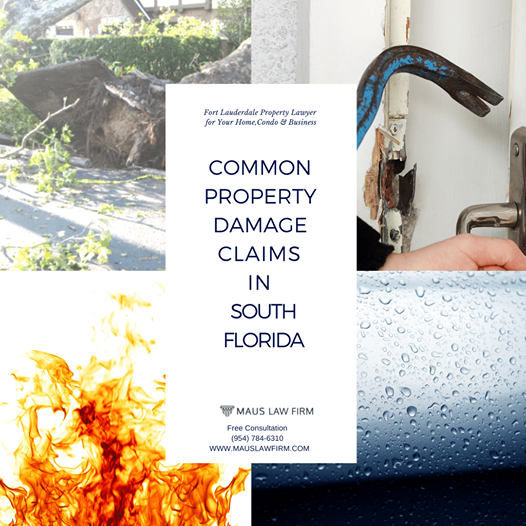
Here are 6 common property damage claims;

#1 Storm Damage, #2 Tree Damage, #3 Water Damage., #4 Fire Damage, #5 Mold, #6 Theft.


Where do you turn to get help?

The Maus Law Firm has been successfully handling insurance-related claims since 1993. We will competently and aggressively represent you in your homeowner property damage insurance claim, or commercial business insurance claim.

Call 954-784-6310 or

visit our website now, for a free consultation.


SFPMA & Members are ready to Handle Storm Damage & Claims for Condo and HOA Properties!

Trusted Members are; Legal Firms, Public Adjusters, Roofing, Engineering & Restoration Service Companies that work with you on Solutions to Storm Related Damage.

This is a Division of SFPMA – http://FloridaAdjusting.com


Tags: ,