SFPMA

SFPMA Industry Articles | news, legal updates, events & education! 

Find Blog Articles for Florida’s Condo, HOA and the Management Industry. 

Garing Parking Enforcement / Garing Property Services

Garing Parking Enforcement / Garing Property Services

Garing Parking Enforcement / Garing Property Services

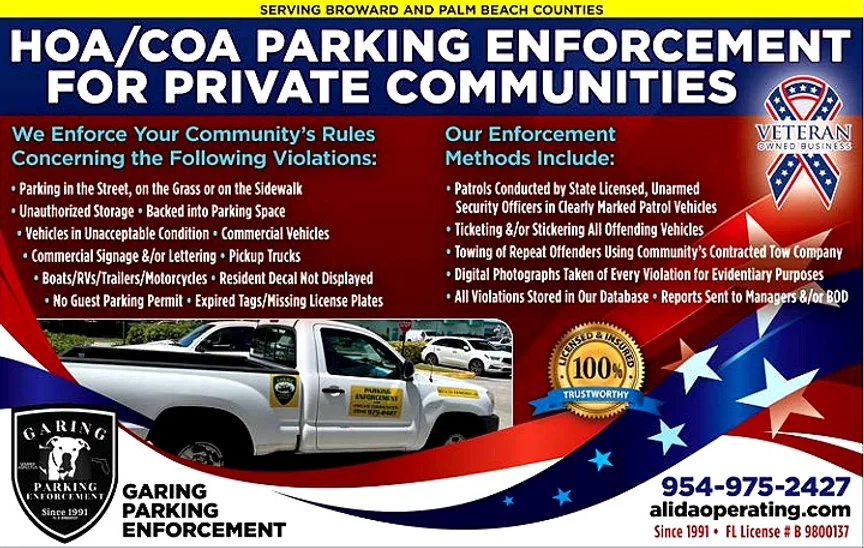
We pride ourselves on providing invaluable services to HOAs/COAs and their property managers throughout S. Florida that facilitate the improvement of safety and appearance of their communities while preserving the integrity of property values. Our first division, Garing Parking Enforcement, was started in 2007 to help communities regain and maintain compliance with their vehicle restrictions and parking regulations.
Our second division, Garing Property Services, was just launched with a similar intent of bringing the residences, recreational and common areas in a community into compliance with the community’s governing documents pertaining to the appearance and upkeep of their dwellings.


TESTIMONIALS

Dear Paul and the Garing Staff

Just so you know, we were more than satisfied with the patrols. I know what your guy went through at times; the threats […] abusive residents, etc. l also know it would be hard to duplicate this service for little or no cost if we choose to do so because you are extremely reasonable with the costs. You have been a tremendous help to our violation enforcement […] I just personally wanted you to know that we appreciate everything you have done for our community.

Sincerely,

Chuck Forcucci
and the Genesis Board of Directors


Dear Paul

I’ve read carefully the report of Garing’s parking ranger. I have no comment other than l do appreciate very much everything that he did on Saturday night, June 21, 2008 between 12:30 am and 1:50 am.

He conducted his duty strictly in accordance with the professional regulations of your company and the agreement with Sawgrass Preserve HOA. The owners of vehicles that were subject of towing in this incident were very well known as frequent violators, not only in illegal parking, but also in other cases (broken gate arm, tailgating…)

On behalf of the Association l praise the professional stand of your ranger and use this opportunity to thank him for everything he did that night to protect the Association rules. Could you please pass to him our great satisfaction for his approach in conducting of his duties.

Thanks.

Miro Imamovic
Tags:
VANDELAY COMMUNICATIONS LLC – EV CHARGING STATIONS

VANDELAY COMMUNICATIONS LLC – EV CHARGING STATIONS

VANDELAY COMMUNICATIONS LLC

Veteran-Owned Small Business, Trusted Consulting Firm for the Telecom Industry.

954-214-2590

Taking Your Business to New Heights

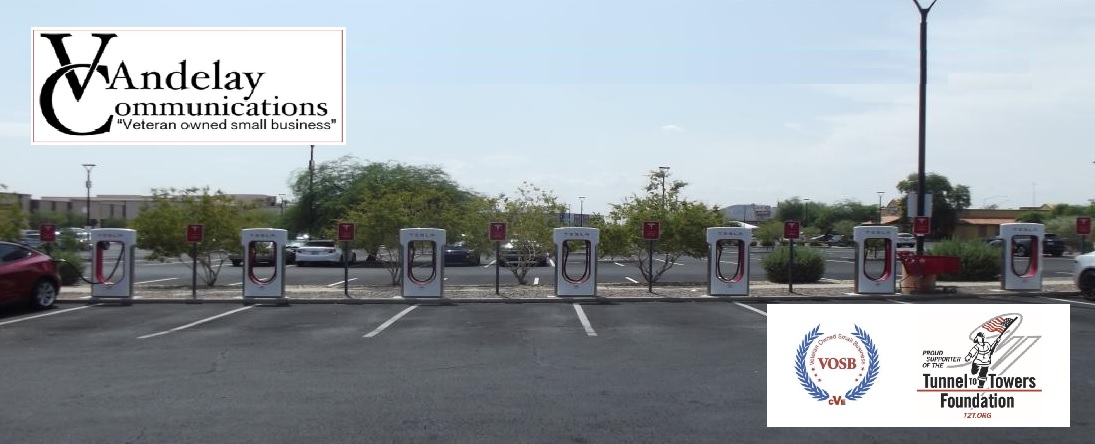
Vandelay Communications is reaching out to all HOA’s across Florida to offer our services. Our company is building Electric Vehicle Charging stations across the country and Florida’s EV use is currently rising at the highest percentage across the country. Is your property prepared? Do your residents now and future have access to EV Chargers in their homes or parking garages?

By 2025 it is estimated that 30% of all vehicles on the road will be electric. By 2030 almost every car manufacturer will be producing electric vehicles. The costs of install can be offset by the residual income that comes from the usage. This also has the ability to offer an HOA an additional income to reduce HOA fees for your residents while increasing property values. We offer single family garage equipment sales and installations, as well as large capacity parking lots and underground or above ground garage installs. Vandelay offers education to residents, free no obligation estimates and is a turn key solution that will guide you through the entire process. Please reach out for more details


VANDELAY COMMUNICATIONS LLC IS A VETERAN OWNED AND OPERATED COMPANY
WE WORK IN BOTH EV CHARGING STATIONS AND CELLULAR COMMUNICATIONS

WE PROVIDE SERVICES THAT INCLUDE SALES OF EQUIPMENT, PLANNING, EDUCATING CONSULTING, INSTALLATION AND MAINTENANCE OF EV CHARGERS
WE ALSO PROVIDE CONSULTING ON CELLULAR APPLICATIONS OF EXISTING EQUIPMENT AND NEW INSTALLS AS WELL AS LEASING CONSULTANTS AND ADVOCATES FOR BUILDING OWNERS

STEVE MILANA
STEVE@VANDELAYCOMMUNICATIONS.COM
EXECUTIVE VP
VANDELAY COMMUNICATIONS LLC
954-214-2590
https://vandelaycommunications.com/


Tags: ,
Architectural Committees Formal Procedures, Published Standards, and Self Help by REMBAUM’S ASSOCIATION ROUNDUP

Architectural Committees Formal Procedures, Published Standards, and Self Help by REMBAUM’S ASSOCIATION ROUNDUP

  • Posted: Apr 29, 2026
  • By:
  • Comments: Comments Off on Architectural Committees Formal Procedures, Published Standards, and Self Help by REMBAUM’S ASSOCIATION ROUNDUP

Architectural Committees Formal Procedures, Published Standards, and Self Help

by REMBAUM’S ASSOCIATION ROUNDUP

Formal Procedures

There are strict legal requirements that a homeowners’ association’s (HOA) architectural review committee (ARC) must follow, most especially if the ARC intends to deny an owner’s request. As this author has witnessed countless times, it is likely that many ARCs do not conduct their activities in conformity with Florida law such that an ARC denial may not withstand judicial scrutiny. If these legal requirements are not followed, and the ARC denies the owner’s architectural request, then it would be quite easy for the owner to challenge the ARC’s decision and prevail. Upon prevailing, the owner would be entitled to their prevailing party attorney’s fees and costs, as well. It is so easy to avoid this outcome, yet so few associations take the time to do it right.

Pursuant to §720.303(2), Florida Statutes, a meeting of the ARC is required to be open and noticed in the same manner as a meeting of the association’s board of directors. Notice of the ARC meeting must be posted in a conspicuous place in the community at least 48 hours in advance of the meeting, and the meeting must be open for all members to attend. Further, pursuant to §720.303(2)(c)(3), Florida Statutes, members of the ARC are not permitted to vote by proxy or secret ballot. Also, bare bone minutes should be taken to create a record of ARC decisions—especially denials.

We often hear from many HOAs that the ARC does not meet openly and does not notice their meetings. This leaves decisions made by the ARC vulnerable to challenge. If the ARC denies an application but fails to do so at a properly noticed board meeting, the owner can challenge the denial, claiming that it is not valid because the ARC did not follow proper procedure. In such cases, the ARC’s denial of an application is not valid because the ARC failed to comply with the procedural requirements for the meeting even if an application violates the declaration or other association-adopted architectural standards. However, by complying with the provisions of Chapter 720, Florida Statutes, your HOA can work to avoid this debacle.


[AdSense-A]


Published Standards

Often a top priority for an HOA is ensuring that homes in the community maintain a harmonious architectural scheme in conformity with community standards and guidelines, and because the ARC is at the frontline of owners’ alterations and improvements to their homes, it is instrumental in ensuring that the community standards and guidelines are met. Pursuant to §720.3035(1), Florida Statutes, an HOA, or the ARC, “has the authority to review and approve plans and specifications only to the extent that the authority is specifically stated or reasonably inferred as to location, size, type, or appearance in the declaration or other published guidelines and standards.” But not every owner request is typically addressed in the declaration or other published guidelines and standards. If not, then the association may not be in a good position for proper denial. Therefore, the ARC is only as effective as the objective guidelines and standards (set forth in the declaration and other published guidelines and standards) are inclusive. So, what is the association to do when the ARC receives an owner’s application for an alteration to the home, but the association does not have any architectural guidelines or standards regulating the requested alteration?

While not court tested yet, a possible solution for this conundrum is to include a “catch-all” provision in the declaration to proactively address those ARC applications where a member may request a modification that is not directly addressed by the governing documents. Such a “catch-all” provision stands for the proposition that, if such a request is made, then the existing state of the community is the applicable standard by which the ARC application is to be judged. For example, imagine if an owner applies to the ARC to paint the owner’s house pink. If there are no architectural guidelines or standards that address what color a house must be, and there are no pink houses in the community, then the existing state of the community may provide a lawful basis for the ARC to deny the request because there are no existing pink houses in the community.

The Trouble With Self-Help Provisions

What if an owner refuses to maintain the owner’s property, such as pressure washing a dirty roof, despite the HOA sending demand letters, levying a fine, and perhaps even suspending the owner’s right to use the HOA’s recreational facilities? What is the HOA’s next step? Is it time to file a lawsuit to compel compliance? Well, Chapter 718 (governing condominiums), Chapter 719 (governing cooperatives), and Chapter 720 (governing HOAs) of the Florida Statutes authorize the association to bring an action at law or in equity to enforce the provisions of the declaration against the owner. Additionally, many declarations contain “self-help” language that authorizes the association to cure a violation on behalf of the owner and even, at times, assess the owner for the costs of doing so. These “self-help” provisions generally contain permissive language, meaning the association, may, but is not obligated to, cure the violation. Sadly, in this instance the word “may” means “shall,” and to find out why, read on.

There is a general legal principal that, if a claimant has a remedy at law (e.g., the ability to recover money damages under a contract), then it lacks the legal basis to pursue a remedy in equity (e.g., an action for injunctive relief). Remember, too, that an association’s declaration is a contract. In the context of an association, the legal remedy would be exercising the “self-help” authority granted in the declaration. An equitable remedy would be bringing an action seeking an injunction to compel an owner to take action to comply with the declaration. Generally, a court will only award an equitable remedy when the legal remedy is unavailable, insufficient, or inadequate.

Assume that the association’s declaration contains both the permissive “self-help” remedy and the right to seek an injunction from the court. Accordingly, it would appear the association has a decision to make—go to court to seek the injunction or enter onto the owner’s property, cure the violation, and assess the costs of same to the owner. However, recent Florida case law affirmed a complication to what should be a simple decision. In two cases decided ten years apart, Alorda v. Sutton Place Homeowners Association, Inc., 82 So.3d 1077 (Fla. 2nd DCA 2012) and Mauriello v. Property Owners Association of Lake Parker Estates, Inc., 337 So.3d 484 (Fla. 2nd DCA 2022), Florida’s Second District Court of Appeal decided that an association did not have the right to seek an injunction to compel an owner to comply with the declaration if the declaration provided the association the authority, but not the obligation, to engage in “self-help” to remedy the violation. Expressed simply, this is because the legal contractually based “self-help” remedy must be employed before one can rely upon equitable remedy of an injunction. Therefore, even though the declaration provided for an optional remedy of “self-help,” it must be used before seeking the equitable remedy of an injunction.

In Alorda, the owners failed to provide the association with proof of insurance required by the declaration. Although the declaration allowed the association to obtain the required insurance, the association filed a complaint against the owners seeking injunctive relief, asking the court to enter a permanent mandatory injunction requiring the owners to obtain the requested insurance. The owners successfully argued that even though they violated the declaration, the equitable remedy of an injunction was not available because the association already had an adequate legal remedy—the “self-help” option of purchasing the required insurance and assessing them for same. The Court agreed.

In Mauriello, the declaration contained similar language as in Alorda but involved the issue of the owners failing to keep their lawn and landscaping in good condition as required by the declaration. The association filed a complaint seeking a mandatory injunction ordering the owners to keep their lawn and landscaping in a neat condition. However, the facts were complicated by the sale of the home in the middle of the suit when the new owners voluntarily brought the home into compliance with the declaration. The parties continued to fight over who was entitled to prevailing party attorney’s fees with the association arguing it was entitled to same because the voluntary compliance was only obtained after the association was forced to commence legal action. The owners, citing Alorda, argued that the complaint should have been dismissed at the onset because the association sought an equitable remedy (injunction) when a legal remedy was already available—the exercise of its “self-help” authority. The Court considered the award of attorney’s fees after the dismissal of the association’s action for an injunction. Ultimately, the Court held that the owners were the prevailing party as the association could not seek the injunction because it already had an adequate remedy at law.

Accordingly, if your association’s declaration contains a “self-help” provision, and your association desires to seek an injunction against an owner rather than pursue “self-help,” the board should discuss the issue in greater detail with the association’s legal counsel prior to proceeding. Also, remember that if the association wants to enforce architectural standards, then they must be published to the membership; and always remember to notice ARC meetings and take minutes.

[AdSense-C]


Tags: , , ,
Sales for Members: Advertising in our Magazine/ the News Blast or our website.

Sales for Members: Advertising in our Magazine/ the News Blast or our website.

  • Posted: Apr 29, 2026
  • By:
  • Comments: Comments Off on Sales for Members: Advertising in our Magazine/ the News Blast or our website.

Take advantage of our Advertising Sale Today.

We have Advertising in our magazine and in the News Blast Avail for 2026

  • News blast: Your company will show as a sponsor for the full year, we publish over 3 blasts per week, M,W,F
  • We also have a special Engineering every Thursday on that your logo is on that page with a link to our Directory,
  • ( only 2 spaces left  @ 350.00 for the year )


  • Magazine Advertising Sponsorship’s, Full Pages, Half Pages and quarter page Ads,. This sale is buy 3 months we match it with the same amount of months. (buy 3 months get 3 months free)


ADVERTISING SALES

1-  We are running this sale for all members become a featured sponsor of our Email News Blast

  • We publish our Email Blast filled with News, Articles, Member Information, This is sent 3 days every week. Mon, Wed and Friday at 9am
  • Your company has a 300px by 300px logo picture linked to your website
  • Be seen as supporting sfpma for the year.  52weeks @3x every week

Special Price of 400.00 for the entire year


2- Take out Advertising in our Publication – FLORIDA RISING MAGAZINE

  • Take out half and full pages in our magazine 3 months get 3 months Free.
  • take advantage of this special pricing
  • See our Advertising FLAT Rates:  Special Pricing

*You can write articles every month we will publish. Each month we have the ability to publish member companies articles, promotions used to educate readers on what you do and how you can help. (min 3 months)

Call us today and lock your Spaces or Fill out the Form We will call you!


We publish by the 15th of each month. or once all artwork is in.

Florida Rising Magazine.


    Main Contact Form SFPMA

    Your Name (required)

    Your Email (required)

    Phone: We will call you back (required)

    Your Website URL

    Subject

    Your Message


    Tags: ,
    SuperHanger(TM) patented PVC Pipe Hanger System for Condo garages throughout Florida for over 30+ years.

    SuperHanger(TM) patented PVC Pipe Hanger System for Condo garages throughout Florida for over 30+ years.

    SuperHanger(TM) patented PVC Pipe Hanger System for Condo garages throughout Florida for over 30+ years.

    brought to you by LEE Composites

    These non-corrosive, non-metallic, Pipe Hangers, Rods, Nuts.
    Both Condo maintenance personnel and plumbing/painting contractors need to know about our SuperHanger(TM) Pipe Hangers.


    THE PERFECT SOLUTION FOR SUPPORTING YOUR PLUMBING

    Steel Rusts, PVC and Fiberglass Don’t. “There’s no other pipe hanger like it!” Lee Composites, Inc. introduces the PVC Super Hanger™ pipe hanger system. The Super Hanger™ pipe hanger is comprised of all nonmetallic, corrosion resistant materials and maintenance free properties.

    The patented Super Hanger™ pipe hanger design allows for ease of installation on both new and used pipe, structural strength for pipe loadings and sizes to support various pipe diameters. They come in multiple sizes and are ready for immediate availability.

    Pipe Hangers (Super Hanger™ PVC & SuperClevis / SuperLoop FRP)
    Lee Composites, Inc. introduces the PVC Super Hanger™ pipe hanger system. The Super Hanger™ pipe hanger is comprised of all nonmetallic, corrosion resistant materials and maintenance free properties.


    For larger pipes use Super Loop Hanger. The SuperLoop is available for sizes from 3″ to 16″ diameter pipes.

    The Super Loop Hanger is great for industrial applications or commercial drainage pipes, where pipes sizes are considerably larger. The biggest advantage of using the Super Loop Hanger is that in any environment the Super Loop performs better than metallic counterparts, because of its rust-free properties.


    We stock all sizes for immediately delivery.

     Bob Lee, President of Lee Composites Inc, has over 50 years of experience in the composites and plastics industry. Bob started his career with Dow Chemical Corporation after graduating from Georgia institute of Technology. As Vice President of a small emerging composite pultrusion, molding and fabrication company for 10 years he became widely recognized for his outstanding entrepreneurial and creative expertise.

    – Bob Lee, President of Lee Composites
         info@leecomposites.com
        (281) 782-2877


    Tags: ,
    Property Management Legal Forms: forms are always needed for proper operation.

    Property Management Legal Forms: forms are always needed for proper operation.

    • Posted: Apr 22, 2026
    • By:
    • Comments: Comments Off on Property Management Legal Forms: forms are always needed for proper operation.

    Property Management Legal Forms

    As you become a CAM Manager and start your business or have a Property Management Business that is established, forms are always needed for proper operation.


    We offer Subscriptions – Where for a small fee you can download and get access to EVERY FORM YOU WILL NEED FROM THOUSANDS OF FORMS


    [button link=”https://sfpma.com/property-managers-legal-forms/” size=”large” target=”” icon=”” color=”orange” lightbox=””]View the Property Management Forms[/button]


    PMLegalForms.com – Property Management, Eviction, Notices to Tenants and Owners, Letters, and many other Legal Documents can be found, View from over 85,000+ Legal Forms simply find and download!  

    With our New Subscription Plans you can subscribe and get access to all of our Forms at any time!  We now have Forms for every State in the US. You can buy just the single form you need or Subscribe and get access to all of the Forms for one low price!


    Just some of the essential forms to assist Property Managers with: leasing your premises, complying with legal requirements, and keeping relations with your tenants amicable. Forms include the 1. Landlord Tenant Closing Statement to Reconcile Security Deposit, 2. Residential Rental Lease Application, 3. Residential Rental Lease Agreement, 4. Commercial Building or Space Lease, 5. Security Deposit Agreement and other forms.


    Tags: , ,
    COMMUNITY ASSOCIATION WEBSITES  By Eric Glazer, Esq.

    COMMUNITY ASSOCIATION WEBSITES By Eric Glazer, Esq.

    COMMUNITY ASSOCIATION WEBSITES

    By Eric Glazer, Esq.

    As you all know by now, Florida condominiums having 150 or more units must have a website that only owners can access and which posts the official records of the association.  Here’s a little background as to how the law was passed.  When originally drafted, the law was only to apply to condominiums with 500 or more units.  That was ridiculous.  So, I flew up to Tallahassee and met with the then Speaker of the House and informed him that the law was a fake, inasmuch as less than one percent of all condominiums in the state contained 500 or more units.  I suggested 50 units.  The compromise was 150.

    I never heard one person tell me this was a bad law.  In fact, it’s a great law.  It’s about transparency.  It takes the burden off of managers having to respond to requests for records.  It prevents lawsuits or arbitrations, as long as the website is kept up to date.

    Just because the law requires condominiums of 150 units or more to have a website does not mean that condominiums of less than 150 units cannot have a website.  In fact, in this attorney’s opinion, if your condominium contains 50 units or more, you can and should have a website for the same reason that condominiums with 150 units should.

    Think about how large some HOAs are.  Many contain well in excess of 500 homes and are sprawling mini cities.  You would think that those communities should be required to post their records on an official website as well.  But no.  HOAs are not required to have a website.  There is simply a hands off approach when it comes to HOAS.

    Again, just because the law requires condominiums of 150 units or more to have a website does not mean that HOAs cannot have a website.  In fact, in this attorney’s opinion, if your HOA contains 50 homes or more, you can and should have a website for the same reason that condominiums with 150 units should.

    This is one law the legislature should amend.  All communities, both condos, co-ops and HOAs with 50 or more units or homes should be required to have a community association website where the official records and notices of meetings are posted.  Bottom line…….it will make the residents less suspicious and happier.


    Community associations, whether condominiums, co-ops, or HOAs, are responsible for providing transparency to their owners. One way to achieve this is through a community association website. In Florida, the state recognizes the importance of transparency in community associations and requires condominiums with 150 or more units to have an owners-only website that posts official records. However, this requirement should extend beyond just large condominiums.

    Community associations of all sizes should consider having their website to give owners transparency. Even if a community does not meet the state-mandated requirement, having a website is still a good idea.

    A website can provide owners with easy access to official records, notices of meetings, and other important information. It can also help reduce the burden on managers to respond to document requests. Additionally, it can prevent lawsuits or arbitrations if the website is kept up-to-date. It’s about more than just meeting legal requirements. It’s about providing owners with a sense of transparency and openness. This can build trust between the board, management, and owners and foster a happier community.

    However, it’s important to note that the community association website should be more comprehensive than just the required information. It should also include commonly asked questions, how to apply to the association, how to pay fees, and other relevant information owners may need. This will help to make the website more user-friendly and informative for owners.

    In conclusion, having a community association website is essential for transparency, no matter the size of the community. It can build trust and create a more positive living experience for all owners. The state of Florida has recognized the importance of transparency in condominiums, and it is time for all community associations to follow suit by establishing their websites with informative content.


    I guess the Florida Legislature thought they did a great job to assure transparency in condominiums when they enacted bills in 2017 and 2018 [FS 718.111(12)(g)], that required condominium associations with more than 150 units to operate a website featuring all so-called “public documents”.

    They would have done a great job — the bills were actually well intended – if there would be as well some sort of enforcement.

    In the real world we are seeing lots of totally incomplete websites, only showing what board members and CAMs want the owners to see – and otherwise it’s business as usual.

    The fights over record requests are keeping arbitrators and courts busy – and the attorneys are still smiling at their bank account statements.

    If the legislators thought that they finally found a solution to end litigation about association records they were dead wrong.

    Everybody knows that laws without enforcement are pretty useless and all these laws created each year are only laws for the rich, meaning the folks who have enough money to hire attorneys and fight for their rights, given to them by these kinds of laws, in district and appeals courts.

    Wouldn’t that mean that all these laws, created year for year adding to the community association statutes, are only LAWS FOR THE  RICH?

    Every other owner who might dare to mention at a board meeting that the board is violating statutes can still be told by the association attorney: “Sit down and shut up. You don’t have the money to sue the association!”


    Read more industry articles on Florida HOA & Condo Blog – 


    Tags: , ,
    United Professional Engineering (UPE) is a leading professional engineering company based in south-east Florida.

    United Professional Engineering (UPE) is a leading professional engineering company based in south-east Florida.

    • Posted: Apr 22, 2026
    • By:
    • Comments: Comments Off on United Professional Engineering (UPE) is a leading professional engineering company based in south-east Florida.

    United Professional Engineering UPE has been in business since 2005 and we have a diverse team of Professional Engineers, Building Inspectors and General Contractors. Our services include Structural Engineering, Building Upkeep and Restoration Engineering, Building Inspections, Threshold Inspections, Civil Engineering and more.

      At UPE, we understand how valuable your time is and we are committed to providing our industry leading expertise to your next project. Our team welcomes any and all challenges to ensure a smooth and cost-effective project for all our clients and everyone involved. Your journey with us is important, and we take pride in making it memorable!
    Today, one of the largest investments is building a structure and how to maintain its lifespan. Structural integrity, environmental factors, atmospheric elements, and maintaining aesthetics are all important factors that we evaluate very carefully, when working on a project. At UPE our highly qualified licensed designers, engineers and general contractors promises to ensure your investment is protected.

    Our trusted team members are ready to listen, help and guide you through the process from start to finish. It doesn’t matter what size of your project, we will be able to alleviate your stress and provide you with the quality of service you deserve.

    Structural Engineering

    Why Proactive Annual Lake and Pond Management Is Better for the Environment and Your Wallet

    Why Proactive Annual Lake and Pond Management Is Better for the Environment and Your Wallet

    Enjoy Balanced Water with Proactive Care

    Keeping a lake or pond healthy can be challenging, but it doesn’t have to be. With a proactive management plan, you can reduce water quality issues while protecting the environment and saving money in the long run.

    Explore how you can keep your waterbody balanced and beautiful with proactive solutions.

    Why Proactive Annual Lake and Pond Management Is Better for the Environment and Your Wallet

    We have all heard the adages about being proactive: “The early bird gets the worm” and “Never do tomorrow what you can do today.” These principles apply to nearly every facet of life, whether it’s our job performance, healthcare, financial planning, or in this case, lake and pond management. It’s no secret that taking care of our environment is important, but it goes beyond that. Science suggests that the preservation of our water resources is a key factor in our health and happiness; memorable experiences and time spent around the water lead to a greater sense of peace and connection to the world around us.

    Much like the human body, when a lake or pond is ‘young,’ it typically requires less effort and funds to keep it healthy and functional. But a lifetime of neglect can lead to premature aging and serious imbalances. Without ongoing management, waterbodies become inundated with organic matter, sediment, debris, and other pollutants that cause aesthetic, ecological, and functional problems. These can arise in a multitude of ways, including recurring water quality issues, nuisance weeds and algae, and foul odors—and even scarier issues may lurk unnoticed beneath the water for many years before they manifest. When they do finally appear, it is generally a sign that the waterbody requires significant intervention.

    What are signs of an unhealthy waterbody?

    • Disregarded plant matter and debris can clog and damage stormwater equipment and increase the risk of dangerous flooding
    • Harmful Algal Blooms can create toxins that may harm aquatic animals, pets, and humans
    • Invasive plants like Phragmites can take years of dedicated treatments to successfully eradicate
    • Invasive animal species like armored catfish, bufo toads, and quagga mussels can out-compete beneficial native species and pose significant challenges and costs to remove
    • Shoreline instability can cause expedited lake and pond “aging” and endanger others
    • The accumulation of muck and sediment over time can reduce depth and volume – with costly and invasive dredging oftentimes being the only solution

    Solutions to Restore Lakes with Poor Water Quality

    The number of tools necessary to restore an imbalanced lake or pond depends on many factors, and the benefits can be fleeting if not done consistently. That’s why year-round maintenance is key. To begin developing an annual management program, aquatic specialists conduct preliminary assessments that examine the biological, physical, and chemical properties of the water. Detailed visual inspections and baseline water quality tests provide valuable insights into the overall health of the waterbody and establish an important foundation of data to inform future management decisions.

    water-quality-assessments-community-lake

    Building A Custom Water Management Program

    Once preliminary assessments are completed, a customized management program can be designed. The most effective programs lean on cutting-edge technologies, comprehensive data collection, routine laboratory analysis, and premium services like nutrient remediationalgae IDbiological augmentationoxygenation, and erosion control solutions that help stakeholders achieve the trifecta of health, functionality, and beauty. And these solutions are underscored by the guidance and expertise of scientists who specialize in freshwater management.

    littoral-shelf-beneficial-buffer

    Pond Management Strategy for Smaller Budgets

    Lakes and ponds exhibiting more mild issues or those with budgetary limitations can still be supported by the basics like periodic visual monitoring, nuisance vegetation controlbuffer management, and decorative pond dye. These ongoing efforts help lay the groundwork until more advanced solutions come into the picture. Consulting with your lake and pond management professional can help you make the most appropriate decision for your property and your wallet.

    Don’t Wait to Manage Your Water… Be Proactive!

    Lakes and ponds are an investment, but the upfront costs to kickstart your management program will help to reduce expenses that are often much larger and more concerning down the road. While every aquatic ecosystem has different needs, they all benefit most from comprehensive maintenance strategies supported by the most effective and sustainable technologies available to us. Like most other facets of life, when it comes to lake and pond management “an ounce of prevention is worth a pound of cure.”

    Tags:
    How are repairs addressed with Property Managers in my building

    How are repairs addressed with Property Managers in my building

    • Posted: Apr 19, 2026
    • By:
    • Comments: Comments Off on How are repairs addressed with Property Managers in my building

    How are repairs addressed with Property Managers in my building

    Maintenance and Repair Costs

    Good maintenance and repairs keep tenants happy and preserve the value of your investment which make them a very important part of land-lording. By hiring a management firm you gain access to both their in-house maintenance staff, as well as their network of licensed, bonded and insured contractors who have already been vetted for good pricing and quality work. This can translate into significant savings compared to going through the yellow pages and hiring a handyman yourself.

    *South Florida Property Management Association has our own Vendor & Business Member directories these members directly aid our Management members giving them cost savings for any work needed in the buildings they manage. This savings means savings for the building owners.


    Increased inspections means happier tenants, It aids in the value of your investment

    Preventative maintenance is achieved through putting systems in place that catch and deal with maintenance and repair issues early on, before they grow into larger more costly problems. This requires a written maintenance check program, detailed maintenance documentation and regular maintenance visits. The management firm can also offer you suggestions and feedback on upgrades and modifications, both how they will affect the rent you can charge, as well as their impact on maintenance and insurance.

    [/accordion-item] [accordion-item title=”Services that Property Managers provide”]The following is a list of the tasks a Manager commonly perform for owners. You may only need some of these services, and the Management companies you interview may offer more or less than what is listed here.

    Evaluate the property and determine an accurate rental rate

    • Perform detailed documentation of the interior and exterior including photos
    • Offer recommendations on repairs and cosmetic improvements that maximize monthly rent while providing good ROI.
    • Gather data on rental rates in the area and work with owners to determine the optimal rental rate. Rent research will vary, but should include looking at the recently rented comparables according to size and type.
    • Discuss with owners the pros and cons of different policies such as accepting pets, allowing smoking etc.


    Market the property for rent

    • Prepare home for rent
      • Clean home and optimize interior appeal
      • Manicure landscaping to increase curb appeal
    • Create ads tailored to the property and advertising medium. Some of the mediums commonly used are:
      • Paid and free rental listing websites
      • Print publications
      • Signs
      • MLS
      • Fliers
    • Work with other realtors and leasing agents to find a tenant
    • Provide a 24-hour hot-line where prospective tenants can listen to detailed information about the property
    • Field calls from prospects for questions and viewings
    • Meet prospective tenants for showings throughout the week and weekend.
    • Provide prospective tenants with rental applications that are legally compliant with fair housing laws
    • Collection applications with application fee
    • Perform a background check to verify identity, income, credit history, rental history, etc.
    • Grade tenant according to pre-defined tenant criteria
    • Inform tenants who were turned down
    • Draw up leasing agreement
    • Confirm move in date with tenant
    • Review lease guidelines with tenant regarding things like rental payment terms and required property maintenance
    • Ensure all agreements have been properly executed
    • Perform detailed move in inspection with tenant and have tenants sign a report verifying the condition of the property prior to move-in.
    • Collect first months rent and security deposit
    • Receiving rent
    • Hunting down late payments
    • Sending out pay or quit notices
    • Enforcing late fees
    • Filing relevant paperwork to initiate and complete an unlawful detainer action
    • Representing owner in court
    • Coordinating with law enforcement to remove tenant and tenants possessions from unit
    • Advise in the event of a legal dispute or litigation
    • Refer owner to a qualified attorney when necessary
    • Understand and abide by the latest local, state and federal legislation that apply to renting and maintaining rental properties.
    • Perform periodic inspections (Inside and outside) on a predefined schedule looking for repair needs, safety hazards, code violations, lease violations, etc.
    • Send owner periodic reports on the condition of the property
    • Provide accounting property management services
    • Make payments on behalf of owner (Mortgage, insurance, HOA dues, etc.)
    • Detailed documentation of expenses via invoices and receipts
    • Maintain all historical records (paid invoices, leases, inspection reports, warranties, etc.)
    • Provide annual reporting, structured for tax purposes as well as required tax documents including a 1099 form
    • Advise owner on relevant tax deductions related to their rental property
    • Provide easy to read monthly cash-flow statements which offer a detailed breakdown of income and itemized expenses
    • Provide and oversee an in-house maintenance crew
    • Establish a preventative maintenance policy to identify and deal with repair needs
    • Provide an network of licensed, bonded and fully insured contractors who have been vetted for good pricing and good work that is up to code.
    • Assign jobs to different parties (in-house employees, handyman and professional contractors) based on who will do the best job for the best price.
    • Maintain outdoor areas
      • Leaf and snow removal
      • Landscaping
      • Removing trash and debris
    • Maintain and monitor a 24 hour emergency repair hot-line
    • Larger renovation or rehab projects
      • Provide recommendations on how the project can maximize rental income.
      • Prepare preliminary cost estimates
      • Get multiple independent bids for the work
      • Act as general contractor overseeing the work
    • Inspect unit and fill out a report on the property’s condition when the client moves out
    • Provide tenant with a copy as well as estimated damages
    • Return the balance of the security deposit to the tenant
    • Forward any portion of the owner’s portion of the tenant deposit to the owner or hold in owner reserves for repairs.
    • Clean unit and perform and needed repairs or upgrades
    • Re-key the locks
    • Put the property back on the market for rent


    How does the community association manager track incoming resident maintenance requests and the subsequent work orders?

    A software solution should be in place here. You want to find a manager with a system that does not allow maintenance requests to fall through the cracks and require multiple tenant requests before the work is done. Ideally, tenants should be able to submit maintenance requests online. ( Add the Page of all PM, Landlord Software )


    How are after hours maintenance requests and emergencies handled and who handles them?

    Make sure its someone qualified to handle the problem. The last thing you want is an answering machine or someone saying you will have to wait till Monday to get your or your tenants issue resolved.


    What system do they have in place to practice preventative maintenance?

    Preventative maintenance is the mechanism a manager uses to maintain the value of your property and avoid letting small issues become larger more expensive problems down the road. This involves things like a predefined maintenance and inspection schedule as well as promptly addressing known issues. This of course assumes owners are willing to make the necessary repairs when they come up. Slum lords may balk, but successful real estate investors know that when you’re in for the long haul you have to engage in sustainable practices that maximize property values, not short-term practices that delay (and multiply) costs.


    Do they have their own maintenance crew?

    If the answer is yes, are they covered by workers compensation and are they licensed, bonded and insured? Additionally are they available 24/7/365 for emergencies?  As a member of SFPMA we have a full listing of vendors & business members on our directories for them to choose from.


    What contractors do they work with?

    Do the contractors carry workers compensation and are they licensed, bonded and insured? Does the management company oversee the contractors’ work for quality, code compliance and cost effectiveness? Some owners like to take the extra step of researching the primary vendors that will be used to make sure there are no red flags. All SFPMA members are checked making sure they have the proper licenses and insurance a requirement for membership.


    What rules do they have in place regarding contractors entering occupied properties?

    Make sure they have an established policy here. Anytime contractors and maintenance personnel are entering occupied units there is potential for trouble if the situation is not handled carefully.


    Do they provide itemized statements with receipts for the work performed?

    This adds accountability and transparency to the billing process. You don’t want to work with a management company that is unwilling to provide solid documentation of where your money is going.


    Do they let tenants perform repairs?

    Tenants perform inferior quality work, and their lack of insurance coverage, liability or workers compensation could leave you liable in the event of an accident or injury. Why take the risk of having them accidentally fall off a roof or ladder, electrocute themselves, or flood your home? If they don’t allow tenant repairs, make sure this is written into the rental agreement. If you are comfortable allowing them, at least have the tenant sign a waiver and agree that the repairs must be approved by the manager.


    Do they allow tenants to hire their own handyman?

    This is also inviting trouble, and the rental agreement should prohibit this. In some cases written into a single family home lease some repairs are included in the rental agreement, Find out if there are any agreement such as this. Check to make sure this is not considered a liability hazard although providing these services eliminates the issue of tenant neglect and can improve tenant satisfaction which helps with retention.


    What is involved in their process for preparing a property to be re-rented after a tenant has vacated? How long does this process take?

    The property should get the usual cleaning, paint job, re-keying, etc. but this is also a good time to consider strategic improvements that will maximize your rental revenue. You want to find a property manager that will proactively offer this kind of feedback on an as needed basis. Obviously the quicker the turnaround time, the better.

    Tags: , , ,