SFPMA

SFPMA Industry Articles | news, legal updates, events & education! 

Find Blog Articles for Florida’s Condo, HOA and the Management Industry. 

Call Chuck’s Painting Inc. Today for All Your Residential, Commercial and Industrial Painting Needs 

Call Chuck’s Painting Inc. Today for All Your Residential, Commercial and Industrial Painting Needs 

Call Chuck’s Painting Inc. Today for All Your Residential, Commercial and Industrial Painting Needs 

A1 Chuck’s Painting

Alex Manganiello
Owner/President
Cell: 954-868-0494
Fax: 954-966-3371
E-Mail: a1chuckspainting@yahoo.com


We are a full service painting company we provide the highest level of quality and service and we are capable of handling all of your painting needs. We specialize in Interior/Exterior Residential painting Townhouse communities Condominium communities Commercial buildings Shopping Plazas and Business Parks.


Tags:
Garing Parking Enforcement / Garing Property Services

Garing Parking Enforcement / Garing Property Services

Garing Parking Enforcement / Garing Property Services

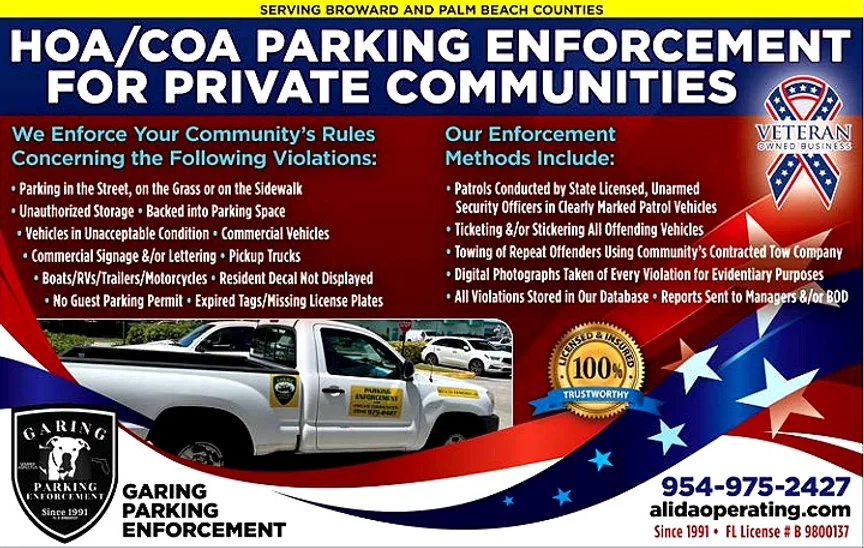
We pride ourselves on providing invaluable services to HOAs/COAs and their property managers throughout S. Florida that facilitate the improvement of safety and appearance of their communities while preserving the integrity of property values. Our first division, Garing Parking Enforcement, was started in 2007 to help communities regain and maintain compliance with their vehicle restrictions and parking regulations.
Our second division, Garing Property Services, was just launched with a similar intent of bringing the residences, recreational and common areas in a community into compliance with the community’s governing documents pertaining to the appearance and upkeep of their dwellings.


TESTIMONIALS

Dear Paul and the Garing Staff

Just so you know, we were more than satisfied with the patrols. I know what your guy went through at times; the threats […] abusive residents, etc. l also know it would be hard to duplicate this service for little or no cost if we choose to do so because you are extremely reasonable with the costs. You have been a tremendous help to our violation enforcement […] I just personally wanted you to know that we appreciate everything you have done for our community.

Sincerely,

Chuck Forcucci
and the Genesis Board of Directors


Dear Paul

I’ve read carefully the report of Garing’s parking ranger. I have no comment other than l do appreciate very much everything that he did on Saturday night, June 21, 2008 between 12:30 am and 1:50 am.

He conducted his duty strictly in accordance with the professional regulations of your company and the agreement with Sawgrass Preserve HOA. The owners of vehicles that were subject of towing in this incident were very well known as frequent violators, not only in illegal parking, but also in other cases (broken gate arm, tailgating…)

On behalf of the Association l praise the professional stand of your ranger and use this opportunity to thank him for everything he did that night to protect the Association rules. Could you please pass to him our great satisfaction for his approach in conducting of his duties.

Thanks.

Miro Imamovic
Tags:
VANDELAY COMMUNICATIONS LLC – EV CHARGING STATIONS

VANDELAY COMMUNICATIONS LLC – EV CHARGING STATIONS

VANDELAY COMMUNICATIONS LLC

Veteran-Owned Small Business, Trusted Consulting Firm for the Telecom Industry.

954-214-2590

Taking Your Business to New Heights

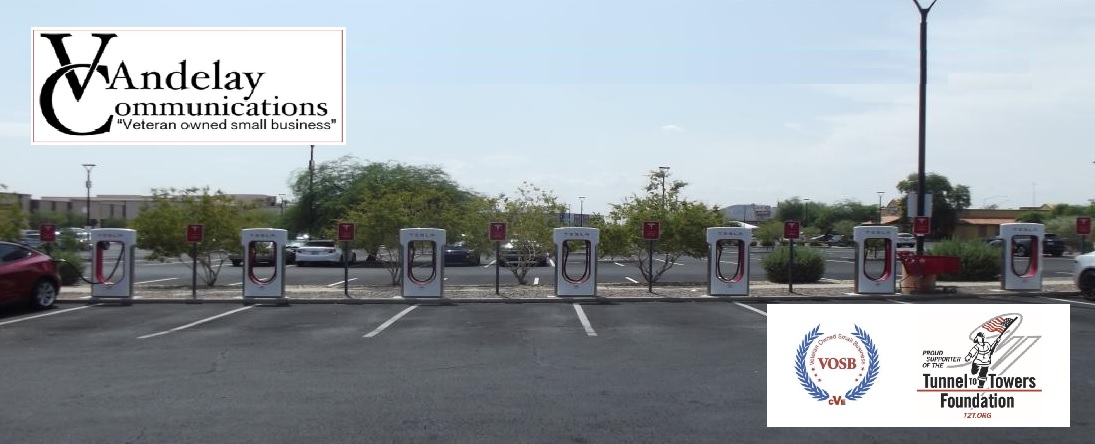
Vandelay Communications is reaching out to all HOA’s across Florida to offer our services. Our company is building Electric Vehicle Charging stations across the country and Florida’s EV use is currently rising at the highest percentage across the country. Is your property prepared? Do your residents now and future have access to EV Chargers in their homes or parking garages?

By 2025 it is estimated that 30% of all vehicles on the road will be electric. By 2030 almost every car manufacturer will be producing electric vehicles. The costs of install can be offset by the residual income that comes from the usage. This also has the ability to offer an HOA an additional income to reduce HOA fees for your residents while increasing property values. We offer single family garage equipment sales and installations, as well as large capacity parking lots and underground or above ground garage installs. Vandelay offers education to residents, free no obligation estimates and is a turn key solution that will guide you through the entire process. Please reach out for more details


VANDELAY COMMUNICATIONS LLC IS A VETERAN OWNED AND OPERATED COMPANY
WE WORK IN BOTH EV CHARGING STATIONS AND CELLULAR COMMUNICATIONS

WE PROVIDE SERVICES THAT INCLUDE SALES OF EQUIPMENT, PLANNING, EDUCATING CONSULTING, INSTALLATION AND MAINTENANCE OF EV CHARGERS
WE ALSO PROVIDE CONSULTING ON CELLULAR APPLICATIONS OF EXISTING EQUIPMENT AND NEW INSTALLS AS WELL AS LEASING CONSULTANTS AND ADVOCATES FOR BUILDING OWNERS

STEVE MILANA
STEVE@VANDELAYCOMMUNICATIONS.COM
EXECUTIVE VP
VANDELAY COMMUNICATIONS LLC
954-214-2590
https://vandelaycommunications.com/


Tags: ,
Architectural Committees Formal Procedures, Published Standards, and Self Help by REMBAUM’S ASSOCIATION ROUNDUP

Architectural Committees Formal Procedures, Published Standards, and Self Help by REMBAUM’S ASSOCIATION ROUNDUP

  • Posted: Apr 29, 2026
  • By:
  • Comments: Comments Off on Architectural Committees Formal Procedures, Published Standards, and Self Help by REMBAUM’S ASSOCIATION ROUNDUP

Architectural Committees Formal Procedures, Published Standards, and Self Help

by REMBAUM’S ASSOCIATION ROUNDUP

Formal Procedures

There are strict legal requirements that a homeowners’ association’s (HOA) architectural review committee (ARC) must follow, most especially if the ARC intends to deny an owner’s request. As this author has witnessed countless times, it is likely that many ARCs do not conduct their activities in conformity with Florida law such that an ARC denial may not withstand judicial scrutiny. If these legal requirements are not followed, and the ARC denies the owner’s architectural request, then it would be quite easy for the owner to challenge the ARC’s decision and prevail. Upon prevailing, the owner would be entitled to their prevailing party attorney’s fees and costs, as well. It is so easy to avoid this outcome, yet so few associations take the time to do it right.

Pursuant to §720.303(2), Florida Statutes, a meeting of the ARC is required to be open and noticed in the same manner as a meeting of the association’s board of directors. Notice of the ARC meeting must be posted in a conspicuous place in the community at least 48 hours in advance of the meeting, and the meeting must be open for all members to attend. Further, pursuant to §720.303(2)(c)(3), Florida Statutes, members of the ARC are not permitted to vote by proxy or secret ballot. Also, bare bone minutes should be taken to create a record of ARC decisions—especially denials.

We often hear from many HOAs that the ARC does not meet openly and does not notice their meetings. This leaves decisions made by the ARC vulnerable to challenge. If the ARC denies an application but fails to do so at a properly noticed board meeting, the owner can challenge the denial, claiming that it is not valid because the ARC did not follow proper procedure. In such cases, the ARC’s denial of an application is not valid because the ARC failed to comply with the procedural requirements for the meeting even if an application violates the declaration or other association-adopted architectural standards. However, by complying with the provisions of Chapter 720, Florida Statutes, your HOA can work to avoid this debacle.


[AdSense-A]


Published Standards

Often a top priority for an HOA is ensuring that homes in the community maintain a harmonious architectural scheme in conformity with community standards and guidelines, and because the ARC is at the frontline of owners’ alterations and improvements to their homes, it is instrumental in ensuring that the community standards and guidelines are met. Pursuant to §720.3035(1), Florida Statutes, an HOA, or the ARC, “has the authority to review and approve plans and specifications only to the extent that the authority is specifically stated or reasonably inferred as to location, size, type, or appearance in the declaration or other published guidelines and standards.” But not every owner request is typically addressed in the declaration or other published guidelines and standards. If not, then the association may not be in a good position for proper denial. Therefore, the ARC is only as effective as the objective guidelines and standards (set forth in the declaration and other published guidelines and standards) are inclusive. So, what is the association to do when the ARC receives an owner’s application for an alteration to the home, but the association does not have any architectural guidelines or standards regulating the requested alteration?

While not court tested yet, a possible solution for this conundrum is to include a “catch-all” provision in the declaration to proactively address those ARC applications where a member may request a modification that is not directly addressed by the governing documents. Such a “catch-all” provision stands for the proposition that, if such a request is made, then the existing state of the community is the applicable standard by which the ARC application is to be judged. For example, imagine if an owner applies to the ARC to paint the owner’s house pink. If there are no architectural guidelines or standards that address what color a house must be, and there are no pink houses in the community, then the existing state of the community may provide a lawful basis for the ARC to deny the request because there are no existing pink houses in the community.

The Trouble With Self-Help Provisions

What if an owner refuses to maintain the owner’s property, such as pressure washing a dirty roof, despite the HOA sending demand letters, levying a fine, and perhaps even suspending the owner’s right to use the HOA’s recreational facilities? What is the HOA’s next step? Is it time to file a lawsuit to compel compliance? Well, Chapter 718 (governing condominiums), Chapter 719 (governing cooperatives), and Chapter 720 (governing HOAs) of the Florida Statutes authorize the association to bring an action at law or in equity to enforce the provisions of the declaration against the owner. Additionally, many declarations contain “self-help” language that authorizes the association to cure a violation on behalf of the owner and even, at times, assess the owner for the costs of doing so. These “self-help” provisions generally contain permissive language, meaning the association, may, but is not obligated to, cure the violation. Sadly, in this instance the word “may” means “shall,” and to find out why, read on.

There is a general legal principal that, if a claimant has a remedy at law (e.g., the ability to recover money damages under a contract), then it lacks the legal basis to pursue a remedy in equity (e.g., an action for injunctive relief). Remember, too, that an association’s declaration is a contract. In the context of an association, the legal remedy would be exercising the “self-help” authority granted in the declaration. An equitable remedy would be bringing an action seeking an injunction to compel an owner to take action to comply with the declaration. Generally, a court will only award an equitable remedy when the legal remedy is unavailable, insufficient, or inadequate.

Assume that the association’s declaration contains both the permissive “self-help” remedy and the right to seek an injunction from the court. Accordingly, it would appear the association has a decision to make—go to court to seek the injunction or enter onto the owner’s property, cure the violation, and assess the costs of same to the owner. However, recent Florida case law affirmed a complication to what should be a simple decision. In two cases decided ten years apart, Alorda v. Sutton Place Homeowners Association, Inc., 82 So.3d 1077 (Fla. 2nd DCA 2012) and Mauriello v. Property Owners Association of Lake Parker Estates, Inc., 337 So.3d 484 (Fla. 2nd DCA 2022), Florida’s Second District Court of Appeal decided that an association did not have the right to seek an injunction to compel an owner to comply with the declaration if the declaration provided the association the authority, but not the obligation, to engage in “self-help” to remedy the violation. Expressed simply, this is because the legal contractually based “self-help” remedy must be employed before one can rely upon equitable remedy of an injunction. Therefore, even though the declaration provided for an optional remedy of “self-help,” it must be used before seeking the equitable remedy of an injunction.

In Alorda, the owners failed to provide the association with proof of insurance required by the declaration. Although the declaration allowed the association to obtain the required insurance, the association filed a complaint against the owners seeking injunctive relief, asking the court to enter a permanent mandatory injunction requiring the owners to obtain the requested insurance. The owners successfully argued that even though they violated the declaration, the equitable remedy of an injunction was not available because the association already had an adequate legal remedy—the “self-help” option of purchasing the required insurance and assessing them for same. The Court agreed.

In Mauriello, the declaration contained similar language as in Alorda but involved the issue of the owners failing to keep their lawn and landscaping in good condition as required by the declaration. The association filed a complaint seeking a mandatory injunction ordering the owners to keep their lawn and landscaping in a neat condition. However, the facts were complicated by the sale of the home in the middle of the suit when the new owners voluntarily brought the home into compliance with the declaration. The parties continued to fight over who was entitled to prevailing party attorney’s fees with the association arguing it was entitled to same because the voluntary compliance was only obtained after the association was forced to commence legal action. The owners, citing Alorda, argued that the complaint should have been dismissed at the onset because the association sought an equitable remedy (injunction) when a legal remedy was already available—the exercise of its “self-help” authority. The Court considered the award of attorney’s fees after the dismissal of the association’s action for an injunction. Ultimately, the Court held that the owners were the prevailing party as the association could not seek the injunction because it already had an adequate remedy at law.

Accordingly, if your association’s declaration contains a “self-help” provision, and your association desires to seek an injunction against an owner rather than pursue “self-help,” the board should discuss the issue in greater detail with the association’s legal counsel prior to proceeding. Also, remember that if the association wants to enforce architectural standards, then they must be published to the membership; and always remember to notice ARC meetings and take minutes.

[AdSense-C]


Tags: , , ,
Property Management Legal Forms: forms are always needed for proper operation.

Property Management Legal Forms: forms are always needed for proper operation.

  • Posted: Apr 22, 2026
  • By:
  • Comments: Comments Off on Property Management Legal Forms: forms are always needed for proper operation.

Property Management Legal Forms

As you become a CAM Manager and start your business or have a Property Management Business that is established, forms are always needed for proper operation.


We offer Subscriptions – Where for a small fee you can download and get access to EVERY FORM YOU WILL NEED FROM THOUSANDS OF FORMS


[button link=”https://sfpma.com/property-managers-legal-forms/” size=”large” target=”” icon=”” color=”orange” lightbox=””]View the Property Management Forms[/button]


PMLegalForms.com – Property Management, Eviction, Notices to Tenants and Owners, Letters, and many other Legal Documents can be found, View from over 85,000+ Legal Forms simply find and download!  

With our New Subscription Plans you can subscribe and get access to all of our Forms at any time!  We now have Forms for every State in the US. You can buy just the single form you need or Subscribe and get access to all of the Forms for one low price!


Just some of the essential forms to assist Property Managers with: leasing your premises, complying with legal requirements, and keeping relations with your tenants amicable. Forms include the 1. Landlord Tenant Closing Statement to Reconcile Security Deposit, 2. Residential Rental Lease Application, 3. Residential Rental Lease Agreement, 4. Commercial Building or Space Lease, 5. Security Deposit Agreement and other forms.


Tags: , ,
COMMUNITY ASSOCIATION WEBSITES  By Eric Glazer, Esq.

COMMUNITY ASSOCIATION WEBSITES By Eric Glazer, Esq.

COMMUNITY ASSOCIATION WEBSITES

By Eric Glazer, Esq.

As you all know by now, Florida condominiums having 150 or more units must have a website that only owners can access and which posts the official records of the association.  Here’s a little background as to how the law was passed.  When originally drafted, the law was only to apply to condominiums with 500 or more units.  That was ridiculous.  So, I flew up to Tallahassee and met with the then Speaker of the House and informed him that the law was a fake, inasmuch as less than one percent of all condominiums in the state contained 500 or more units.  I suggested 50 units.  The compromise was 150.

I never heard one person tell me this was a bad law.  In fact, it’s a great law.  It’s about transparency.  It takes the burden off of managers having to respond to requests for records.  It prevents lawsuits or arbitrations, as long as the website is kept up to date.

Just because the law requires condominiums of 150 units or more to have a website does not mean that condominiums of less than 150 units cannot have a website.  In fact, in this attorney’s opinion, if your condominium contains 50 units or more, you can and should have a website for the same reason that condominiums with 150 units should.

Think about how large some HOAs are.  Many contain well in excess of 500 homes and are sprawling mini cities.  You would think that those communities should be required to post their records on an official website as well.  But no.  HOAs are not required to have a website.  There is simply a hands off approach when it comes to HOAS.

Again, just because the law requires condominiums of 150 units or more to have a website does not mean that HOAs cannot have a website.  In fact, in this attorney’s opinion, if your HOA contains 50 homes or more, you can and should have a website for the same reason that condominiums with 150 units should.

This is one law the legislature should amend.  All communities, both condos, co-ops and HOAs with 50 or more units or homes should be required to have a community association website where the official records and notices of meetings are posted.  Bottom line…….it will make the residents less suspicious and happier.


Community associations, whether condominiums, co-ops, or HOAs, are responsible for providing transparency to their owners. One way to achieve this is through a community association website. In Florida, the state recognizes the importance of transparency in community associations and requires condominiums with 150 or more units to have an owners-only website that posts official records. However, this requirement should extend beyond just large condominiums.

Community associations of all sizes should consider having their website to give owners transparency. Even if a community does not meet the state-mandated requirement, having a website is still a good idea.

A website can provide owners with easy access to official records, notices of meetings, and other important information. It can also help reduce the burden on managers to respond to document requests. Additionally, it can prevent lawsuits or arbitrations if the website is kept up-to-date. It’s about more than just meeting legal requirements. It’s about providing owners with a sense of transparency and openness. This can build trust between the board, management, and owners and foster a happier community.

However, it’s important to note that the community association website should be more comprehensive than just the required information. It should also include commonly asked questions, how to apply to the association, how to pay fees, and other relevant information owners may need. This will help to make the website more user-friendly and informative for owners.

In conclusion, having a community association website is essential for transparency, no matter the size of the community. It can build trust and create a more positive living experience for all owners. The state of Florida has recognized the importance of transparency in condominiums, and it is time for all community associations to follow suit by establishing their websites with informative content.


I guess the Florida Legislature thought they did a great job to assure transparency in condominiums when they enacted bills in 2017 and 2018 [FS 718.111(12)(g)], that required condominium associations with more than 150 units to operate a website featuring all so-called “public documents”.

They would have done a great job — the bills were actually well intended – if there would be as well some sort of enforcement.

In the real world we are seeing lots of totally incomplete websites, only showing what board members and CAMs want the owners to see – and otherwise it’s business as usual.

The fights over record requests are keeping arbitrators and courts busy – and the attorneys are still smiling at their bank account statements.

If the legislators thought that they finally found a solution to end litigation about association records they were dead wrong.

Everybody knows that laws without enforcement are pretty useless and all these laws created each year are only laws for the rich, meaning the folks who have enough money to hire attorneys and fight for their rights, given to them by these kinds of laws, in district and appeals courts.

Wouldn’t that mean that all these laws, created year for year adding to the community association statutes, are only LAWS FOR THE  RICH?

Every other owner who might dare to mention at a board meeting that the board is violating statutes can still be told by the association attorney: “Sit down and shut up. You don’t have the money to sue the association!”


Read more industry articles on Florida HOA & Condo Blog – 


Tags: , ,
United Professional Engineering (UPE) is a leading professional engineering company based in south-east Florida.

United Professional Engineering (UPE) is a leading professional engineering company based in south-east Florida.

  • Posted: Apr 22, 2026
  • By:
  • Comments: Comments Off on United Professional Engineering (UPE) is a leading professional engineering company based in south-east Florida.

United Professional Engineering UPE has been in business since 2005 and we have a diverse team of Professional Engineers, Building Inspectors and General Contractors. Our services include Structural Engineering, Building Upkeep and Restoration Engineering, Building Inspections, Threshold Inspections, Civil Engineering and more.

  At UPE, we understand how valuable your time is and we are committed to providing our industry leading expertise to your next project. Our team welcomes any and all challenges to ensure a smooth and cost-effective project for all our clients and everyone involved. Your journey with us is important, and we take pride in making it memorable!

Today, one of the largest investments is building a structure and how to maintain its lifespan. Structural integrity, environmental factors, atmospheric elements, and maintaining aesthetics are all important factors that we evaluate very carefully, when working on a project. At UPE our highly qualified licensed designers, engineers and general contractors promises to ensure your investment is protected.

Our trusted team members are ready to listen, help and guide you through the process from start to finish. It doesn’t matter what size of your project, we will be able to alleviate your stress and provide you with the quality of service you deserve.

Structural Engineering

Four reasons why hydrojetting can be important for winter maintenance in the state of Florida. by GreenTeam Building Services.

Four reasons why hydrojetting can be important for winter maintenance in the state of Florida. by GreenTeam Building Services.

Hydrojetting is a method of cleaning and maintaining pipes using high-pressure water to remove debris, sediment, and other buildups. While Florida generally experiences milder winters compared to many other regions, there are still reasons why hydrojetting can be important for winter maintenance in the state:

1. Preventing Clogs from Cold Weather Effects: Hydrojetting prevents winter temperature-related pipe blockages by breaking down and flushing out materials that can solidify in colder water.
2. Clearing Debris from Storms and Heavy Rain: Heavy rain and storms during Florida winters can lead to debris accumulation in sewer systems. Hydrojetting clears these obstructions, preventing potential flooding.
3. Maintaining Sewer System Efficiency: Regular hydrojetting as part of winter maintenance prevents blockages and backups, ensuring the optimal year-round operation of sewer systems.
4. Addressing Potential Tree Root Intrusions: Hydrojetting is effective in removing and preventing tree root intrusions into sewer lines, reducing the risk of disruptions during winter months.
Hydrojetting is crucial for Florida’s winter maintenance, addressing challenges like temperature-related clogs, storm debris, and tree root intrusions. Stay proactive in preserving your commercial properties sewer systems’ efficiency by contacting us today!
📍 North Andrews Avenue Extension
Pompano Beach, Florida 33069
📞 Call us at (954) 210-4100
📧Email us at Service@getgreenteam.com
For other inquiries email us:
Projects@getgreenteam.com
Backflow@getgreenteam.com
Vacservice@getgreenteam.com
Tags: , ,
U.S. FLAGPOLE INC IS A FULL SERVICE FLAGPOLE COMPANY

U.S. FLAGPOLE INC IS A FULL SERVICE FLAGPOLE COMPANY

  • Posted: Apr 15, 2026
  • By:
  • Comments: Comments Off on U.S. FLAGPOLE INC IS A FULL SERVICE FLAGPOLE COMPANY

U.S. Flagpole Inc.

727-217-6487

U.S. FLAGPOLE INC IS A FULL SERVICE FLAGPOLE REPAIR COMPANY

Are you ready for Americas 250 yr Celebrations?

Take advantage of years of expertise – contact us for all of your Flag Pole Needs!

Our specialized equipment allows us to repair most flagpoles without the use of a bucket truck, reducing costs or damage by heavy equipment and allowing access in difficult-to-reach areas.

We service the entire state of Florida

Members of sfpma

Matt McClue
General Manager
U.S. Flagpole Inc.
727-217-6487
usflagpole@yahoo.com

“RIMKUS” IS A WORLDWIDE LEADER IN ENGINEERING, CONSTRUCTION MANAGEMENT AND CONSULTING AND SO MUCH MORE.

“RIMKUS” IS A WORLDWIDE LEADER IN ENGINEERING, CONSTRUCTION MANAGEMENT AND CONSULTING AND SO MUCH MORE.

“RIMKUS” ENGINEERING, CONSTRUCTION MANAGEMENT, CONSULTING AND SO MUCH MORE…

FOR THOSE OF YOU WHO NEED ANY ASSISTANCE WITH YOUR 30, 40 OR 50 YEAR INSPECTIONS, CALCULATING AND PREPARING YOUR NEW RESERVE STUDIES OR NEED REPAIRS TO YOUR CONDOMINIUM PROPERTY — WATCH THEIR ONE MINUTE VIDEO.


Building Envelope Assessments

 The Rimkus Architecture, Engineering, and Construction (AEC) Building Envelope Services team can provide a complete assessment of a structure’s building envelope (façades, roofs, windows, balconies, walkways, parking areas, etc.) describing the condition of such and all items in need of repair. A recommended timeline and a projected construction cost will also be provided to assist the owner in projecting future budgets.For a full survey of all building components, Rimkus can increase the scope of the survey and provide a full Property Condition Assessment (P.C.A.) including mechanical, electrical and plumbing systems, elevators, and interiors.Building Envelope Assessments and PCAs are typically provided with 5- or 10-year projections; however, they may be customized to the client’s needs. These reports can be utilized as a tool to help create capital expenditure budgets and establish maintenance schedules.

Maximizing the value and life cycle of a building requires continuously maintaining performance and improving energy efficiency. Our building envelope services include:

  • Façade Inspections
  • Façade Restoration
  • Building Envelope Assessments
  • Roof Consulting
  • Waterproofing and Weatherproofing Assessments and Design
  • Historic Preservation
  • Pavement Engineering

RIMKUS

http://www.rimkus.com

AECAssignments@rimkus.com

800-580-3228


Tags: , , , ,