SFPMA

SFPMA Industry Articles | news, legal updates, events & education! 

Find Blog Articles for Florida’s Condo, HOA and the Management Industry. 

Professional Mailbox Installation and Repair Company Servicing all Florida Counties

Professional Mailbox Installation and Repair Company Servicing all Florida Counties

  • Posted: Apr 01, 2026
  • By:
  • Comments: Comments Off on Professional Mailbox Installation and Repair Company Servicing all Florida Counties

ASAP Mailbox And More, Inc.

239-262-1165

Professional mailbox installation and repair company servicing all Florida counties


ASAP Mailbox and More, Inc. supplies and installs all types of residential curbside mailboxes and all styles of cluster box units ( CBU’s) We are a one-stop source for everything related to installing a new mailbox. From removal of the existing mailbox, to the installation of the new one in concrete, to the address numbering, we handle everything and provide our services in all Florida counties.


ASAP Mailbox And More, Inc.’s main facility is located in Cape Coral, Florida. From this main warehouse and fabrication location, we are able to sell and ship our mailboxes WITH INSTALLATION INCLUDED Nationwide in conjunction with our network of local dealers located in each county.

We take pride in living up to our name “ASAP” when it comes to handling mailbox installs and repairs for HOA’s, property managers and individual homeowners.

From providing complete Community mailbox and signage replacement to repairing a broken bracket for a homeowner, we always handle the project professionally and in a timely manner.

If you need a Mailbox installed please fill out the form below, when filling out the form, make sure to select “I Need A Mailbox Installed” in the select box.

If your need is urgent (mailbox installation, repairs or other needs), please call us at 877-272-7624.


Tags: , ,
SFPMA has the top companies ready to help condo and HOA communities, find them on the Members Directory.

SFPMA has the top companies ready to help condo and HOA communities, find them on the Members Directory.

SFPMA Directory- 

SFPMA has many of the top companies ready to help condo and HOA communities with everything from Accountants Attorneys, Collection Companies, website design and Building software(CRM) and Service Companies where estimates and Bidding are always asked during budget season. If you require a RFP (Request For Proposal)Search our Members Directory Business and Service Companies and ask them to help with cost savings for your Budgets.

Find Members ready to help with Management, Business and Services for your properties.

Property Maintenance is an integral part of managing the day to day operations for every type of property. Search the Members Directory for Companies working with Property Management, Condo and HOA properties in Florida. Search companies for RFP’s in this Budget Season.


It takes more than just posting about your company on social media for your companies to get noticed and selected by Board Members and Property Managers.  It takes Trust!

Become a Member today join SFPMA get listed on our Directory


<

p style=”text-align: center;”>[AdSense-A]

SFPMA will be down due to cleaning up Records & Memberships

SFPMA will be down due to cleaning up Records & Memberships

We had some calls that caused our IT Teams to go over Coding and Updates to our Directory. 

Monday and Tuesday we will be working on these changes. 

This will remove and add to the categories so our members show on the categories that they work in. It was found that some member companies wished to show on multiple categories when we did this in some cases it was hiding the few from the directory or changing the categories for companies.  Once this is fixed the few companies that were changes will show up on the multi categories again.  

Sorry for this….we will be giving these companies free Advertising in our upcoming Editions of our Magazine Florida Rising for a few months. 


At Axela, we don’t replace your process — we enhance it.  Easy Collect simplifies collections with transparency, automation, and real-time reporting

At Axela, we don’t replace your process — we enhance it. Easy Collect simplifies collections with transparency, automation, and real-time reporting

At Axela, we don’t replace your process — we enhance it.
Easy Collect simplifies collections with transparency, automation, and real-time reporting, leaving your managers free to focus on what matters: keeping Boards and communities happy and healthy.

Because when you give your managers have the right tools, your communities thrive.

✅ Less workload
✅ Faster recovery
✅ Happier boards

🔗 Learn more about our Management Company partnerships:
https://lnkd.in/euSCQsNf


Preparing for Extreme Heat: The New Natural Disaster by Donna DiMaggio Berger of Becker

Preparing for Extreme Heat: The New Natural Disaster by Donna DiMaggio Berger of Becker

  • Posted: Jul 08, 2025
  • By:
  • Comments: Comments Off on Preparing for Extreme Heat: The New Natural Disaster by Donna DiMaggio Berger of Becker

Preparing for Extreme Heat this Summer: The New Natural Disaster

by Donna DiMaggio Berger / Becker

The word “hot” has many connotations: it can reveal anger when you say someone is “hot around the collar”; it can invoke personal appeal or desirability “he’s so hot”; it can refer to a disorganized person or situation, hence the description as “a hot mess”; and can also be used to describe an emotional issue or topic as a “hot button”. However, since the earliest of times, the word hot has been used to describe the temperature and we’ve been hearing this word a lot lately in many parts of the US given the ongoing heat waves. More than 61,000 people died because of the heat waves that swept the European continent. We won’t know for some time how many US fatalities have occurred due to our extreme heat during the summer.

Extreme heat can cause dehydration, heat exhaustion, exacerbation of existing medical and mental health conditions, respiratory distress, and heatstroke. Dehydration can cause dizziness, fatigue, and muscle weakness. Heat exhaustion may result in heavy sweating, nausea, headache, rapid heartbeat, faintness, and muscle cramps. Extreme heat can more greatly affect people with underlying respiratory, cardiovascular and kidney disorders with extreme heat being tied to an increased risk of heart attacks or other cardiovascular events. Heatwaves have also been linked to diminished air quality in urban areas which can worsen respiratory conditions such as asthma. Lastly, extreme heat can impact mental well-being, leading to irritability, mood swings and difficulty concentrating, all of which can make communal living more stressful.

Dealing with extreme heat events in a multifamily building, especially for those on fixed incomes, can be challenging. What should your association board and management team be doing in response to an extreme heat event? Certainly, including preparation for heat waves into your emergency disaster plan is recommended. The following are some items you may wish to consider:

  • If your association has employees, work with counsel to review your employee guidebook particularly for employees whose work requires them to be outdoors. For those employees, you will want to be sure that they have access to plenty of water throughout the day to stay hydrated and replace fluids lost through perspiration. If those employees are required to wear a certain uniform that is not well suited to an extreme heat event, you should consider an alternate uniform for extreme heat event. You may also want to be confirm that your outside vendors who provide services outdoors have provided adequate water and protection from the sun for their workers.
  • Create shade around the building by using umbrellas, awnings, or strategically placed vegetation to reduce the impact of direct sunlight. Bear in mind that some of these shade additions may require advance membership approval.
  • Revisit any architectural control guidelines you have in place which may restrict or prohibit the use of fans on patios, balconies and lanais. Fans are used to circulate air and can create a cooling effect. Consider how curtains, blinds and blackout shades may reduce the temperature inside units particularly if a unit owner is not running the AC at reasonable temperatures. Allow people to close their blinds and/or their hurricane shutters during the day to block out direct

    sunlight and prevent heat from entering the living space.
  • Consider limiting daytime hours of play for outdoor tennis and pickleball courts as well as any other outdoor recreational areas when temperatures are soaring. Installing thermometers on the common areas may also help remind your residents about climbing temperatures.
  • Consider purchasing a whole building generator if you don’t already have one. In the event that increased electric demands during a heat wave cause a blackout or brownout that generator may save lives in your building. Naturally, a generator will also help in the aftermath of a windstorm which knocks out electricity.
  • Check in with your residents who may be living alone and dealing with physical or mental health challenges as well as economic burdens. These residents may not be running their A/C as often or at a

    temperature that is needed for their wellbeing. This is also the time to confirm that you have emergency contacts for your residents.
  • Reach out to local community organizations, social services, or government agencies that provide assistance during extreme weather events. They may offer cooling centers, fan distribution programs, or other resources for your residents.

The strategies your board and management team use in response to an extreme heat event depends, in large part, on your building’s location and infrastructure as well as the available monetary and personnel resources. However, there are some basic steps all associations can take to educate their residents about the dangers of extreme heat. The phrase, “we’re having a heat wave” doesn’t have to spell disaster in a well-prepared community.

For additional information please listen to my podcast conversation with Jane Gilbert, Miami-Dade’s Chief Heat Officer which can be found here.


 Donna DiMaggio Berger is a Shareholder with the Becker law firm, is Board-certified, is a Fellow with the College of Community Association Lawyers (CCAL) and is a keynote speaker and the host of the popular Take It To The Board podcast on association issues.

Donna DiMaggio Berger is a Shareholder in Becker’s Community Association Practice in Ft. Lauderdale, Florida. She is a member of the College of Community Association Lawyers (CCAL), a prestigious national organization that acknowledges community association attorneys who have distinguished themselves through contributions to the evolution or practice of community association law and who have committed themselves to high standards of professional and ethical conduct in the practice of community association law. She is also one of only 190 attorneys statewide who is a Board Certified Specialist in Condominium and Planned Development Law.

As Founder and Executive Director of Becker’s Community Association Leadership Lobby (CALL), Ms. DiMaggio Berger has led various community association advocacy initiatives, working with legislators and other public policymakers on behalf of those who live, serve, and work in common interest ownership communities. She has testified before the Florida Legislature regarding community association law and frequently appears on radio talk shows and in print media discussing these issues.

Tags: , , ,
Update: what happens if condos dont get the florida inspection. sfpma.com

Update: what happens if condos dont get the florida inspection. sfpma.com

What happens if condos dont get the florida inspection?
If a condo in Florida does not undergo the required inspection, the condo association could face significant consequences including: difficulty obtaining insurance renewals, increased insurance premiums, potential legal action from owners, inability to sell units easily due to disclosure requirements, and may be forced to levy special assessments on owners to cover necessary repairs identified in the inspection if they are not completed, potentially leading to financial strain for residentsultimately, if structural issues are severe, the building could be deemed unsafe for occupancy by local authorities.

Key points about Florida condo inspections:
  • New legislation:

    Florida enacted strict laws requiring regular structural inspections for condos, particularly older buildings, following the tragic Champlain Towers collapse in Surfside.

  • Consequences of non-compliance:

    Condo associations that fail to get inspections done could face penalties, including difficulty securing insurance, higher insurance costs, and potential legal action from unit owners.

  • Disclosure requirements:

    Inspection reports must be disclosed to potential buyers, making it difficult to sell units if the building has not been inspected and repairs are needed.

  • Reserve funds:
    Inspections are often tied to the need to build up sufficient reserve funds to cover necessary repairs identified in the inspection

Update Jan, 13, 25
What is the new law for condo inspection in Florida?
Under the laws, all buildings occupied before 1992 must complete a milestone inspection by Dec.31, 2024. This is an examination of the building’s structural integrity by an architect or engineer. The requirement also applies to buildings at least 25 years old that are within 3 miles of the coast

In Florida, if your condo association fails to get a required “milestone inspection” done by the deadline, they could face legal consequences, including potential fines and penalties, as the law mandates these inspections for structural integrity, particularly for buildings reaching 30 years old and every 10 years thereafter; however, if you are actively trying to schedule the inspection and encounter delays due to factors like a backlog of engineers, you might be able to demonstrate “good faith effort” to avoid severe repercussions. 

Key points about Florida condo inspections and missed deadlines:
  • Milestone Inspection Requirement:

    Florida law requires most condominium buildings to undergo a comprehensive “milestone inspection” once they reach 30 years old and then every 10 years after that. 

  • Potential Consequences:

    If the inspection is not completed on time, the condo association could face penalties or legal action from the state or unit owners. 

  • “Good Faith Effort” Defense:

    If the association can demonstrate they were actively trying to schedule the inspection and encountered unavoidable delays (like a shortage of qualified engineers), they might be able to avoid severe penalties. 

  • What to do if you miss the deadline:
    • Contact the condo association: Immediately reach out to the association board to understand the situation and discuss next steps. 
    • Review the inspection requirements: Ensure the association is aware of the specific deadlines and necessary steps for the milestone inspection. 
    • SB 4-D increases the safety of Florida’s condominiums by requiring inspections for all condominiums and cooperative buildings that are three stories or higher. SB 4-D requires the following for condominiums and cooperatives:

      • Condominiums and cooperatives must conduct a Structural Integrity Reserve Study (SIRS) for buildings that are three stories or higher to ensure that necessary funding is available for any future structural repairs that may be needed. This study must be completed at least every 10 years after the condominium’s creation, regardless of the condominium’s age.
      • Structural milestone inspections are required for condominium and cooperative buildings of a certain age, depending on their distance from the coastline.
      • To increase transparency and accountability, all structural inspection reports and reserve studies are required to be part of the condominium association’s’ official record and must be provided to potential purchasers of a condo unit.Consult legal advice: If there are concerns about potential legal issues, consider seeking advice from a legal professional specializing in Florida condominium law.


What is Senate Bill 4-D?  -Some background:

SB 4-D increases the safety of Florida’s condominiums by requiring inspections for all condominiums and cooperative buildings that are three stories or higher. SB 4-D requires the following for condominiums and cooperatives:

  • Condominiums and cooperatives must conduct a Structural Integrity Reserve Study (SIRS) for buildings that are three stories or higher to ensure that necessary funding is available for any future structural repairs that may be needed. This study must be completed at least every 10 years after the condominium’s creation, regardless of the condominium’s age.
  • Structural milestone inspections are required for condominium and cooperative buildings of a certain age, depending on their distance from the coastline.
  • To increase transparency and accountability, all structural inspection reports and reserve studies are required to be part of the condominium association’s’ official record and must be provided to potential purchasers of a condo unit.


What is Senate Bill 154?

SB 154 revised the requirement for condominiums to collect reserves and allows a majority of voting residents to elect not to provide reserves or to provide less reserves than required. However, this legislation prohibits waiving or reducing reserve funding for repairs and maintenance of structural components identified in the SIRS.

Additionally, SB 154 refined the requirements of the SIRS to provide clarification on the items required in a SIRS and expanded who can perform a SIRS.

SB 154 allowed a specific type of condominium (multi-condominium with 25 condominiums or more) to provide no reserves or less reserves than required if an alternative funding method was approved by the Division of Condominiums, Timeshares, and Mobile Homes. The Division received funding to contract with a third-party to review alternative funding methods submitted to the Division for review and approval.


What is House Bill 1021?

HB 1021 increases transparency and accountability through changes to meeting requirements, voting, education for condominium directors, recordkeeping and reporting, and support from the Florida Department of Business and Professional Regulation (DBPR). Additionally, HB 1021 introduced criminal penalties for board members who act in bad faith, increased DBPR’s ability to address resident complaints through investigations, and established a criminal referral process to streamline accountability for individuals that have engaged in criminal activity.

What types of buildings or structures are excluded from the Structural Integrity Reserve study (SIRS) requirements?

The SIRS requirements do not apply to buildings less than three stories in height; single-family, two-family, or three family dwellings with three or fewer habitable stories above ground; any portion or component of a building that has not been submitted to the condominium form of ownership; or any portion or component of a building that is maintained by a party other than the association.

Who is required to do a Structural Integrity Reserve study (SIRS)?

A residential condominium association must complete a SIRS for every building in the condominium that is three stories or higher, as determined by the Florida Building Code.

When is the Structural Integrity Reserve study (SIRS) due, and how often does my association need to complete a SIRS?

Unit owner-controlled associations existing on or before July 1, 2022, must have a SIRS completed by December 31, 2024. A residential condominium must have a SIRS completed at least every 10 years after the condominium’s creation.

The deadline to complete a SIRS is December 31, 2024. When does my association have to start reserving for a SIRS?

If your budget is adopted on or before December 31, 2024, you may vote to waive or provide less than the required SIRS reserves with a majority vote of the total voting interest of the association. You will need to begin funding your SIRS reserves in accordance with the reserve study January 1, 2026.

If your budget is adopted on or after January 1, 2025, you may not waive your SIRS reserves and need to begin funding your SIRS reserves in accordance with the reserve study.

When does my association have to report to the SIRS?

Within 45 days after receiving the SIRS, the association must provide the division with a statement indicating the study was completed and provided to the unit owners.

Can a milestone inspection or inspection for a similar local requirement, such as a re-certification inspection, substitute a SIRS visual inspection?

An association that is required to complete a MI in accordance with section 553.899, Florida Statutes, on or before December 31, 2026, may complete the SIRS simultaneously with the milestone inspection (MI). However, in no event may the SIRS be completed after December 31, 2026.

If the MI required by section 553.899, Florida Statutes, or an inspection completed for a similar local requirement, was performed within the past 5 years and meets the SIRS requirements, such inspection may be used in place of the visual inspection portion of the SIRS.

What is the difference between a milestone inspection and a SIRS?

A milestone inspection is a structural inspection of the building, including the load-bearing elements.

A SIRS is based off a visual inspection of the items required in s. 718.112(2)(g), F.S. and is a budget planning tool that identifies components of a condominium that are the responsibility of the association to maintain and replace and includes a plan to fund future maintenance and repairs.


ROUTINE INSPECTON IS THE FOUNDATION UPON WHICH ALL GREAT MAINTENANCE PLANS ARE BUILT.

ROUTINE INSPECTON IS THE FOUNDATION UPON WHICH ALL GREAT MAINTENANCE PLANS ARE BUILT.

  • Posted: Jan 11, 2025
  • By:
  • Comments: Comments Off on ROUTINE INSPECTON IS THE FOUNDATION UPON WHICH ALL GREAT MAINTENANCE PLANS ARE BUILT.

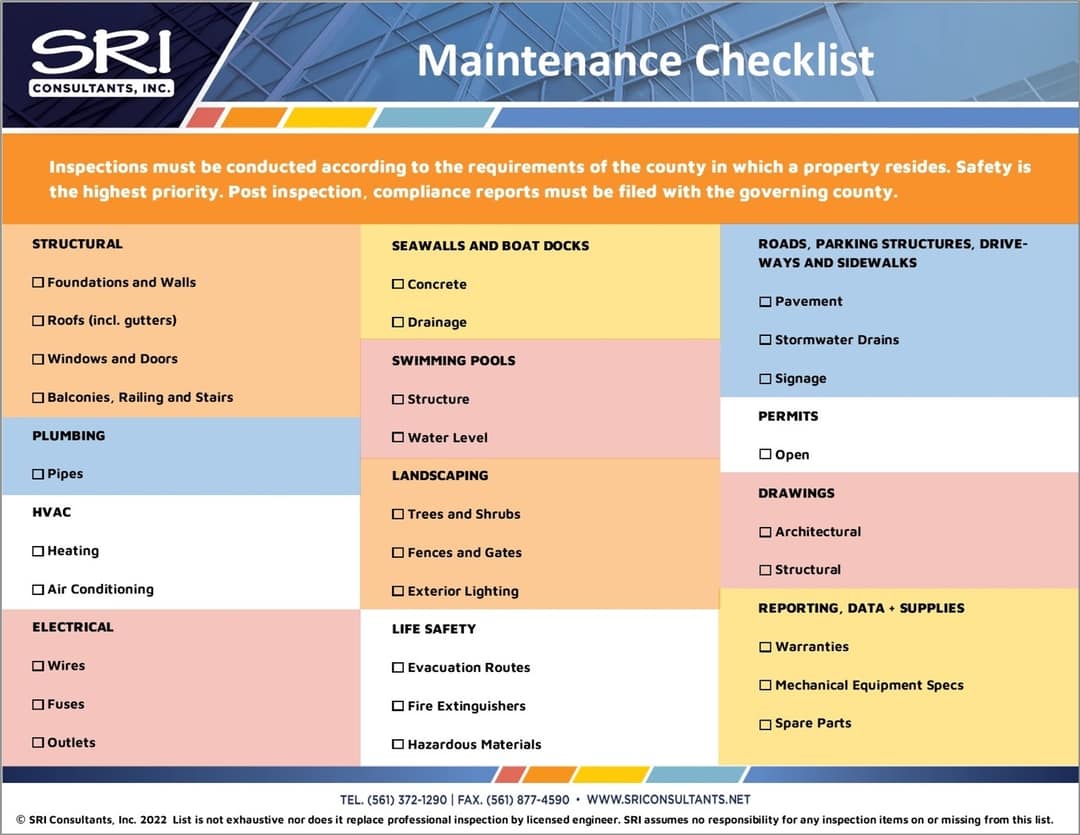
Managers here is a maintenance checklist to get the ball rolling? We’ve created just the one to help you identify problem areas before they reach critical status.

Preventive Maintenance is Key, A good manager should get out of the Office and walk the property, get your hands dirty, take action on any problem or the start of a problem you see. This way you will not have a major problem later.

SRI Consultants has come up with a great checklist for you to use. DL it below.

Sign up for your FREE 3-page property maintenance checklist now http://ow.ly/M7YV50IITeO
And make sure to reach out when you require detailed inspections and repair recommendations by a licensed engineer (Hint: 30-40-50-year surveys). We look forward to your call!

Ask our AI about 4D

Do you have questions about Florida’s building safety legislation, Senate Bill 4D? Just enter your query in the textbox  and click “Send Query”. For example, try asking, “What is the Florida Senate Bill 4D?”. This AI tool is experimental and provides no warranties regarding the accuracy of its results. Use at your own risk.

AI gets smarter with every Q&A asked.  it will take time to have every query become available. Try it out. 

This AI tool is experimental and provides no warranties regarding the accuracy of its results. Use at your own risk.
Contact SRI Consultants at office@sriconsultants.net or call (561) 372-1290


Tags: ,
Condo HOA Loans: We can assist you in obtaining the necessary funds for Projects, Reserves, or Cash Flow.

Condo HOA Loans: We can assist you in obtaining the necessary funds for Projects, Reserves, or Cash Flow.

  • Posted: Jan 06, 2025
  • By:
  • Comments: 0

Condo HOA Loans

We can assist you in obtaining the necessary funds for Projects Reserves or Cash Flow.

Your Trusted Community Association Financial Resource


Don’t go it alone. Whether your Community requires Conventional or Private Lending, CondoHOALoans can assist you in obtaining the necessary funds for Projects, Reserves, or Cash Flow.

When your Community Association works with our Law Firm to facilitate and secure financing, your Community will also have the optional benefit of receiving 100% FREE Delinquent Account Collection Services.

Not sure if financing is right for your Association? Download the Association Funding Options Infographic and take our Free Financial Health Survey to find out.


Take the Free Financial Health Survey

Completing this Survey will provide you with a written report you will be able to immediately download upon completion.

[button link=”https://condohoaloans.com/financial-health-survey/” size=”large” target=”_self” icon=”” color=”orange” lightbox=”true”]Take Our FREE Financial Health Survey[/button]


Association Funding Options

Getting started with CondoHOALoans is easy.

We’ll help your community identify funding resources and lending options for all of its financial needs. Our Legal Services to your community do not end at the successful closing of your loan with the Lender of YOUR choice. As a valued client of Katzman Chandler, you will have the option, but not the obligation, to have ALL future delinquent accounts collected for FREE.


The Condo Building Maintenance Crisis in Florida

As a consequence of hurricanes, business cycles, and fluctuations in the real estate market over the last 20 years, financial distress has been caused to those who live in Community Associations as well as the Communities Association entities themselves.  There presently exist hundreds (if not thousands) of communities whose stories can be illustrated by the timeline below.

Many of these communities presently have underfunded budgets, inadequate cash flow, and lack adequate reserves to accomplish necessary preventative maintenance and actual present maintenance needs. Overall, Boards are starting to realize that there is a lot to do, with little or no money to do it.


CondoHOALoans is the best solution for customized, competitive lending options.
Download the Infographic to learn more.

(833) 427-3863

Tags: , ,