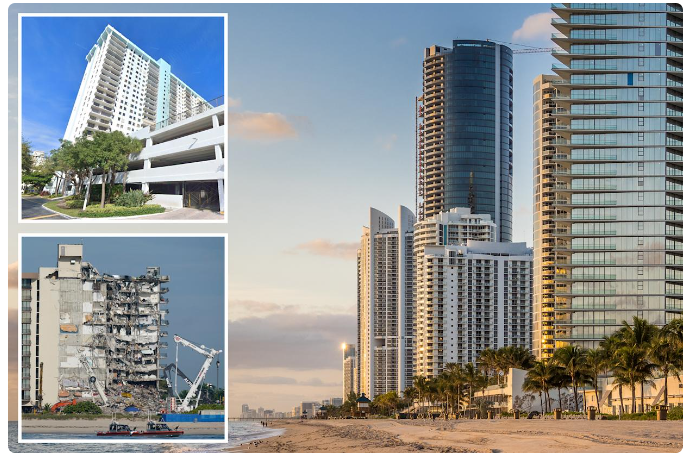
There are certain years that are more defining than others. Certain years that stand out. Well, if you live in a Florida condominium, 2025 will be that year. To understand why, we have to pay respect to another year that stands out more than any other ever will, and that is 2021, the year the Champlain Towers collapsed in Surfside, Florida killing 98 innocent men, women and children.
As a result of 2021, and The Florida Legislature’s promise to Floridians that another Surfside will never happen again, massive legislation was passed requiring mandatory inspections, mandatory repairs, mandatory education for Board members and perhaps the most important and controversial new law, the requirement to fund reserves for your condominium that is 3 stories or taller, based upon a Structural Integrity Reserve Study that needed to be prepared by an architect, engineer or someone with CAI credentials and completed by December 31st, 2024.
If you didn’t do it yet —– you’re late and in violation of Florida law.
Think about this…….any condominium budget you will ever pass again must include mandatory reserves based upon the results of that structural integrity reserve study. Here’s the new law:
For a budget adopted on or after December 31, 2024, the members of a unit-owner-controlled association that must obtain a structural integrity reserve study may not determine to provide no reserves or less reserves than required by Your Structural Integrity Reserve Study.
Here’s what a structural integrity reserve study is and how often it must be performed:
(g) Structural integrity reserve study.—
1. A residential condominium association must have a structural integrity reserve study completed at least every 10 years after the condominium’s creation for each building on the condominium property that is three stories or higher in height, as determined by the Florida Building Code, which includes, at a minimum, a study of the following items as related to the structural integrity and safety of the building:
a. Roof.
b. Structure, including load-bearing walls and other
primary structural members and primary structural
systems as those terms are defined in s. 627.706.
c. Fireproofing and fire protection systems.
d. Plumbing.
e. Electrical systems.
f. Waterproofing and exterior painting.
g. Windows and exterior doors.
h. Any other item that has a deferred maintenance
expense or replacement cost that exceeds $10,000
and the failure to replace or maintain such item
negatively affects the above items as determined
by the visual inspection portion of the structural
integrity reserve study.
Yes – for those condo associations that have ignored funding reserves for years or decades — your bill has come due. And it’s going to be expensive. For those of you who thought it was a bad idea to put away money for a rainy day because you might not be alive at that time —- I guess the bad news is —–YOU LIVED!
Virtually all explanations of dredging include the physical scooping up of underwater sand and clay sediments to enhance a merchant ship’s access to a port or waterway. If these waterways become inaccessible, the economic consequences are far-reaching.
Today, however, massive algal blooms, animal fatalities from toxic byproducts of algae, and the spread of invasive plants and animals are sharing the front-page news with national economic interests. For those of us living on a waterbody, it’s clear that our personal economic interests are rewarded via higher property values if the nearby water is both navigable and healthy. As a waterbody ages and becomes “silted-in,” organic nutrients fuel invasive plant and algae growth, and property owners suffer the consequences of bright green water, fish kills, and dangerous swimming conditions. Unfortunately, the solution to these rampant biological problems involves more than just scooping up the muck. Hence, we need to look at dredging options and aquatic management in a unified perspective.
Choosing the Dredging Tool for Your Waterbody
Fortunately, there are many proactive aquatic management solutions that can be implemented to help slow or prevent the aging of waterbodies, such as proper land use management, maintenance of beneficial vegetative buffers and sediment traps, installation of aeration systems, and utilization of nutrient absorbing products. However, when sediment buildup is too much to dock a boat or when aquatic plants and algae are perpetually out of control, you’ll need to call in a professional waterbody manager accompanied by a portfolio of dredging techniques.
There are several methods of sediment or muck removal: hydraulic dredging, clamshell or backhoe dredging, dry dredging, and hydro-raking. The chosen method will depend on a number of factors, including sediment composition, environmental sensitivity, the volume of materials removed, budget, and disposal considerations.
Mechanical Dredging
Mechanical dredges (clamshell or backhoe dredgers) use buckets to scoop out bottom sediment and transfer it to trucks or barges for transport to disposal sites. Truck transportable mechanical dredges such as Aquamogs can remove small volumes of sediments such as shoals that prevent boater access to a lake, while large oceangoing dredgers are capable of digging to great depths to facilitate the new era of ultra–large container ships. In the case of the drawdown and excavation method (dry dredging), the whole waterbody is drained and sufficient shoreline access is needed for the trucking and hauling involved. However, most lakes cannot be emptied due to environmental concerns or high water tables.
Hydraulic Dredging
Hydraulic dredges are the workhorse of the dredging industry and are effective in moving large volumes of organic and inorganic sediment. They work by sucking slurry (a mixture of sediment and water) from the bottom and then pumping it to an offshore location through a pipeline. Hydraulic dredges have almost continuous operating cycles, allowing the removal of large volumes of material in a short time while minimizing the resuspension of material into the water column due to their closed-cycle system of operation. Typically, this method is better suited for sediments with little debris mixed in, as large objects and rocks can damage the cutter and clog the pipeline. A large disposal area is also required.
Hydro-raking
Unlike the mechanical and hydraulic dredge, the hydro-rake cannot be used to remove sediment, however, it is an effective tool for accumulated muck removal. Hydro-raking is frequently chosen as a method to remove nuisance aquatic vegetation, root structures, debris, and organic muck on a smaller scale waterbody. The hydro-rake can best be described as a floating barge upon which is mounted a backhoe with a digging bucket or rake capable of removing accumulated muck in water as shallow as 18 inches. Hydro-raking can effectively target organic muck accumulations and debris in coves, stormwater ponds, and other shallow areas. If a pond is periodically maintained through hydro-raking, the need to perform a large-scale dredging project may be eliminated, saving financial resources and minimizing ecological disruptions.
How to Maintain Balanced Water Quality
Dredging is generally thought of as an expensive activity, but both your waterbody can benefit significantly from just a few days of budget-friendly spot dredging at pump intakes, swimming areas, or around boat docks. However, the ultimate cost-savings approach is proactive management. By taking preventative steps to reduce erosion, limit weed and algae growth, and maintain balanced water quality, it’s possible to prolong the need for both dredging and hydro-raking. The best way to accomplish this is through an annual management program that leans on sustainable strategies like aeration, nutrient remediation, shoreline maintenance, and many other custom solutions to maintain a healthy, functional waterbody.
To learn more or navigate through a wide variety of sediment, aquatic plant, or algae removal options for your waterbody, we encourage you to speak with your lake or pond management professional.
A slow-motion crisis is unfolding in Florida’s condo market, threatening to upend the state’s image as a haven for retirees and reasonably priced beach living.
Owners of the state’s older condos are bracing for steep special assessments, while racing to sell their homes and receiving only tepid buyer response.
Amid a property market that’s still vibrant for nearly every other segment, Florida’s aging condominiums are losing value. And nearly 1,400 buildings are now blacklisted from receiving mortgage financing, making those apartments an even-tougher sell.
Thousands of Florida condo units face special repair assessments which are making them difficult to sell — and causing them to lose value quickly. oldmn – stock.adobe.com
At the heart of this turmoil is a basic reality: Florida’s aging condo buildings desperately need repairs, and state officials are forcing them to assess (and pay for) those long-overdue upgrades.
Under a law enacted after the tragic 2021 collapse of Champlain Towers South in Surfside, which saw 98 people lose their lives, condo boards may no longer defer major structural improvements to another day — or decade. The “Building Safety Act” required every condo tower in Florida aged 30 years or older to complete a structural integrity study by the end of 2024, to get a full grasp of what problems need fixing.
This year, the tab for those repairs comes due. Condo boards must now set aside funds to fix the issues found in those studies — from concrete restoration to balcony overhauls. And the assessments on individual condo owners are looking both pricey and unsettling.
“You’re going to see a massive reduction in the value of these buildings based on these giant special assessments and the work that has to be done,” said Orest Tomaselli, CEO of Strategic Inspections, which advises condo boards nationally on how to shore up their reserves.
In Florida buildings he’s worked with, Tomaselli has seen special assessments as low as $250 per month, to a property that levied $2,500 per month, per unit owner, for a three-year stretch.
The assessments result from inspection and repair mandates stemming from the 2021 Surfside building collapse that killed 98 people. AP
“There are real people in these units that may be displaced,” Tomaselli said of the assessments, “that may lose their nest egg and may lose tremendous amounts of value in their units.”
”At Aventura’s Mediterranean Village, a waterfront condo complex with a marina out front, unit owners were hit with six-figure special assessments last year, some as high as $400,000, according to published reports.
At Miami’s Cricket Club, a 50-year-old waterfront tower burdened with $134,000 special assessments per condo, 23 of the building’s 217 condos are currently for sale, according to brokerage Compass. In a Miami market where the median condo price was $445,000 in the fourth quarter of last year, condos at the Cricket Club are seeking buyers with prices as low as $220,000 for a 1,950-square-foot two-bedroom on the 19th floor. (The owner initially sought $330,000).
The Summit Towers in Hollywood, FL is facing a $56 million assessment. Google Maps
Meanwhile, at Summit Towers in Hollywood, a building-wide special assessment of $56 million led to the ousting of four board members in a January election, in favor of new members who promised “a more moderate approach” to building up reserves, said Amy Greenberg, a broker and resident of the building with several listings there.
“A lot of people moved here to be able to retire and live their life here, and they’re on fixed incomes,” said Kathleen DiBona, a 50-year resident of Hollywood who serves as president of the Hollywood Beach Civic Association. “They’re having a difficult time being able to manage all that’s coming and hitting them.”Many owners whom DiBona knows in Hollywood, a city dotted with older towers, are seeking to off-load units with little success. Others, she said, have dropped insurance coverage for their condos so they can manage to pay their special assessments.
Failure to pay these assessments will impact more than just the individual owners who can’t afford them. If 15% of unit owners in a building default, the entire property could become ineligible for mortgage financing, according to Tomaselli of Strategic Inspections.
“What happens if nobody can get a loan to buy a unit in your building?” says Joseph Hernandez, a Miami-based partner in the real estate group of law firm Bilzin Sumberg. “It essentially makes the units in your building unsaleable and it makes the value of those units go down.
“We may see a lot of condo projects go into distress.”
Some could already be getting close. In February, Fannie Mae, the national mortgage finance agency, updated its running list of “unavailable” US condo buildings, meaning they are no longer eligible for mortgage financing. Of the 4,885 buildings currently on the list, 29% are located in Florida, the highest share of any state. The top reason: “critical repairs or deferred maintenance,” according to a person familiar with the roster.
One newly flagged example is 4000 Island Blvd., a 32-story condominium in Aventura’s exclusive Williams Island, which was built in 1985 and added to Fannie Mae’s no-lending list in January. At least 24 unit owners are trying to sell, according to Compass. Barry Sytner, the condo board’s president, called the building’s inclusion on Fannie Mae’s list “incorrect,” noting that the property just secured a bank loan commitment to cover expenses tied to its 40-year inspection.
There are roughly 1.1 million condo units in Florida that are 30 years old or more, and subject to the new law, according to the Florida Policy Project. Of those, 58% are concentrated along the Southwest and Southeast coastal counties, in places like Tampa, Clearwater and the greater Miami metro area, including Fort Lauderdale and Palm Beach County.
Around two dozen condos are up for sale in this Aventura, FL condo building, according to reports. miamiresidence.com
That means the law’s reach extends to more than half of all condo owners in Florida’s famed retirement enclaves. According to brokerage ISG World, apartments that are over 30 years old accounted for 86% of all Southeast Florida condo listings in the fourth quarter of 2024 — a total of 17,198 properties for sale across Miami-Dade, Broward and Palm Beach counties.
Yet even as thousands of newcomers flock to the region, these abundant and discounted units are languishing on the market, weighed down by the threat of special assessments and uncertainty over looming repair costs.
“The fear of the unknown is scaring the hell out of potential buyers,” said Craig Studnicky, ISG’s chief executive officer.
“Remember that show, ‘Let’s Make a Deal?’ ” Studnicky said. “They may get a special assessment and it could be quite modest, which means you just made one hell of a deal. But what if you’re wrong, and the special assessment is gargantuan? Not only is the special assessment big, but the scope of construction is big, and you’re going to be living in a construction site for the next two years.”
The full extent of special assessments is still an open question for many Florida properties. While the state deadline for condos to submit their structural integrity studies was on Dec. 31, only 39% of buildings in Southeast Florida have done so, according to the Miami Association of Realtors.
Some of that’s because engineers were simply not available, amid a statewide rush to get these studies completed. Others could be gambling that enforcement won’t be robust or swift, said Peter Zalewski, a Miami-based broker, analyst and condo investment consultant.
“You’re going to see a massive reduction in the value of these buildings based on these giant special assessments and the work that has to be done,” said Orest Tomaselli, CEO of Strategic Inspections.
“You have buildings that are shopping for studies, because maybe they’re coming in too high, and maybe they can find someone who can lowball it,” Zalewski said.
“People are figuring out what to do,” Zalewski added. “They think there will be a silver bullet, some kind of cure in the upcoming Florida legislative session” amid outcry from condo owners
The state legislature, which convenes its 2025 session March 4, has no plans to bail out condos or offer reprieve from the deadlines to fund repairs, Florida legislative leaders said at a condo conference last month held by Miami Realtors, according to Homes.com.
“A lot of people moved here to be able to retire and live their life here, and they’re on fixed incomes,” said Kathleen DiBona. Courtesy of Kathleen DiBona
Lawmakers, however, might consider financing solutions to help condos cover the cost of structural studies and maintenance, including allowing reserve funds they set aside to be invested.
Despite some maintenance challenges, Florida’s older condos still reflect the only affordable opportunity at homeownership for those who can’t swing the price tags of Miami’s new crop of ultra-luxury developments, says Scott Diffenderfer, a Miami-Beach-based broker for Compass who specializes in sales of older units.
He says he’s pretty upfront with potential buyers these days about the scope and costs of repair that some of his listings will undergo.
Brokers view the new regulations and mandatory repairs as a necessary correction to Florida’s once-lax condo standards, Diffenderfer explained.
Previously, buyers had little insight into a building’s true condition — much like purchasing a used car without a Carfax report.
Now, with stricter enforcement requiring proper reserves and full disclosure of maintenance history, brokers say the condo market could become more transparent and ultimately unlock greater value for owners.
“For probably 75% of the buildings in South Florida, when the dust settles, people are going to say, ‘You know what? That was painful. But look at these buildings!’ ” Studnicky said. “They’re in great shape.”
Comments: Comments Off on ROUTINE INSPECTON IS THE FOUNDATION UPON WHICH ALL GREAT MAINTENANCE PLANS ARE BUILT.
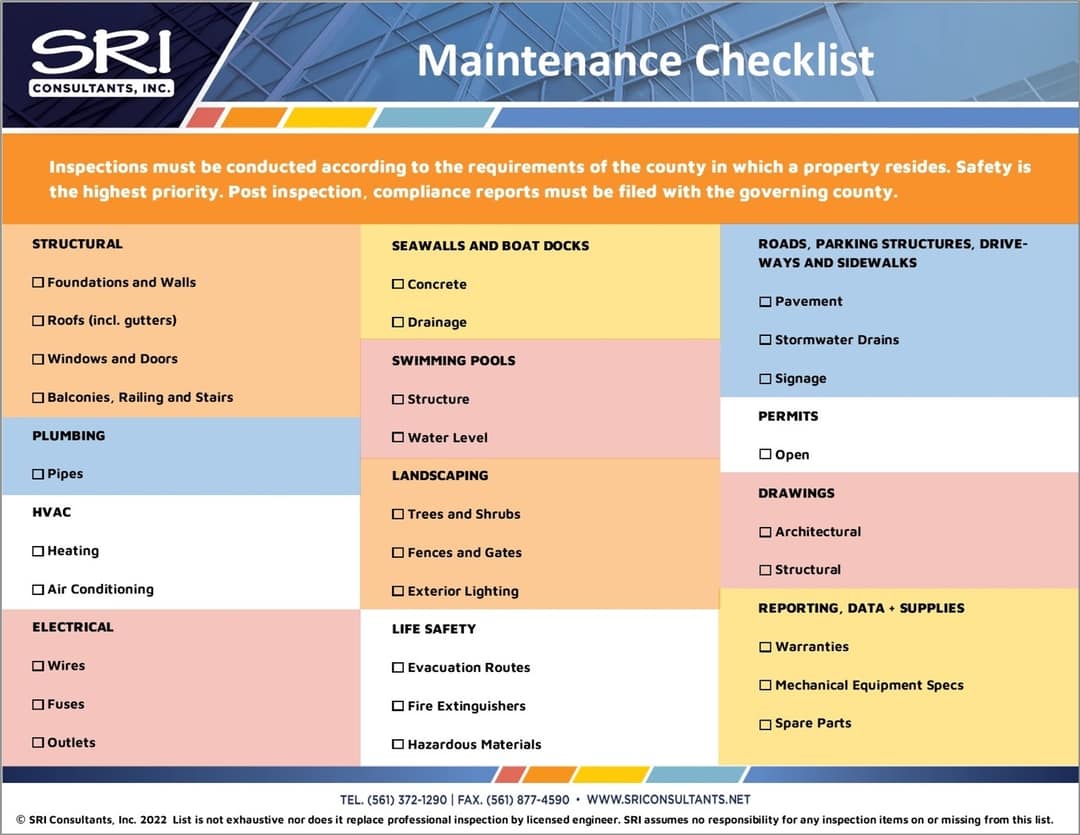
Managers here is a maintenance checklist to get the ball rolling? We’ve created just the one to help you identify problem areas before they reach critical status.
Preventive Maintenance is Key, A good manager should get out of the Office and walk the property, get your hands dirty, take action on any problem or the start of a problem you see. This way you will not have a major problem later.
SRI Consultants has come up with a great checklist for you to use. DL it below.
And make sure to reach out when you require detailed inspections and repair recommendations by a licensed engineer (Hint: 30-40-50-year surveys). We look forward to your call!
Do you have questions about Florida’s building safety legislation, Senate Bill 4D? Just enter your query in the textbox and click “Send Query”. For example, try asking, “What is the Florida Senate Bill 4D?”. This AI tool is experimental and provides no warranties regarding the accuracy of its results. Use at your own risk.
Comments: Comments Off on Proposals from Vendors for the yearly budgets, here are some of the things to consider
As Board Members are asking for Proposals from Vendors for the yearly budgets, here are some of the things to consider.
BY ROYALE MANAGEMENT
Budgets take time for any Condo and HOA Community, each year many of the services paid for by these associations come under review at budget season. While its nice to think about cost savings we feel it is much more important to look at workmanship, licensing, scope of work and then Costs. SFPMA and our Members are here for every community, on our Directory finding everything from Services to the businesses that keep your operations up and running to the Legal Experts safely protecting Condo and HOA’s from disputes and Litigation.
HERE IS A LIST OF THINGS NO VENDOR CONTRACT SHOULD CONTAIN:
1) An automatic renewal clause. While it’s ok for an agreement to continue on a month to month basis it’s wrong to saddle future board with an obligation to track and cancel an agreement on a certain date or between certain dates to keep it from automatically being extended for an additional term.
2) A right of first refusal. This allows an existing vendor to match the price and terms of any new vendor proposal and thereby force the association to keep them. Most often an association gets proposals from new contractors because they are unhappy with more than the price and terms and giving a vendor a right to stay because they agree to match price and terms, does not solve the problem and can only lead to litigation.
3) Contracts with unnecessarily long terms. While a vendor that has upfront cost for things like equipment like a laundry vendor bringing in new equipment who needs to recover the equipment cost agreement terms should be kept as short as possible. Five years might be ok for the laundry contract but would not be for a landscaping contract in this case a one year term would long enough.
4) Cancellation only for “cause” clause. Proving cause only makes the lawyers richer and can be hard to do. The best solution is to build in a “cause free” ability to cancel with a 30-day notice.
Royale Management Services, Inc
Phone: (954) 563-1269
Full-service, CAM (Community Association Management) licensed, residential property management company, specializing in management, consulting and accounting for Condominium Associations and Home Owners Associations.
“The expansion into Community Association and Home Owner’s Association management was a natural move after a number of our clients serving on condo boards asked for our help with their associations accounting, budgeting and management, due to increasing operating cost and sloppy accounting records maintained by their current bookkeepers and managers.”
Comments: Comments Off on Accessible parking isn’t just a nice thing to have – it’s the law. – TrueLines
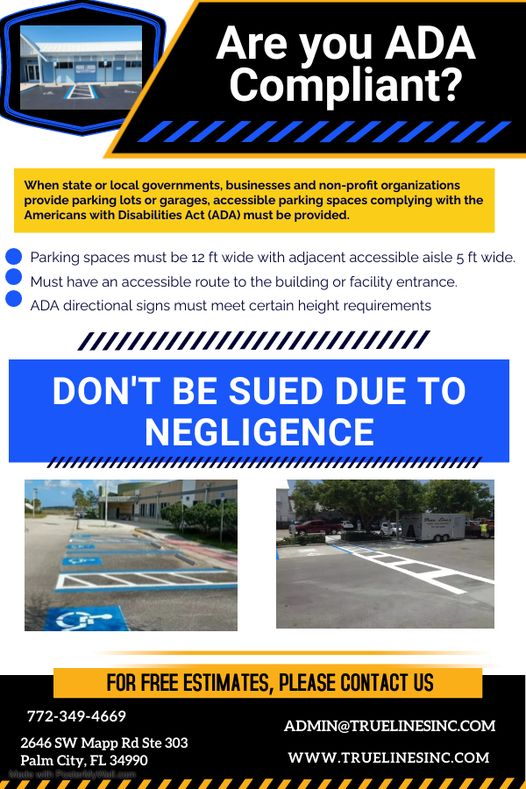
Accessible parking isn’t just a nice thing to have – it’s the law.
Most parking lots must provide accessible parking spaces that align with ADA standards.
This legal requirement ensures people with disabilities can park safely and conveniently, making it easier for them to patronize businesses, access services, and participate in community life.
Navigating the legal landscape can be challenging, but with our expertise, your parking lot can open doors for all.
Connect with us to stay informed about the crucial aspects of making your parking lot welcoming and accessible to all.
Mold testing and remediation are essential because they provide a comprehensive approach to identifying and eliminating mold at its source, preventing recurrence, and ensuring a safe, healthy environment.
Here’s why each step is critical:
Identifying the Extent of the Problem with Mold Testing
• Accurate Detection: Mold often grows in hidden places like wall cavities, ceilings, or HVAC systems. Testing helps identify mold’s presence, type, and spread, which might not be visible.
• Targeted Remediation: Knowing the mold’s location and type informs a tailored approach to remediation, ensuring the complete removal of all affected areas rather than just visible mold patches.
• Health Risk Assessment: Testing can reveal the concentration of airborne spores, which is vital for assessing the potential health risks, especially in buildings with sensitive occupants.
Ensuring Effective Removal and Prevention with Remediation
• Eliminates Mold at the Source: Remediation not only removes visible mold but also addresses underlying issues like water leaks and humidity, which are primary causes of mold growth.
• Prevents Future Growth: Proper remediation includes moisture control and preventive measures, which significantly reduce the chances of mold returning.
• Protects Building Integrity: Mold can weaken structural elements over time, compromising walls, ceilings, and insulation. Remediation stops the damage, preserving the property’s safety and value.
3. Ensuring Health and Safety
• Reduces Health Risks: Mold can cause respiratory issues, allergies, and other health problems. Testing and remediation minimize these risks by improving indoor air quality and reducing exposure to allergens and toxins.
• Compliance with Safety Standards: For commercial or residential buildings, remediation may be necessary to comply with health codes and regulations, particularly in environments with vulnerable populations.
Testing and remediation work together to thoroughly address the mold problem, protect the building structure, and maintain a safe, healthy living or working environment.
To schedule a mold inspection, reach out to Servtec Restoration. We can assess your property for mold, identify affected areas, and recommend next steps for remediation if needed.
Early detection and professional guidance are key to ensuring a safe and mold-free environment.
Keeping a lake or pond healthy can be challenging, but it doesn’t have to be. With a proactive management plan, you can reduce water quality issues while protecting the environment and saving money in the long run.
Explore how you can keep your waterbody balanced and beautiful with proactive solutions.
Why Proactive Annual Lake and Pond Management Is Better for the Environment and Your Wallet
We have all heard the adages about being proactive: “The early bird gets the worm” and “Never do tomorrow what you can do today.” These principles apply to nearly every facet of life, whether it’s our job performance, healthcare, financial planning, or in this case, lake and pond management. It’s no secret that taking care of our environment is important, but it goes beyond that. Science suggests that the preservation of our water resources is a key factor in our health and happiness; memorable experiences and time spent around the water lead to a greater sense of peace and connection to the world around us.
Much like the human body, when a lake or pond is ‘young,’ it typically requires less effort and funds to keep it healthy and functional. But a lifetime of neglect can lead to premature aging and serious imbalances. Without ongoing management, waterbodies become inundated with organic matter, sediment, debris, and other pollutants that cause aesthetic, ecological, and functional problems. These can arise in a multitude of ways, including recurring water quality issues, nuisance weeds and algae, and foul odors—and even scarier issues may lurk unnoticed beneath the water for many years before they manifest. When they do finally appear, it is generally a sign that the waterbody requires significant intervention.
What are signs of an unhealthy waterbody?
Disregarded plant matter and debris can clog and damage stormwater equipment and increase the risk of dangerous flooding
Harmful Algal Blooms can create toxins that may harm aquatic animals, pets, and humans
Invasive plants like Phragmites can take years of dedicated treatments to successfully eradicate
Invasive animal species like armored catfish, bufo toads, and quagga mussels can out-compete beneficial native species and pose significant challenges and costs to remove
Shoreline instability can cause expedited lake and pond “aging” and endanger others
The accumulation of muck and sediment over time can reduce depth and volume – with costly and invasive dredging oftentimes being the only solution
Solutions to Restore Lakes with Poor Water Quality
The number of tools necessary to restore an imbalanced lake or pond depends on many factors, and the benefits can be fleeting if not done consistently. That’s why year-round maintenance is key. To begin developing an annual management program, aquatic specialists conduct preliminary assessments that examine the biological, physical, and chemical properties of the water. Detailed visual inspections and baseline water quality tests provide valuable insights into the overall health of the waterbody and establish an important foundation of data to inform future management decisions.
Building A Custom Water Management Program
Once preliminary assessments are completed, a customized management program can be designed. The most effective programs lean on cutting-edge technologies, comprehensive data collection, routine laboratory analysis, and premium services like nutrient remediation, algae ID, biological augmentation, oxygenation, and erosion control solutions that help stakeholders achieve the trifecta of health, functionality, and beauty. And these solutions are underscored by the guidance and expertise of scientists who specialize in freshwater management.
Pond Management Strategy for Smaller Budgets
Lakes and ponds exhibiting more mild issues or those with budgetary limitations can still be supported by the basics like periodic visual monitoring, nuisance vegetation control, buffer management, and decorative pond dye. These ongoing efforts help lay the groundwork until more advanced solutions come into the picture. Consulting with your lake and pond management professional can help you make the most appropriate decision for your property and your wallet.
Don’t Wait to Manage Your Water… Be Proactive!
Lakes and ponds are an investment, but the upfront costs to kickstart your management program will help to reduce expenses that are often much larger and more concerning down the road. While every aquatic ecosystem has different needs, they all benefit most from comprehensive maintenance strategies supported by the most effective and sustainable technologies available to us. Like most other facets of life, when it comes to lake and pond management “an ounce of prevention is worth a pound of cure.”
Comments: Comments Off on 30/40 Year Building Recertification: Your Property Depends on it.
30/40 Year Building Recertification: Your Property Depends on it.
Building inspections are crucial for maintaining the safety and integrity of buildings. This is particularly true here in South Florida due to our region’s unique climate and environmental conditions. High humidity, Salt Air, extreme heat, and the hurricane season can all cause damage to building’s structure and envelopes over time. These are some of the reasons why building recertification has become mandated in South Florida every 30 or 40 years, depending on the building’s age.
Identifying Hidden Problems
Building inspections are essential to identify underlying problems that may not be readily apparent to residents. For instance, buildings may develop foundation cracks, leaks in the roof, or other issues that can pose significant risks to the property’s structural integrity. Regular inspections can catch these issues early and detect severe problems that may cause serious water damage or building collapse.
Building inspections can prevent these situations, uncover hidden issues, and allow for prompt repair or replacement. Identifying problems early on can also save property owners money and time by preventing more severe cases from developing. Deterioration in coastal environments is a progressive problem that will cost more to address as time passes. By addressing these problems, property owners can promote their buildings’ safety and structural integrity.
Cost Savings
Building inspections can provide property owners with significant cost savings in the long run by identifying potential issues early on. Often, structural engineers can find problems during an inspection that can be repaired immediately at a lower cost than if they were allowed to escalate into more significant issues.
For example, if a building inspector discovers a small leak in the roof, the property owner can have it repaired before it causes more extensive damage to the interior of the building. If left unattended, this leak could cause extensive water damage, resulting in costly repairs and possible damage to the building’s structure.
Inspectors may identify areas in the building that could be more energy-efficient. In this case, the property owner can upgrade the building’s insulation, HVAC, or lighting systems—leading to significant savings in energy costs and reducing the property owner’s overall operating expenses.
Experience and Expertise
Structural Workshop has extensive experience conducting building inspections. Our experienced engineers and inspectors work closely with clients to help them keep their buildings safeand well-maintained. Whether you are a property manager, building owner, or homeowner, we can help you navigate the complexity of building inspections. Please get in touch with us today to schedule a recertification or learn more about our services.
If your company needs marketing please contact our member Jessica Vail Vail Marketing Solutions (908) 528.4087 www.vailmarketingsolutions.com
SFPMA works throughout the State of Florida, we are a multi-member organization for the Condo, HOA and Property Management industry. Through knowledge based Articles, Events and our Members Directory, Clients find the right information to make an informed decisions for their Florida properties.