Get The Career You Love
Get The Career You Love
Prolicense Florida
919 NE 24th Ave Hallandale Beach, Florida 33009 USA


Find Blog Articles for Florida’s Condo, HOA and the Management Industry.
919 NE 24th Ave Hallandale Beach, Florida 33009 USA


SFPMA has many of the top companies ready to help condo and HOA communities with everything from Accountants Attorneys, Collection Companies, website design and Building software(CRM) and Service Companies where estimates and Bidding are always asked during budget season. If you require a RFP (Request For Proposal)Search our Members Directory Business and Service Companies and ask them to help with cost savings for your Budgets.
Property Maintenance is an integral part of managing the day to day operations for every type of property. Search the Members Directory for Companies working with Property Management, Condo and HOA properties in Florida. Search companies for RFP’s in this Budget Season.
It takes more than just posting about your company on social media for your companies to get noticed and selected by Board Members and Property Managers. It takes Trust!
Become a Member today join SFPMA get listed on our Directory
<
p style=”text-align: center;”>[AdSense-A]

We had some calls that caused our IT Teams to go over Coding and Updates to our Directory.
Monday and Tuesday we will be working on these changes.
This will remove and add to the categories so our members show on the categories that they work in. It was found that some member companies wished to show on multiple categories when we did this in some cases it was hiding the few from the directory or changing the categories for companies. Once this is fixed the few companies that were changes will show up on the multi categories again.
Sorry for this….we will be giving these companies free Advertising in our upcoming Editions of our Magazine Florida Rising for a few months.

Because when you give your managers have the right tools, your communities thrive.
✅ Less workload
✅ Faster recovery
✅ Happier boards
🔗 Learn more about our Management Company partnerships:
https://lnkd.in/euSCQsNf
Florida enacted strict laws requiring regular structural inspections for condos, particularly older buildings, following the tragic Champlain Towers collapse in Surfside.
Condo associations that fail to get inspections done could face penalties, including difficulty securing insurance, higher insurance costs, and potential legal action from unit owners.
Inspection reports must be disclosed to potential buyers, making it difficult to sell units if the building has not been inspected and repairs are needed.
In Florida, if your condo association fails to get a required “milestone inspection” done by the deadline, they could face legal consequences, including potential fines and penalties, as the law mandates these inspections for structural integrity, particularly for buildings reaching 30 years old and every 10 years thereafter; however, if you are actively trying to schedule the inspection and encounter delays due to factors like a backlog of engineers, you might be able to demonstrate “good faith effort” to avoid severe repercussions.
Florida law requires most condominium buildings to undergo a comprehensive “milestone inspection” once they reach 30 years old and then every 10 years after that.
If the inspection is not completed on time, the condo association could face penalties or legal action from the state or unit owners.
If the association can demonstrate they were actively trying to schedule the inspection and encountered unavoidable delays (like a shortage of qualified engineers), they might be able to avoid severe penalties.
SB 4-D increases the safety of Florida’s condominiums by requiring inspections for all condominiums and cooperative buildings that are three stories or higher. SB 4-D requires the following for condominiums and cooperatives:
SB 4-D increases the safety of Florida’s condominiums by requiring inspections for all condominiums and cooperative buildings that are three stories or higher. SB 4-D requires the following for condominiums and cooperatives:
SB 154 revised the requirement for condominiums to collect reserves and allows a majority of voting residents to elect not to provide reserves or to provide less reserves than required. However, this legislation prohibits waiving or reducing reserve funding for repairs and maintenance of structural components identified in the SIRS.
Additionally, SB 154 refined the requirements of the SIRS to provide clarification on the items required in a SIRS and expanded who can perform a SIRS.
SB 154 allowed a specific type of condominium (multi-condominium with 25 condominiums or more) to provide no reserves or less reserves than required if an alternative funding method was approved by the Division of Condominiums, Timeshares, and Mobile Homes. The Division received funding to contract with a third-party to review alternative funding methods submitted to the Division for review and approval.
HB 1021 increases transparency and accountability through changes to meeting requirements, voting, education for condominium directors, recordkeeping and reporting, and support from the Florida Department of Business and Professional Regulation (DBPR). Additionally, HB 1021 introduced criminal penalties for board members who act in bad faith, increased DBPR’s ability to address resident complaints through investigations, and established a criminal referral process to streamline accountability for individuals that have engaged in criminal activity.
The SIRS requirements do not apply to buildings less than three stories in height; single-family, two-family, or three family dwellings with three or fewer habitable stories above ground; any portion or component of a building that has not been submitted to the condominium form of ownership; or any portion or component of a building that is maintained by a party other than the association.
A residential condominium association must complete a SIRS for every building in the condominium that is three stories or higher, as determined by the Florida Building Code.
Unit owner-controlled associations existing on or before July 1, 2022, must have a SIRS completed by December 31, 2024. A residential condominium must have a SIRS completed at least every 10 years after the condominium’s creation.
If your budget is adopted on or before December 31, 2024, you may vote to waive or provide less than the required SIRS reserves with a majority vote of the total voting interest of the association. You will need to begin funding your SIRS reserves in accordance with the reserve study January 1, 2026.
If your budget is adopted on or after January 1, 2025, you may not waive your SIRS reserves and need to begin funding your SIRS reserves in accordance with the reserve study.
Within 45 days after receiving the SIRS, the association must provide the division with a statement indicating the study was completed and provided to the unit owners.
An association that is required to complete a MI in accordance with section 553.899, Florida Statutes, on or before December 31, 2026, may complete the SIRS simultaneously with the milestone inspection (MI). However, in no event may the SIRS be completed after December 31, 2026.
If the MI required by section 553.899, Florida Statutes, or an inspection completed for a similar local requirement, was performed within the past 5 years and meets the SIRS requirements, such inspection may be used in place of the visual inspection portion of the SIRS.
A milestone inspection is a structural inspection of the building, including the load-bearing elements.
A SIRS is based off a visual inspection of the items required in s. 718.112(2)(g), F.S. and is a budget planning tool that identifies components of a condominium that are the responsibility of the association to maintain and replace and includes a plan to fund future maintenance and repairs.
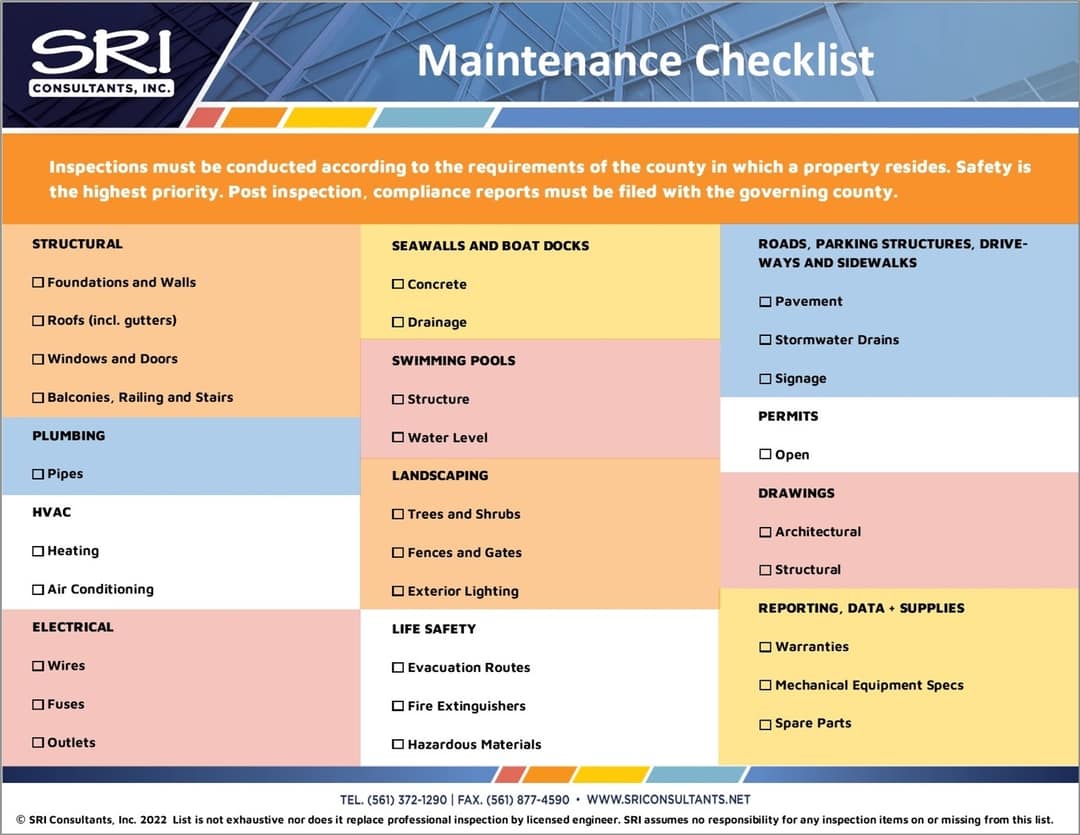
Preventive Maintenance is Key, A good manager should get out of the Office and walk the property, get your hands dirty, take action on any problem or the start of a problem you see. This way you will not have a major problem later.
SRI Consultants has come up with a great checklist for you to use. DL it below.
Do you have questions about Florida’s building safety legislation, Senate Bill 4D? Just enter your query in the textbox and click “Send Query”. For example, try asking, “What is the Florida Senate Bill 4D?”. This AI tool is experimental and provides no warranties regarding the accuracy of its results. Use at your own risk.
This AI tool is experimental and provides no warranties regarding the accuracy of its results. Use at your own risk.
Contact SRI Consultants at office@sriconsultants.net or call (561) 372-1290


Don’t go it alone. Whether your Community requires Conventional or Private Lending, CondoHOALoans can assist you in obtaining the necessary funds for Projects, Reserves, or Cash Flow.
When your Community Association works with our Law Firm to facilitate and secure financing, your Community will also have the optional benefit of receiving 100% FREE Delinquent Account Collection Services.
Not sure if financing is right for your Association? Download the Association Funding Options Infographic and take our Free Financial Health Survey to find out.
[button link=”https://condohoaloans.com/financial-health-survey/” size=”large” target=”_self” icon=”” color=”orange” lightbox=”true”]Take Our FREE Financial Health Survey[/button]
We’ll help your community identify funding resources and lending options for all of its financial needs. Our Legal Services to your community do not end at the successful closing of your loan with the Lender of YOUR choice. As a valued client of Katzman Chandler, you will have the option, but not the obligation, to have ALL future delinquent accounts collected for FREE.
As a consequence of hurricanes, business cycles, and fluctuations in the real estate market over the last 20 years, financial distress has been caused to those who live in Community Associations as well as the Communities Association entities themselves. There presently exist hundreds (if not thousands) of communities whose stories can be illustrated by the timeline below.
Many of these communities presently have underfunded budgets, inadequate cash flow, and lack adequate reserves to accomplish necessary preventative maintenance and actual present maintenance needs. Overall, Boards are starting to realize that there is a lot to do, with little or no money to do it.



Letting Property Managers, Condo and HOA Boards and Owners stay up to date with the ever changing laws and regulations. When it comes to running properties we feel its important to feature new products being used today as well as the top companies for Service, Business and Property Management.
Our members are the experts in their collective fields. They Supply SFPMA with articles and information, projects and products that are being used all over Florida. Weekly our teams send out direct emails, informative articles and sales getting your information in front of the decision makers.
Our Members include: Property Management Companies, Building Owners, HOA’s, Condo Boards, Self Managed Associations, Business and Service members throughout Florida.
SFPMA has had so many companies join this past month and the current month we are still adding the new members to our members directory. this usually takes only a few days, We are working had to have all of them added and will have the remaining member companies posted this week.
Our IT Team had to make changes to our platform so everything runs smoothly with no down time, there have been other factors with WordPress changes, thus making sure our platform, and website work well with the changes they have made took time.
Thank You for your understanding.
Some sfpma news:
We have updated our CRM for billing, the membership Team is currently going through each members directory listing – expect to get a call – we want to make sure all your information is up to date, as clients come and view your membership page we want to make sure the contact information is correct.
Our Billing dept for memberships is also going through and will be sending out information requests check your emails for letters and statements.
SFPMA
Property Managers, Condo & HOA Board Members are use our members in the buildings and communities they manage, for them this equates to happier residents, fewer high-priced emergency repair bills and cost savings overall. Through membership its all about forming relationships that lead to increased business for your company and lasting relationships for you.
Tags: SFPMA Articles, SFPMA Members News

Our Offices will be closed as of Monday Dec 23, 2024 we will return Jan 3, 2025 again our Offices will be closed till after the New Year, if you need us we will be available by email Membership@sfpma.com
We look forward to the many changes in the New Year as should you. Our new editions of our Florida Rising Magazine even more members are being added – All to benefit the boards and Managers.
State of Florida Property Management Association
2401 E Atlantic Blvd, Pompano Beach, FL 33062
https://g.page/r/Ca16pZV0_yhcEAI/review

We are reposting this, for all the buildings That have not had inspections…..
With home insurers leaving Florida in droves, and following pressure from members of both political parties in the legislature to actually do something about it, in May 2022, the governor called a special legislative session to address the problem. A very real concern to the insurers is the effect of both time and inclement weather on Florida’s aging high-rise buildings. Until now, and for the most part, Florida law largely ignored these concerns. Enter Senate Bill 4-D (SB 4-D) which already became effective upon being signed into law by Governor DeSantis on May 26, 2022. This new piece of legislation addresses condominium and cooperative building inspections and reserve requirements (while this article primarily addresses these new laws in the context of condominium association application, they are equally applicable to cooperative associations).
By way of background, during the regular legislative session, there were several bills introduced in the Florida House of Representatives (House) and in the Florida Senate (Senate) addressing building safety issues, but none of them were passed into law due to the inability to match the language of the bills in both the House and the Senate which is a requirement for legislation to pass and go to the governor for consideration. As such, it was a little surprising to many observers that the legislature was able to approve SB 4-D in essentially a 48-hour window during the special session in May. The language used in SB 4-D was initially drafted into a proposed bill in November 2021. At that time, and during the most recent legislative session, input was provided by many industry professional groups including engineers, reserve study providers, and association attorneys. Many of these industry professionals indicated that there were challenges with some of the language and concepts being proposed in SB 4-D during session.
Notwithstanding these challenges, and in an effort to ensure some form of life safety legislation was passed this year, SB 4-D was unanimously approved in both the House and Senate and signed by the governor. A plain reading of this well intended, but in some instances not completely thought-out, legislation evidences these challenges. Some will say it is a good start that will need significant tweaking, which is expected during the 2023 Legislative Session. Others praise it, and yet others say it is an overreach of governmental authority, such as an inability to waive or reduce certain categories of reserves. You be the judge. We begin by examining the mandatory inspection and reserve requirements of SB 4-D.
I. MILESTONE INSPECTIONS: MANDATORY STRUCTURAL INSPECTIONS FOR CONDOMINIUM AND COOPERATIVE BUILDINGS. (§553.899, Fla. Stat.)
You will not find these new milestone inspection requirements in Chapters 718 or 719 of the Florida Statutes, but rather in Chapter 553, Florida Statutes, as cited above.
MILESTONE INSPECTIONS:
The term “milestone inspection” means a structural inspection of a building, including an inspection of load-bearing walls and the primary structural members and primary structural systems as those terms are defined in section 627.706, Florida Statutes, by a licensed architect or engineer authorized to practice in this state for the purposes of attesting to the life safety and adequacy of the structural components of the building and, to the extent reasonably possible, determining the general structural condition of the building as it affects the safety of such building, including a determination of any necessary maintenance, repair, or replacement of any structural component of the building. The purpose of such inspection is not to determine if the condition of an existing building is in compliance with the Florida Building Code or the fire safety code.
SUBSTANTIAL STRUCTURAL DETERIORATION:
The term “substantial structural deterioration” means substantial structural distress that negatively affects a building’s general structural condition and integrity. The term does not include surface imperfections such as cracks, distortion, sagging, deflections, misalignment, signs of leakage, or peeling of finishes unless the licensed engineer or architect performing the phase one or phase two inspection determines that such surface imperfections are a sign of substantial structural deterioration.
MILESTONE INSPECTIONS FOR BUILDINGS THREE STORIES OR MORE IN HEIGHT:
A condominium association under chapter 718 and a cooperative association under chapter 719 must have a milestone inspection performed for each building that is three stories or more in height by December 31 of the year in which the building reaches 30 years of age, based on the date the certificate of occupancy for the building was issued, and every 10 years thereafter.
WITHIN THREE MILES OF COASTLINE:
If the building is three or more stories in height and is located within three miles of a coastline, the condominium association or cooperative association must have a milestone inspection performed by December 31 of the year in which the building reaches 25 years of age, based on the date the certificate of occupancy for the building was issued, and every 10 years thereafter.
The condominium association or cooperative association must arrange for the milestone inspection to be performed and is responsible for ensuring compliance.
The condominium association or cooperative association is responsible for all costs associated with the inspection.
IF THE CERTIFICATE OF OCCUPANCY WAS ISSUED BEFORE JULY 1, 1992:
If a milestone inspection is required under this statute and the building’s certificate of occupancy was issued on or before July 1, 1992, the building’s initial milestone inspection must be performed before December 31, 2024. If the date of issuance for the certificate of occupancy is not available, the date of issuance of the building’s certificate of occupancy shall be the date of occupancy evidenced in any record of the local building official.
Upon determining that a building must have a milestone inspection, the local enforcement agency must provide written notice of such required inspection to the condominium association or cooperative association by certified mail, return receipt requested.
Within 180 days after receiving the written notice the condominium association or cooperative association must complete phase one of the milestone inspection. For purposes of this section, completion of phase one of the milestone inspection means the licensed engineer or architect who performed the phase one inspection submitted the inspection report by e-mail, United States Postal Service, or commercial delivery service to the local enforcement agency.
A MILESTONE INSPECTION CONSISTS OF TWO PHASES:
(a) PHASE 1: For phase one of the milestone inspection, a licensed architect or engineer authorized to practice in this state must perform a visual examination of habitable and non-habitable areas of a building, including the major structural components of a building, and provide a qualitative assessment of the structural conditions of the building. If the architect or engineer finds no signs of substantial structural deterioration to any building components under visual examination, phase two of the inspection (discussed below) is not required. An architect or engineer who completes a phase one milestone inspection shall prepare and submit an inspection report.
(b) PHASE 2: A phase two of the milestone inspection must be performed if any substantial structural deterioration is identified during phase one. A phase two inspection may involve destructive or nondestructive testing at the inspector’s direction. The inspection may be as extensive or as limited as necessary to fully assess areas of structural distress in order to confirm that the building is structurally sound and safe for its intended use and to recommend a program for fully assessing and repairing distressed and damaged portions of the building. When determining testing locations, the inspector must give preference to locations that are the least disruptive and most easily repairable while still being representative of the structure. An inspector who completes a phase two milestone inspection must prepare and submit an inspection report.
POST-MILESTONE INSPECTION REQUIREMENTS:
Upon completion of a phase one or phase two milestone inspection, the architect or engineer who performed the inspection must submit a sealed copy of the inspection report with a separate summary of, at minimum, the material findings and recommendations in the inspection report to the condominium association or cooperative association, and to the building official of the local government which has jurisdiction. The inspection report must, at a minimum, meet all of the following criteria:
(a) Bear the seal and signature, or the electronic signature, of the licensed engineer or architect who performed the inspection.
(b) Indicate the manner and type of inspection forming the basis for the inspection report.
(c) Identify any substantial structural deterioration within a reasonable professional probability based on the scope of the inspection, describe the extent of such deterioration, and identify any recommended repairs for such deterioration.
(d) State whether unsafe or dangerous conditions, as those terms are defined in the Florida Building Code, were observed.
(e) Recommend any remedial or preventive repair for any items that are damaged but are not substantial structural deterioration.
(f) Identify and describe any items requiring further inspection.
LOCAL GOVERNMENT ENFORCEMENT:
A local enforcement agency may prescribe time lines and penalties with respect to compliance with the milestone inspection requirements.
A board of county commissioners may adopt an ordinance requiring that a condominium or cooperative association schedule or commence repairs for substantial structural deterioration within a specified time frame after the local enforcement agency receives a phase two inspection report; however, such repairs must be commenced within 365 days after receiving such report. If an association fails to submit proof to the local enforcement agency that repairs have been scheduled or have commenced for substantial structural deterioration identified in a phase two inspection report within the required time frame, the local enforcement agency must review and determine if the building is unsafe for human occupancy.
BOARD’S DUTY AFTER OBTAINING THE MILESTONE REPORT:
Upon completion of a phase one or phase two milestone inspection and receipt of the inspector-prepared summary of the inspection report from the architect or engineer who performed the inspection, the association must distribute a copy of the inspector-prepared summary of the inspection report to each unit owner, regardless of the findings or recommendations in the report, by United States mail or personal delivery and by electronic transmission to unit owners who previously consented to receive notice by electronic transmission; must post a copy of the inspector-prepared summary in a conspicuous place on the condominium or cooperative property; and must publish the full report and inspector-prepared summary on the association’s website, if the association is required to have a website.
WHO PAYS FOR THE MILESTONE INSPECTION:
Pursuant to section 718.112, Florida Statutes, if an association is required to have a milestone inspection performed, the association must arrange for the milestone inspection to be performed and is responsible for ensuring compliance with all of the requirements thereof. The association is responsible for all costs associated with the inspection.
FAILURE TO OBTAIN THE MILESTONE INSPECTION:
If the officers or directors of an association willfully and knowingly fail to have a milestone inspection performed pursuant to section 553.899, Florida Statutes, such failure is a breach of the officers’ and directors’ fiduciary relationship to the unit owners.
MANAGER’S DUTY:
If a community association manager or a community association management firm has a contract with a community association that has a building on the association’s property that is subject to milestone inspection, the community association manager or the community association management firm must comply with the requirements of performing such inspection as directed by the board.
EXEMPTIONS:
For clarity, the otherwise required milestone inspection does not apply to a single family, two-family, or three-family dwelling with three or fewer habitable stories above ground.
FLORIDA BUILDING COMMISSION REQUIREMENTS:
The Florida Building Commission must review the milestone inspection requirements and make recommendations, if any, to the legislature to ensure inspections are sufficient to determine the structural integrity of a building. The commission must provide a written report of any recommendations to the Governor, the President of the Senate, and the Speaker of the House of Representatives by December 31, 2022.
The Florida Building Commission must consult with the State Fire Marshal to provide recommendations to the legislature for the adoption of comprehensive structural and life safety standards for maintaining and inspecting all types of buildings and structures in this state that are three stories or more in height. The commission must provide a written report of its recommendations to the Governor, the President of the Senate and the Speaker of the House of Representatives by December 31, 2023.
II. STRUCTURAL INTEGRITY RESERVE STUDIES AND MANDATORY RESERVES:
The reserve legislation set out in section 718.112 (f)(2)(a), Florida Statutes, is, for all intents and purposes, re-written. Prior to examining these most recent revisions, it is necessary to first examine the definitions set out in section 718.103, Florida Statutes, where a brand new term is added as follows:
Structural integrity reserve study means a study of the reserve funds required for future major repairs and replacement of the common areas based on a visual inspection of the common areas applicable to all condominiums and cooperative buildings 3 stories or higher.
Hereafter, the structural integrity reserve study is referred to as “SIRS”. Now we can turn our attention to the requirements of the SIRS as set out in section 718.112 (f)(2)(a), Florida Statutes
THE STRUCTURAL INTEGRITY RESERVE STUDY (required for all condominium and cooperative buildings three stories or higher regardless of date of certificate of occupancy):
An association must have a SIRS completed at least every 10 years after the condominium’s creation for each building on the condominium property that is three stories or higher in height which includes, at a minimum, a study of the following items as related to the structural integrity and safety of the building:
a. Roof.
b. Load-bearing walls or other primary structural members.
c. Floor.
d. Foundation.
e. Fireproofing and fire protection systems.
f. Plumbing.
g. Electrical systems.
h. Waterproofing and exterior painting.
i. Windows.
j. Any other item that has a deferred maintenance expense or replacement cost that exceeds $10,000 and the failure to replace or maintain such item negatively affects the items listed in subparagraphs a.-i., as determined by the licensed engineer or architect performing the visual inspection portion of the structural integrity reserve study.
The SIRS may be performed by any person qualified to perform such study. However, the visual inspection portion of the structural integrity reserve study MUST be performed by an engineer licensed under chapter 471 or an architect licensed under chapter 481.
As further set out in the legislation, at a minimum, “a structural integrity reserve study must identify the common areas being visually inspected, state the estimated remaining useful life and the estimated replacement cost or deferred maintenance expense of the common areas being visually inspected, and provide a recommended annual reserve amount that achieves the estimated replacement cost or deferred maintenance expense of each common area being visually inspected by the end of the estimated remaining useful life of each common area.”
The amount to be reserved for an item is determined by the association’s most recent structural integrity reserve study that must be completed by December 31, 2024. If the amount to be reserved for an item is not in the association’s initial or most recent structural integrity reserve study or the association has not completed a structural integrity reserve study, the amount must be computed using a formula based upon estimated remain useful life and estimated replacement cost or deferred maintenance expense of each reserve item.
If the condominium building is less than three stories then the legislation provides that, “in addition to annual operating expenses, the budget must include reserve accounts for capital expenditures and deferred maintenance. These accounts must include, but are not limited to, roof replacement, building painting, and pavement resurfacing, regardless of the amount of deferred maintenance expense or replacement cost, and any other item that has a deferred maintenance expense or replacement cost that exceeds $10,000.”
The association may adjust replacement reserve assessments annually to take into account any changes in estimates or extension of the useful life of a reserve item caused by deferred maintenance.
If an association fails to complete a SIRS, such failure is a breach of an officer’s and director’s fiduciary relationship to the unit owners.
NON-WAIVABLE AND WAIVABLE RESERVES IN THE UNIT OWNER CONTROLLED ASSOCIATION:
As to the SIRS, the legislation is patently clear that unit owners may not vote for no reserves or lesser reserves for items set forth SIRS report. There is on-going debate amongst attorneys in regard to whether a condominium under three stories can waive or reduce reserves for any of the reserve items required to be in the SIRS that are included in the under three story condominium reserve, for example, roof and painting (For those interested, examine lines 1029 to 1033 and 1050 to 1071 in SB 4-D).
MANDATORY RESERVES IN THE DEVELOPER CONTROLLED ASSOCIATION:
Before turnover of control of an association by a developer to unit owners other than a developer pursuant to section 718.301, Florida Statutes, the developer-controlled association may not vote to waive the reserves or reduce the funding of the reserves (Previously, a developer could fully waive all reserves for the first two years, meaning this is a monumental change).
PRE-TURNOVER DEVELOPER DUTY:
Before a developer turns over control of an association to unit owners other than the developer, the developer must have a SIRS completed for each building on the condominium property that is three stories or higher in height.
III. OFFICIAL RECORDS:
Official records of the condominium and cooperative association include structural integrity reserve studies, financial reports of the association or condominium, and a copy of the inspection reports and any other inspection report relating to a structural or life safety inspection of condominium or cooperative property.
In addition to the right to inspect and copy the declaration, bylaws and rules renters have the right to inspect the milestone inspection report and structural integrity reserve study inspection reports as well.
Structural integrity reserve studies must be maintained for at least 15 years after the study is completed. In addition, inspection reports report and any other inspection report relating to a structural or life safety inspection of condominium property must be maintained for 15 years after receipt of such report.
IV. ASSOCIATION WEBSITES:
In addition to other positing requirements, the inspection reports described above and any other inspection report relating to a structural or life safety inspection of condominium property and the association’s most recent structural integrity reserve study must be posted to the website.
V. JURISDICTION OF DIVISION OF CONDOMINIUMS, TIMESHARES, AND MOBILE HOMES:
Pre-turnover, the Division of Florida Condominiums, Timeshares, and Mobile Homes (Division) may enforce and ensure compliance with rules relating to the development, construction, sale, lease, ownership, operation, and management of residential condominium units, and complaints related to the procedural completion of milestone inspections. After turnover has occurred, the Division has jurisdiction to investigate complaints related only to financial issues, elections, and the maintenance of and unit owner access to association records, and the procedural completion of structural integrity reserve studies.
VI. NEW REPORTING REQUIREMENTS FOR ALL CONDOMINIUM AND COOPERATIVE ASSOCIATIONS:
On or before January 1, 2023, condominium associations existing on or before July 1, 2022, must provide the following information to the Division in writing, by e-mail, United States Postal Service, commercial delivery service, or hand delivery, at a physical address or e-mail address provided by the division and on a form posted on the division’s website:
An association must provide an update in writing to the division if there are any changes to the information in the list within six months after the change.
VII. APPLICABLE TO ALL SELLERS OF UNITS:
As a part of the sales process, the seller of a condominium or cooperative unit and developers must provide to potential purchasers a copy of the inspector-prepared summary of the milestone inspection report and a copy of the association’s most recent structural integrity reserve study or a statement that the association has not completed a structural integrity reserve study.
VIII. GLITCHES:
As with any new legislation of such a substantial nature, there often follow in subsequent years what are referred to as “glitch bills” which help provide additional clarity, remove ambiguity, and fix unintended errors. To name a few: (i) the term “common areas” is used in the legislation when in fact the correct term is “common element;” (ii) clarity needs to be provided regarding whether reserve items that are required to be in SIRS, but show up in the under three story reserves, such as paint and paving, can be waived or reduced by the membership; and (iii) for those buildings that are within three miles of the coastline, additional clarity could be provided to provide better guidance as to how to perform the measurement.
Tags: Board of Directors, Condo and HOA Law, Reserves