Become our Member : JOIN SFPMA TODAY   LogIn / Register: LOGIN/REGISTER

SFPMA Industry Articles | news, legal updates, events & education! 

Find Blog Articles for Florida’s Condo, HOA and the Management Industry. 

Lighting of Tomorrow facilitates communities to switch from inefficient lighting fixtures to new state-of-the-art LED lighting technology.

Lighting of Tomorrow facilitates communities to switch from inefficient lighting fixtures to new state-of-the-art LED lighting technology.

  • Posted: Dec 13, 2021
  • By:
  • Comments: Comments Off on Lighting of Tomorrow facilitates communities to switch from inefficient lighting fixtures to new state-of-the-art LED lighting technology.

Lighting of Tomorrow facilitates communities to switch from inefficient lighting fixtures to new state-of-the-art LED lighting technology.


How to Reduce Commercial Energy Usage

These recent days, we are going through some real problems such as an increase in energy usage. Also, when it comes to solving these problems, people cannot really think of the solutions. Hence, we are here to provide the solutions on How to Reduce Commercial Energy Usage.

Thus, here are some tips to reduce energy usage:

Equipment functioning should be checked

The equipment functioning should be regularly checked now and then. There should be a proper check of the equipment, and even it should be double-checked. This can also lead to the improvement of the equipment in commercial settings.

Increase in Usage Air Compressors

Air compressors are one of the best solutions to reduce energy reduction. The drive motor is the main element of the air compressor. And, the latest systems allow for these drives to use a change in frequency that reduces the power that the drive is requesting (depending on load).

Plant and Trees Outside Your Commercial Property

Plants and trees must be planted on the south and east sides of your commercial building. These plants and trees will provide proper shade in the summer, which leads to a reduction in the cooling load, and will allow sunlight to enter your building in the winter, reducing the heating load as well.

Update the Regular Lighting to Modern Technology Lighting

If you have old and outdated lighting LED lighting can make a quick, moving impact on your energy consumption. Converting your old lighting to LED lighting may result in a decrease of up to 60% of the electrical costs of your daily lighting energy consumption.  LED lighting also has some additional benefits such as less heat generation that results in reducing your air conditioning load as well as reducing your maintenance costs as well.

Install Energy Effective Practices

Getting your employees to participate in energy-saving rituals is an effective way to help decrease energy expenses. You can also create incentives or competitions to check how low a commercial property can get their average energy to spend per month is quite an innovative way to boost employees toward saving energy.

Conclusion

Hence, these were some of the tips on How to Reduce Commercial Energy Usage and specifically when you can just change certain lifestyle habits. Thus, you can just introduce these tips as rituals in your commercial property to reduce energy usages very effectively.


Contact Us

840 E Oakland Park Blvd 117 Oakland Park, FL 33334

954.626.0267

info@lightingot.com

About Us

Lighting of Tomorrow is commited to providing our clients energy saving lighting solutions. We provide a complete service, so we can continue “lighting the way for a sustainable tomorrow”


Tags: ,
Call Pioneering Pest Services today for your free estimate on any of our services!! ☎️ 386.734.2142 ☎️

Call Pioneering Pest Services today for your free estimate on any of our services!! ☎️ 386.734.2142 ☎️

  • Posted: Dec 10, 2021
  • By:
  • Comments: Comments Off on Call Pioneering Pest Services today for your free estimate on any of our services!! ☎️ 386.734.2142 ☎️

Call today for your free estimate on any of our services!! ☎️ 386.734.2142 ☎️

Send us a Facebook message or email spetit@pioneerpestservices.com for more information!

☘️Lawn & Shrub care   🐜 Pest Prevention  🪳Termite Protection

Fertilizer ☑️ Insect control ☑️
Weed elimination ☑️

Dependability starts with Pioneer Pest Services!

Pioneer Pest Services, Inc. was established in 1985 and proudly serves Volusia, Flagler, Lake, and Seminole counties. We are a local family-owned and operated company with a proven track record for reliable and professional pest services.

Our goal is to partner with homeowners, business owners, and property managers to control pest, termite, and lawn and shrub problems. We will immediately assess and address current pest issues, as well as your lawn and shrub needs, and help you to prevent them from happening in the future.

Whether they fly, creep, sting, or swarm, pests are a persistent problem for Floridians—and they can do serious damage if they’re not kept in check. At Pioneer Pest Services, we understand that pests need to be taken care of promptly and effectively. That’s been our mission for the past three decades! A local, family-owned company, we’re committed to quality service for residential and commercial customers in Volusia, Flagler, Seminole, and Lake counties. RELIABLE PEST SERVICES SINCE 1985

Protecting your property is our priority, call us today for a FREE estimate. 📱386.734.2142📱

Members of SFPMA: View our Membership page.


Tags: , ,
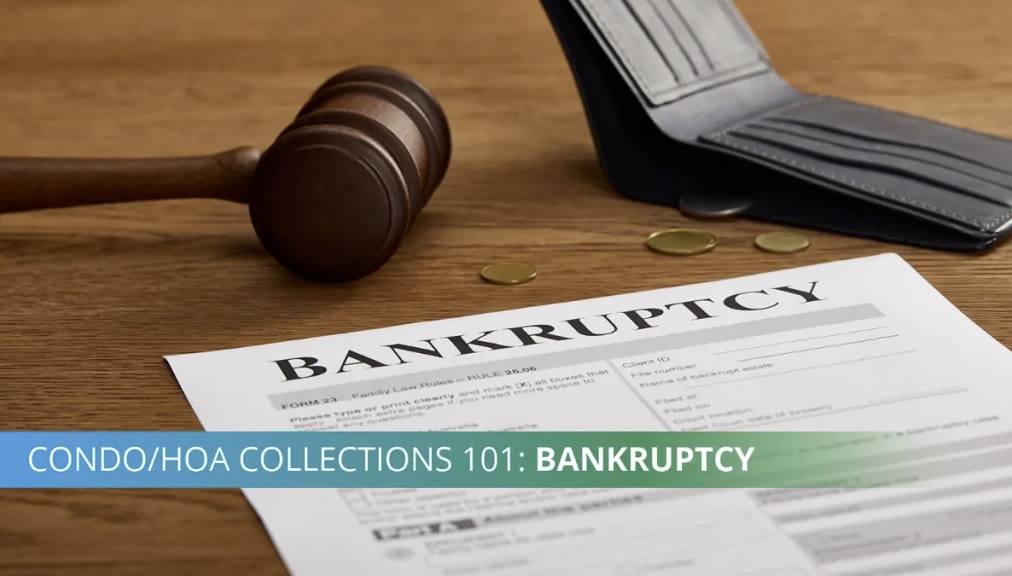
Community Association Collections 101: What Happens When An Owner Files For Bankruptcy? by Axela’s / Mitch Drimmer

Community Association Collections 101: What Happens When An Owner Files For Bankruptcy? by Axela’s / Mitch Drimmer

  • Posted: Dec 10, 2021
  • By:
  • Comments: Comments Off on Community Association Collections 101: What Happens When An Owner Files For Bankruptcy? by Axela’s / Mitch Drimmer

It seems as if bankruptcy will be the next big subject, this article is a step by step process for community associations

Community Association Collections 101:

What Happens When An Owner Files For Bankruptcy?

Bankruptcy NoticeThe collections process isn’t a fun one, and depending on what causes delinquency, it can get complicated. A homeowner who falls behind on just their association payments is one thing, but someone who’s so behind on all of their financials that they have to declare bankruptcy is a very different story. We’re asked all the time about what happens when a condo or HOA has to deal with homeowner bankruptcy. If your association is dealing with a bankrupt homeowner who is not paying their post-bankruptcy amounts, there are decisions to be made and steps that can be taken. Let’s review what must happen and how the community association can best navigate this situation.


Two LedgersWhat Happens When Bankruptcy is Filed?

Filing for bankruptcy isn’t a quick process. When a person, known as the “petitioner,” files for bankruptcy, they must file a list of their creditors with the bankruptcy court (which is a federal court). The creditors will be noticed with a “bankruptcy notification” and will be given a time frame by which to respond, usually under two months. Government claims can be submitted up to six months after the petition date (it’s good to be the government.)

There is no requirement that the response (or proof of claim) from the creditor must be submitted to the court via an attorney, which is good for you–the less an association is required to spend on costly attorney fees, the better. This proof of claim can be submitted by the association directly, the management company, or by a collections partner like Axela. Just be sure that everything that is legally owed to the association is included on that proof of claim–this should include assessments, late fees, late interest, fines and violations, special assessments, and any other sundry items that have been charged to the property. Be sure to double-check the ledger because it is expensive to get a second bite at that apple if you find you want to amend your claim with the court.

From there, the bankruptcy court will hold a “341 meeting,” which is a meeting between the debtor and the creditors but it is not mandatory for any creditor to attend. Then comes the really complicated part.


Types of Bankruptcy

It is important to know what type of homeowner bankruptcy you are dealing with as this knowledge will direct your business decisions going forward. When a property goes bankrupt in a community association, the community needs to prepare two ledgers: a pre-petition ledger and a post-petition ledger. You cannot add the post-petition amounts to the bankruptcy claim because next month’s bills are not this month’s debts. Regardless of which kind of bankruptcy they have filed, the petitioner has an obligation to pay the post-petition amounts during the bankruptcy. If the delinquent owner is NOT paying their post-petition debts, the association needs to make a decision and take action immediately, and the type of bankruptcy will determine which steps to take


Chapter 7

Complete wipeoutChapter 7 bankruptcy, also known as “no-asset” bankruptcy, is a complete wipeout. This means that no money will be recovered from the pre-petition amounts.  A Chapter 7 bankruptcy case can take as little as six months to complete because there is no settlement to be made. Creditors can claim to the court that there are assets being hidden but, in most cases, it is all over fairly quickly. If the delinquent owner is not paying the post-petition amounts, then the association can wait until the case is discharged and then move forward with collections activity. If the owner has been paying their post-petition amounts, then the issue is resolved albeit the association has taken a hit.


Chapter 13

Wage Earner;s PlanChapter 13 bankruptcy is known as a “wage earners plan” and is a workout where the court will make a settlement and oversee it until the payment plan has been completed. This is when the association needs to make a business decision.

In a Chapter 13 bankruptcy case, the pre-petition debts will not be discharged for 3-5 years, and the petitioner remains in bankruptcy. If they are not paying the post-petition amounts, the association cannot submit the delinquency for collections or to an attorney for foreclosure. The only course of action is for the association to ask the court for an “injunctive stay of relief” which is essentially asking the court to allow the association to move forward with collections and or foreclosure efforts.


So What Needs to Be Done?

If a unit owner files for Chapter 13 bankruptcy and is not paying their current assessments, it is not a stretch to believe that most likely they will never pay. It is unfair that the association needs to wait three to five years until the pre-petition debts are paid, the delinquent owner is discharged from bankruptcy, and the association can finally move forward. As we mentioned above, if a delinquent owner has filed for Chapter 13 bankruptcy and is not paying their current assessments, the association should file with the court a motion for injunctive relief. During the gap period, section 1519(a) of the Bankruptcy Code states that a bankruptcy court has the power to grant provisional injunctive relief and certain other forms of relief where “relief is urgently needed to protect the assets of the debtor or the interests of the creditors.” Additionally, an order staying execution against the debtor can also be granted. If a property owner is not paying their assessments, then the case can be made that a stay order is required to protect the assets (the property).


How to Handle Homeowner Bankruptcy in Your Association

The same way you’d handle any other bankruptcy situation in your association: call a professional. Homeowner bankruptcy in your association can be managed and worked through, but it takes a lot of knowledge and a lot of time. Many times, when a management company or a board of directors is reviewing delinquencies, the units that are delinquent and are also in bankruptcy get glossed over. There is a feeling that once a delinquent owner files for bankruptcy, the association has no options other than to wait until the bankruptcy is discharged. This is not the case as there are options and every case is unique. Axela Technologies has the experience, knowledge, and experience to deal with all these contingencies. Call us today for a no-cost, no-obligation analysis, and review of your delinquencies.


About the Author

Mitch Drimmer is a respected thought leader in his field and has led numerous continuing education classes in collections, His articles have been published in key trade journals and newspapers, and he is a speaker at educational seminars.

As the President of Business Development for Axela Technologies, Drimmer works with community associations and their management companies to introduce innovative strategies to collect delinquent maintenance fees.

Throughout his career, Drimmer has worked with community associations to help them see their way through tough times, especially during the real estate crash. He is a passionate advocate for community associations and has participated in the legislative process over the years trying to bring fair and equitable legislation that serves community associations.

Drimmer earned a Bachelor of Arts in History from Hunter College in New York City, and has worked in the community association collections space since 2007.


Tags: , ,
Corey Parshall is the founder of Parshall Tree Care Experts, a full-service tree company offering reinvented solutions to outperform and challenge the industry

Corey Parshall is the founder of Parshall Tree Care Experts, a full-service tree company offering reinvented solutions to outperform and challenge the industry

  • Posted: Dec 03, 2021
  • By:
  • Comments: Comments Off on Corey Parshall is the founder of Parshall Tree Care Experts, a full-service tree company offering reinvented solutions to outperform and challenge the industry

Corey Parshall is the founder of Parshall Tree Care Experts, a full-service tree company offering reinvented solutions to outperform and challenge the industry.

They deliver services to residential, commercial, municipal, and utility clients in Michigan and Florida! With a desire to break stereotypes and bring the tree service industry into the 21st century, Corey designed a business with unparalleled service.

Entering the market, Corey saw opportunity in the outdated practices that ensnare other companies. He understood the pitfalls in the tree service industry and decided to do his part to change it. He saw under-serviced clients and poor service in general. Using his entrepreneurial spirit, he started his own company to address these problems. Leveraging changes in technology, Parshall Tree Care aims to challenge themselves with creative ways of thinking, always looking to push the industry further.

Corey’s biggest challenges are the unknowns. In the early stages of running his business he experienced a lot of trial and error, discovering this was the most expensive way to learn and grow. Rather than bleeding money, Corey started investing in resources to grow his team instead. He found mentors that could help with problem-solving and educate the team. Before he knew it he had a clear roadmap that prevented him from constantly having to relearn everything.


With a mind focused on the positive, Corey believes your goals are within reach. A negative outlook can erode your confidence in taking calculated risks, while a positive outlook brings opportunity. Corey has noticed that when he keeps a positive mindset relationships line up, doors open, and he is generally luckier as an entrepreneur. By overcoming his biggest obstacle of thinking small, he found great success by intentionally setting unobtainable goals just to see what he and his team can achieve. Corey pays attention to fears that creep up when goal-setting. To him, fear is a communicator that action is needed to reach the desired opportunity.

For anyone interested in starting their own business, Corey recommends setting outrageous goals. He recommends anything considered to be a “good goal” should be multiplied by 1000 because you will probably underestimate rather than overestimate. Low expectations lead to boredom and if your business is boring you’re more likely to give up. Once you have a plan set, Corey suggests finding mentors, even if you have to pay for them. Learning from the experience of others saves you time and money in the long run.

Success, to Corey, is building a team that includes his family. In doing so, they find freedom from being tied down by that which is out of their control. He finds financial freedom knowing he and his family enjoy a better quality of life, and he has a legacy to share with generations to come. He loves sharing his success with his team as they experience the same freedom. At the end of the day, Corey’s dream is to see the entire tree service industry revolutionized—that they can leave a generational impact and improve an outdated industry.

Corey is so grateful to his staff for everything they do to help carry out the company’s mission, and to his clients who trust him to provide his service. He knows he can’t make a difference in the tree industry without either piece missing. This company isn’t about Corey Parshall, but the Parshall Tree Care Experts revolution. Parshall Tree TV, a free educational platform, is the latest division of the company.


Parshall Tree Care Experts

also have plans to grow their new offices in Ohio and Indiana, then expand toward the eastern US to Florida. But Corey’s ultimate goal is to be known as the industry leader in the tree service community.

Corey Parshall
Founder
Parshall Tree Care Experts
corey@parshalltreecare.com
877-250-2060
http://parshalltreecare.com


Tags: , ,
Florida Community Association Manager License Courses, CAM License Courses and Real Estate in Florida

Florida Community Association Manager License Courses, CAM License Courses and Real Estate in Florida

  • Posted: Dec 03, 2021
  • By:
  • Comments: Comments Off on Florida Community Association Manager License Courses, CAM License Courses and Real Estate in Florida

Online Courses for Licensing can be completed while your at home.

ProLicense Florida CAM LICENSE COURSE 

ProLicense Florida Pre – CAM LICENSE COURSE

ProLicense Florida Continuing Education


  Questions & Answers                   

  A competent manager can add significant value to your investment, which is why many seasoned real estate investors will tell you that a good management company is worth their weight in gold.

 Q & A of Management


Tags: ,
Financial Screening of Purchasers: How Far Is Too Far? by KBRLegal

Financial Screening of Purchasers: How Far Is Too Far? by KBRLegal

  • Posted: Dec 03, 2021
  • By:
  • Comments: Comments Off on Financial Screening of Purchasers: How Far Is Too Far? by KBRLegal

Financial Screening of Purchasers: How Far Is Too Far?

A few months back a case came before the county court in the 20th Judicial Circuit for Collier County, wherein a prospective buyer challenged the validity of a board-adopted rule which required that all prospective buyers provide two years of tax returns with their application for ownership approval. This requirement was in addition to the background check and credit check that were also required. While this is only a county court case and, therefore, has no precedential value other than to the parties themselves, there are principles addressed of which associations and managers should be aware; even though many learned attorneys would opine that the conclusions of the court are legally flawed under the facts of the case and, if appealed, would likely be overturned. Nevertheless, there are still nuggets of knowledge that can be gleaned from this case.

In this case, Mech v. Crescent Beach Condominium Association, Inc., Case No. 19-SC-3498, decided June 2020, the purchaser, who was the plaintiff, was seeking to buy a unit at Crescent Beach Condominium for $400,000, which was to be paid in cash. The purchaser purportedly had a clean background and a credit score of 800. Nonetheless, the board required that, like all other prospective purchasers at the condominium, this purchaser needed to produce his tax returns in order for the association to approve the transfer. The purchaser refused to provide his tax returns and cited his good credit score and clean background as evidence enough for approval. Eventually, an impasse was reached, and the purchaser canceled the contract. Then he brought the county court lawsuit challenging the requirement. (Generally speaking, typically under current Florida law, the purchaser would not have legal standing to even bring the claim against the association; but it does not appear that this legal infirmity was raised by the association, which allowed the case to proceed.)

The purchaser challenged the rule, arguing that the rule was not within the scope of the association’s authority to adopt, nor did it reflect reasoned decision-making. (It is noteworthy to point out that, after the initiation of the lawsuit, the association amended its declaration of condominium to provide that the association may require tax returns in an application for approval of a sale. However, this is not relevant to the conclusions of the Court in this case since it occurred after the litigation was filed.)

The association argued that the tax returns are necessary because they provide more information than a credit report and could help ensure that the potential purchaser is “a good credit risk.” The Court, however, did not agree, calling the argument “nonsensical.” The Court goes on to identify what this judge considers to be the best indicator of a person’s financial history, and as a result, it is the only information the association is allowed to seek. (We note that this conclusion is also without a stated legal basis.)

In the final judgment, some might argue that the Court goes way beyond what proper judicial consideration and conclusions typically contain and indicates that she could find “NO justification for the invasive requirement that a full, or even partial, return would be required when, in fact, the board already requires a full background check and credit check.” While no legal support for the conclusion was provided, the Court held that the request for tax returns was invasive and unnecessary and that the requirement was “shocking.”

The Court objected to the blanket requirement that applied to every applicant regardless of the results of their background and credit checks. Had the tax returns only been required when an applicant’s credit history showed a history of financial instability or delinquencies, the rule may have been upheld by the Court. How-ever, the Court held that “to take a position that ‘every person’ who applies to be a member at is patently unreasonable and shall be stricken.” Lastly, also without a legal basis or ability, the Court ordered the association to strike all reference in its condominium documents which require potential purchasers to produce tax returns unless the association can show good cause to request the information.

A brief discussion regarding the adoption of rules and regulations is necessary to highlight lessons that can be learned from this case. Generally, both condominium and homeowners association governing documents will typically provide that the board of the directors has the authority to adopt rules and regulations for the community. While some governing documents may contain restrictions requiring a membership vote to approve new rules, it is common for the governing documents to provide the board with the authority to adopt rules and regulations. (Careful review of the documentary authority for each community is recommended as some may limit the rule-making authority to common areas only and not to the residential property within the community.)  Although the board is generally authorized to adopt rules and regulations, those rules and regulations must not conflict with any provision expressly set out in the governing documents or reasonably inferred from them, and they must be reasonable. (This should be contrasted with covenants recorded in the County’s official records, which may be unreasonable and still be legally enforceable under long-standing Florida case law.)

In Beachwood Villas Condominium v. Poor, et. al., a 1984 Fourth District Court of Appeal (4th DCA) case  in which several owners challenged rules enacted by their association’s board of directors, the Court noted that there could be two sources of use restrictions: (i) those set out in the declaration of condominium and (ii) those adopted by the board. As to the use restrictions set out in the declaration, the court held that such restrictions are “clothed with a very strong presumption of validity,” as initially provided in Hidden Harbor Estates v. Basso (a 1981 4th DCA case).

In examining board-adopted rules, the court first must determine whether the board acted within its scope of authority—in other words, whether the board had the express authority in the documents to adopt the rule in the first place. If the answer is “yes,” the second question to determine is whether the rule conflicts with an express provision of the governing documents or one that is reasonably inferred. (If the documents are silent on an issue, the inference is that it is unrestricted. Adopting a rule to restrict a topic that the declaration is otherwise silent about would conflict with the inferred unrestricted use and therefore be unenforceable.)  If these first two issues are found to exist, the court will then determine if the rule is reasonable. The board’s exercise of its reasonable business judgment in adopting a rule is generally upheld so long as the rule is not “violative of any constitutional restrictions and does not exceed any specific limitations set out in the statutes or condominium documents.”

In examining your own board-adopted rules, ask the following:

  • Did the board have the power to adopt the rule?
  • Is the rule in accord with with the declaration, articles of incorporation, or bylaws?
  • Is the rule reasonable under the circumstances? (While ultimately only a court can make this final determination, the board should use its best judgment, with assistance of its counsel, to reach this decision.)

If the answer to these three questions is “yes,” then the rule should be found to be valid and enforceable by the court upon an owner challenge.

Ultimately, what can be gleaned from Mech v. Crescent Beach Condominium Association Inc. is that even if the association acts reasonably when adopting rules and even when amending the declaration, a lower court judge can reach almost any decision it wishes. Had the provision at issue only required tax returns when the background or credit checks revealed that the prospective purchaser had a history of financial irresponsibility, the provision may have withstood judicial challenge by this particular judge. Additionally, had the provision requiring tax returns been set out in the declaration before the initiation of the lawsuit, the outcome may have been different under existing, well-established case law.

Bottom line, whenever the board is considering new rules, it is recommended that the board consult with the association’s legal counsel before adopting them.

(Reprinted with permission from KBR Legal)

Jeffrey Rembaum’s, Esq. of Kaye, Bender, Rembaum attorneys at law, legal practice consists of representation of condominium, homeowner, commercial and mobile home park associations, as well as exclusive country club communities and the developers who build them. Mr. Rembaum is a Certified Specialist in Condominium and Planned Development Law. He is the creator of ‘Rembaum’s Association Roundup’, an e-magazine devoted to the education of community association board members, managers, developers and anyone involved with Florida’s community associations.  His column appears monthly in the Florida Community Association Journal. Every year since 2012, Mr. Rembaum has been selected to the Florida Super Lawyers list and was also named Legal Elite by Florida Trends Magazine. He can be reached at 561-241-4462.

Tags: , ,
Royale Management Services, Inc., call today for a free quote and proposal!

Royale Management Services, Inc., call today for a free quote and proposal!

  • Posted: Dec 02, 2021
  • By:
  • Comments: Comments Off on Royale Management Services, Inc., call today for a free quote and proposal!

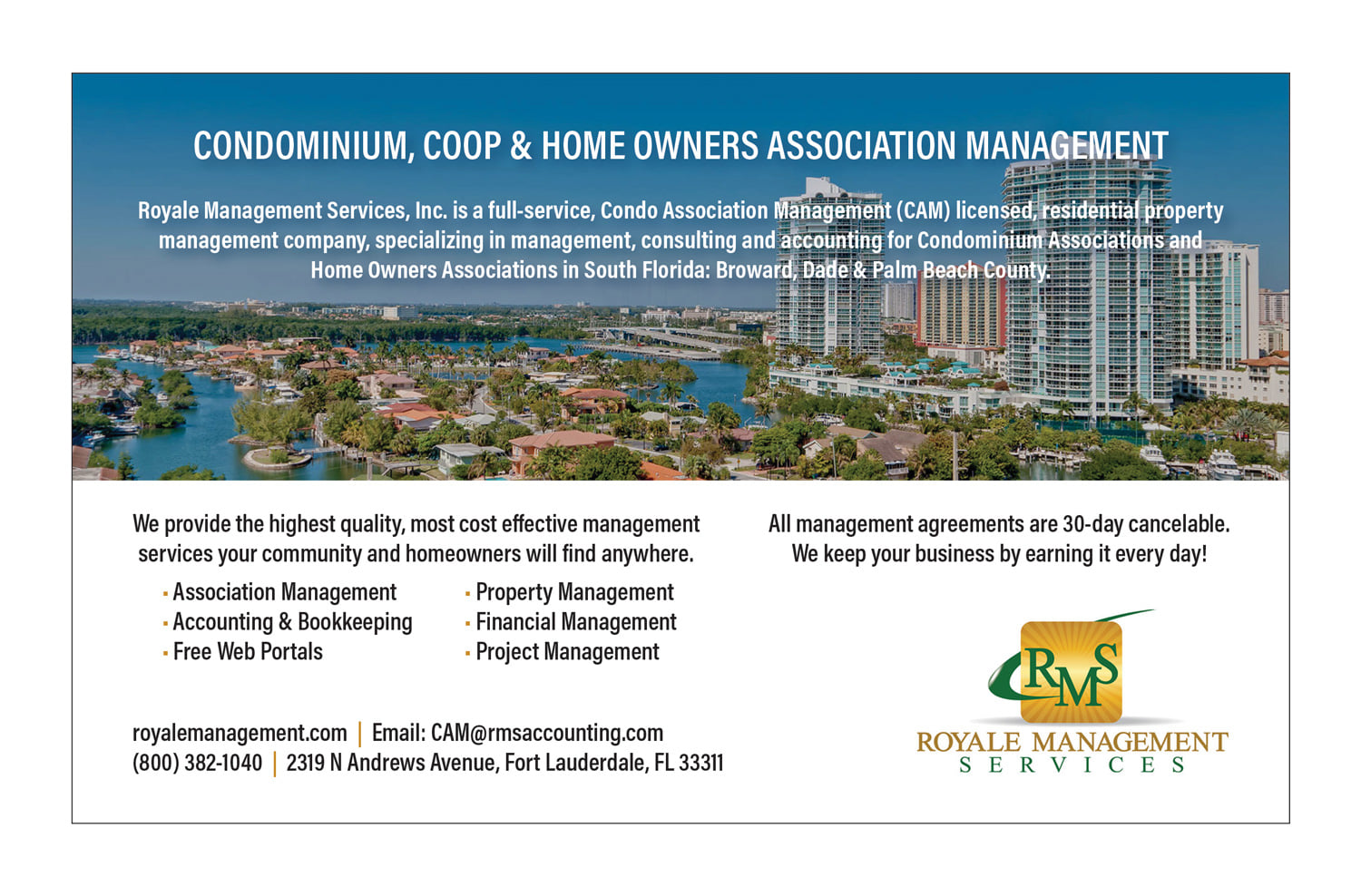
CONDOMINIUM, COOP & HOME OWNERS ASSOCIATION MANAGEMENT

Royale Management Services, Inc. is a full-service, Condo Association Management (CAM) licensed, residential property management company, specializing in management, consulting and accounting for Condominium Associations and Home Owners Associations in South Florida: Broward, Dade & Palm Beach County.


We provide the highest quality, most cost effective management services your community and homeowners will find anywhere.

Accounting & Bookkeeping

Financial Management

Property Management

Web Services

Royale Management Services, Inc., exists to meet the needs of association owners, board members, and officers by providing, with the highest quality and integrity, association management, accounting and financial services, while controlling costs and making each community a better place for every owner.

We offer unprecedented access and transparency to the owners, board members and officers of each community we serve. Association records are open and available 24 hours a day, 365 days a year for inspection via our secure web portal. These records include all check, invoices, contracts, receivables, deposits, payments and correspondence.  Our revenue comes from management fees and disclosed charges included in our management agreement. We do not provide or perform services through related companies or divisions that add additional margins and profits to our bottom line. We maintain no preferred contractor lists based on any form of revenue sharing or other fees and associations and their boards are free to use existing contractors or others outside service.

We aim for and reach superior, measurable standards of quality with every service we provide. We serve only local associations (Broward County) where owners, board members, and officers can have access to all our professional staff and where we can be sure that all activities are supervised by our senior staff.

Our clients will regard us not only as a national leader in the world of association management and financial problem solving but also as a trusted friend and ally; as a partner in the pursuit of their community goals and objectives.

The Royale Management Services name will be synonymous with superior service-superior not only in quality and quantity but also in spirit. Mere adequacy of quality and quantity of service is not sufficient to satisfy the commitment we have made to our clients. In fact, it’s the spirit in which we deliver our service that makes us unique. In a large part, it is the spirit which accounts for the Royale Management Services difference.


Tags: , ,
We Are Thankful For YOU – We are grateful for our dedicated colleagues, vendor partners, and loyal clients who have a passion for preserving aquatic resources.

We Are Thankful For YOU – We are grateful for our dedicated colleagues, vendor partners, and loyal clients who have a passion for preserving aquatic resources.

  • Posted: Nov 24, 2021
  • By:
  • Comments: Comments Off on We Are Thankful For YOU – We are grateful for our dedicated colleagues, vendor partners, and loyal clients who have a passion for preserving aquatic resources.

We Are Thankful For YOU

We are grateful for our dedicated colleagues, vendor partners, and loyal clients who have a passion for preserving aquatic resources.

As Thanksgiving approaches, we’d like to thank you for your ongoing support. Because of you, we get to enhance and preserve lakes and ponds across the country while also making positive impacts in our local communities through The SOLution. We hope you have a safe and joyful Thanksgiving with your loved ones!

https://www.youtube.com/watch?v=Rjgdc8s7FFU&t=1s

Our offices will be closed on the following dates:

Thursday, Nov. 25 &
Friday, Nov. 26

Thanksgiving Holiday

Friday, Dec. 24 & Monday, Dec. 27

Christmas Holiday

Monday, Jan. 3

New Year’s Day (observed)

During this time, contact us here or leave a message at 888-480-LAKE (5253).

Tags: ,
Webinar: Why You Need Good Governing Documents by Becker Lawyers

Webinar: Why You Need Good Governing Documents by Becker Lawyers

  • Posted: Nov 24, 2021
  • By:
  • Comments: Comments Off on Webinar: Why You Need Good Governing Documents by Becker Lawyers

Webinar: Why You Need Good Governing Documents

Learn why it’s important for condo and community associations to have “good governing documents” and how that is the starting point for effective enforcement. Some of the topics covered will include:

  • Maintenance Responsibilities
  • Conflicts within governing documents and with the statutes
  • Sale and Lease Restrictions
  • Material Alterations


————————-

SPEAKERS:

Joseph Adams
SHAREHOLDER
Becker
jadams@beckerlawyers.com

Kevin L. Edwards
SHAREHOLDER
Becker
kedwards@beckerlawyers.com


Tags: