
Become our Member : JOIN SFPMA TODAY   LogIn / Register: LOGIN/REGISTER

SFPMA Industry Articles | news, legal updates, events & education! 

Find Blog Articles for Florida’s Condo, HOA and the Management Industry. 

Community Association Collections 101: What Happens When An Owner Files For Bankruptcy? by Axela’s / Mitch Drimmer

Community Association Collections 101: What Happens When An Owner Files For Bankruptcy? by Axela’s / Mitch Drimmer

  • Posted: Dec 10, 2021
  • By:
  • Comments: Comments Off on Community Association Collections 101: What Happens When An Owner Files For Bankruptcy? by Axela’s / Mitch Drimmer

It seems as if bankruptcy will be the next big subject, this article is a step by step process for community associations

Community Association Collections 101:

What Happens When An Owner Files For Bankruptcy?

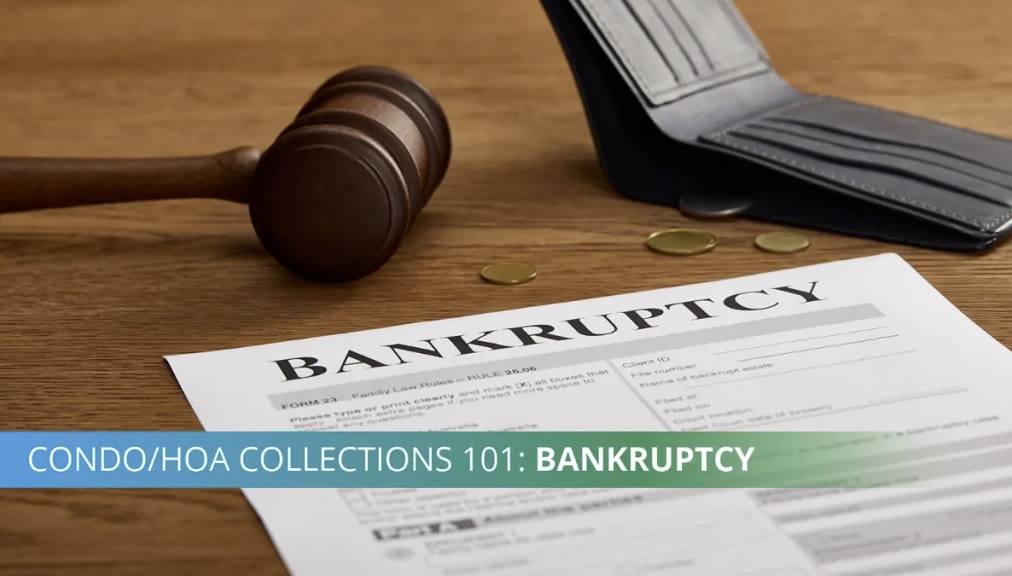
Bankruptcy NoticeThe collections process isn’t a fun one, and depending on what causes delinquency, it can get complicated. A homeowner who falls behind on just their association payments is one thing, but someone who’s so behind on all of their financials that they have to declare bankruptcy is a very different story. We’re asked all the time about what happens when a condo or HOA has to deal with homeowner bankruptcy. If your association is dealing with a bankrupt homeowner who is not paying their post-bankruptcy amounts, there are decisions to be made and steps that can be taken. Let’s review what must happen and how the community association can best navigate this situation.


Two LedgersWhat Happens When Bankruptcy is Filed?

Filing for bankruptcy isn’t a quick process. When a person, known as the “petitioner,” files for bankruptcy, they must file a list of their creditors with the bankruptcy court (which is a federal court). The creditors will be noticed with a “bankruptcy notification” and will be given a time frame by which to respond, usually under two months. Government claims can be submitted up to six months after the petition date (it’s good to be the government.)

There is no requirement that the response (or proof of claim) from the creditor must be submitted to the court via an attorney, which is good for you–the less an association is required to spend on costly attorney fees, the better. This proof of claim can be submitted by the association directly, the management company, or by a collections partner like Axela. Just be sure that everything that is legally owed to the association is included on that proof of claim–this should include assessments, late fees, late interest, fines and violations, special assessments, and any other sundry items that have been charged to the property. Be sure to double-check the ledger because it is expensive to get a second bite at that apple if you find you want to amend your claim with the court.

From there, the bankruptcy court will hold a “341 meeting,” which is a meeting between the debtor and the creditors but it is not mandatory for any creditor to attend. Then comes the really complicated part.


Types of Bankruptcy

It is important to know what type of homeowner bankruptcy you are dealing with as this knowledge will direct your business decisions going forward. When a property goes bankrupt in a community association, the community needs to prepare two ledgers: a pre-petition ledger and a post-petition ledger. You cannot add the post-petition amounts to the bankruptcy claim because next month’s bills are not this month’s debts. Regardless of which kind of bankruptcy they have filed, the petitioner has an obligation to pay the post-petition amounts during the bankruptcy. If the delinquent owner is NOT paying their post-petition debts, the association needs to make a decision and take action immediately, and the type of bankruptcy will determine which steps to take


Chapter 7

Complete wipeoutChapter 7 bankruptcy, also known as “no-asset” bankruptcy, is a complete wipeout. This means that no money will be recovered from the pre-petition amounts.  A Chapter 7 bankruptcy case can take as little as six months to complete because there is no settlement to be made. Creditors can claim to the court that there are assets being hidden but, in most cases, it is all over fairly quickly. If the delinquent owner is not paying the post-petition amounts, then the association can wait until the case is discharged and then move forward with collections activity. If the owner has been paying their post-petition amounts, then the issue is resolved albeit the association has taken a hit.


Chapter 13

Wage Earner;s PlanChapter 13 bankruptcy is known as a “wage earners plan” and is a workout where the court will make a settlement and oversee it until the payment plan has been completed. This is when the association needs to make a business decision.

In a Chapter 13 bankruptcy case, the pre-petition debts will not be discharged for 3-5 years, and the petitioner remains in bankruptcy. If they are not paying the post-petition amounts, the association cannot submit the delinquency for collections or to an attorney for foreclosure. The only course of action is for the association to ask the court for an “injunctive stay of relief” which is essentially asking the court to allow the association to move forward with collections and or foreclosure efforts.


So What Needs to Be Done?

If a unit owner files for Chapter 13 bankruptcy and is not paying their current assessments, it is not a stretch to believe that most likely they will never pay. It is unfair that the association needs to wait three to five years until the pre-petition debts are paid, the delinquent owner is discharged from bankruptcy, and the association can finally move forward. As we mentioned above, if a delinquent owner has filed for Chapter 13 bankruptcy and is not paying their current assessments, the association should file with the court a motion for injunctive relief. During the gap period, section 1519(a) of the Bankruptcy Code states that a bankruptcy court has the power to grant provisional injunctive relief and certain other forms of relief where “relief is urgently needed to protect the assets of the debtor or the interests of the creditors.” Additionally, an order staying execution against the debtor can also be granted. If a property owner is not paying their assessments, then the case can be made that a stay order is required to protect the assets (the property).


How to Handle Homeowner Bankruptcy in Your Association

The same way you’d handle any other bankruptcy situation in your association: call a professional. Homeowner bankruptcy in your association can be managed and worked through, but it takes a lot of knowledge and a lot of time. Many times, when a management company or a board of directors is reviewing delinquencies, the units that are delinquent and are also in bankruptcy get glossed over. There is a feeling that once a delinquent owner files for bankruptcy, the association has no options other than to wait until the bankruptcy is discharged. This is not the case as there are options and every case is unique. Axela Technologies has the experience, knowledge, and experience to deal with all these contingencies. Call us today for a no-cost, no-obligation analysis, and review of your delinquencies.


About the Author

Mitch Drimmer is a respected thought leader in his field and has led numerous continuing education classes in collections, His articles have been published in key trade journals and newspapers, and he is a speaker at educational seminars.

As the President of Business Development for Axela Technologies, Drimmer works with community associations and their management companies to introduce innovative strategies to collect delinquent maintenance fees.

Throughout his career, Drimmer has worked with community associations to help them see their way through tough times, especially during the real estate crash. He is a passionate advocate for community associations and has participated in the legislative process over the years trying to bring fair and equitable legislation that serves community associations.

Drimmer earned a Bachelor of Arts in History from Hunter College in New York City, and has worked in the community association collections space since 2007.


 

Tags: , ,
Traditional Collection Methods Versus the HOA Business Model

Traditional Collection Methods Versus the HOA Business Model

  • Posted: Nov 04, 2021
  • By:
  • Comments: Comments Off on Traditional Collection Methods Versus the HOA Business Model

Traditional Collection Methods Versus the HOA Business Model

The Collections Conundrum

Human interaction is the foundation of a good business, that’s a pretty standard assessment. But that interaction gets complicated in a business like a community association. It can be a very muddy concept–homeowners buy a house that comes with a way to try to guarantee property values for a marginal fee, but it isn’t always clear that this agreement makes them part of a larger business model. This complicated relationship can make difficult business practices, like debt collection, all the more painful.

Fabio Ades, owner of PMI Top Florida Properties, who manages Serenity Place IV Condominium, found Axela’s post-foreclosure process to be the key to uncomplicating this unique business relationship, and softening the blow of debt collection.

“Implementing Axela was seamless for my management team because it connected with our existing accounting system. The way Axela’s systems are set up just made things easier for us,” says Ades. “But more importantly, Axela helps our customers. Consistent collections keep up the health of the community and protect members’ assets.”

Traditional Collections in an Untraditional Business Model

Collections are traditionally a process regarded as heartless. It calls to mind thoughts of unending phone calls from aggressive debt collectors armed with threats of asset repossession and loss of livelihood. It creates a general feeling of uneasiness in just about everyone. Unlike other business collections processes, that lack of ease is typically felt on both sides of the table when it comes to collections in a community association.

“It’s hard for people to remember that it’s not Fabio calling to collect–it’s not the Community Association Manager. It’s not the Board Treasurer who’s the bad guy, we’re not the bad guys,” Ades said.

Unfortunately, that’s what homeowners see. They see the person they’ve made friends with, they see their neighbor, the grill master who lives two doors down, or the dog walker on the third floor. They’re being asked by friendly faces for money they’re struggling to make, and those friends and neighbors are just as unhappy to be doing the asking.

But that’s the job. And that job is made a lot harder with the knowledge that there isn’t a lot of wiggle room when it comes to acting on delinquency.

“Management companies frequently have regulations that make it hard to help homeowners,” Ades lamented.

Community associations have little to no flexibility when it comes time to collect on past due payments from a homeowner. This is often a four-step process:

  1. Send an initial courtesy letter to the owner about the unpaid fees, alerting the homeowner of penalty fines if they remain unpaid
  2. Send a second courtesy letter, again warning of penalty fines for unpaid fees
  3. Send a final courtesy letter requesting payment and warning of pending legal action
  4. Refer the case to an attorney to begin pursuing legal action, at cost to the association

When a lawyer is on a collections case and the bank forecloses, it’s game over. If the property is in a super lien state then the association will recover a pittance of what is owed and the attorney will advise the association to “write off” the balance. Also, the attorney will advise the association that they owe him/her for legal services.

All of this happens over the course of 60 to 90 days. For a homeowner struggling to make payments, that time flies by and often isn’t enough to get current on the account.


Tags:
The Mystery of the Missing Minutes: How Community Association Document Retention Protects Against Liability

The Mystery of the Missing Minutes: How Community Association Document Retention Protects Against Liability

  • Posted: Sep 23, 2021
  • By:
  • Comments: Comments Off on The Mystery of the Missing Minutes: How Community Association Document Retention Protects Against Liability

The Mystery of the Missing Minutes: How Community Association Document Retention Protects Against Liability

Who Voted for What and When…Where Did the Minutes go?

Here is a cautionary tale: Your board of directors voted for a big capital improvement project along with a special assessment. Like a well-governed association, they memorialized the motion and the vote from the meeting in the minutes. With that project, the association needs to make a special assessment because the reserves were not funded well. A few owners are not happy about the special assessment and retained a lawyer to strike it down.

Years go by before it makes it to court and in discovery, the plaintiffs request the minutes as proof that the board did their fiduciary duty when making the decision. Except, after all this time has passed, the association has changed management companies and the minutes are nowhere to be found. Nobody remembers anything: some old board members have moved on; the management companies did not keep your minutes or did not turn them over to the new management company.

Now all the association can do is pay the attorneys (a big waste of money) and start all over again. This is how, without a community association document retention policy in place, a simple capital improvement project which may have cost $50,000.00 is overshadowed by a massive and unnecessary loss of resources for your community association.

HOA Document Retention

Safeguarding Your Documents Protects You from Liability

Boards may change over time, but the safekeeping of all records does not. When a new board is elected, it is the obligation of the outgoing board to return or hand over all community records — most important of all the minutes of all their meetings. If a new management company is hired, they must obtain all the documentation and records from the previous management company. Unfortunately, it’s often a futile task, and you might as well be looking for your documents in the Bermuda Triangle.

Most state laws require that community associations keep records for five to seven years (depending on the state). If there are no statutes regarding document retention, common sense tells you that they should be retained and accessible.

A simple test to know if your community is protected

If you are a board member or an owner, ask your management company to produce records of minutes from a meeting five years ago. Ask them for the budgets for the last three years. This should not be a difficult request. This is a simple test that can be conducted by diligent board members to ensure your record-keeping obligations are being met. If they cannot find the last three years’ budgets, you have a very big problem.

Community associations are required to retain a large number of records, many more than any individual director is accustomed to in their personal lives. So naturally, the task falls on the management company. Failure can have various negative effects, particularly, as in the example above, when the association gets sued.

Improper Documentation can Lead to an Inability to Collect on Delinquencies

Here’s another example: What if a board has decided to put Mister Delinquent into collections for non-payment of assessments for the past three years (don’t be surprised, some boards will wait before moving on an issue like this). Your collection agency asks for the budgets and minutes of budget meetings to verify the debt and they are nowhere to be found. I think you can guess how this pans out. Without the budget minutes and other documents required to put a budget into play, from a legal point of view, there is no debt to collect.

Condo Association Document Retention

In the midst of chaos, You need a source of truth

Let’s face the facts and understand that community associations are volatile environments and quite dynamic. Boards of Directors change, emotions run high, management companies are dismissed frequently, as are attorneys, vendors, and whoever else gets an opportunity to work for an association. Sometimes by accident (and sometimes by design) disgruntled board members, dismissed employees (managers), or untrained office staff may feel that the round file (garbage can) is for everything that is over a year old.

The minutes are the history of all board actions and decisions and losing them is like losing your medical records…It’s unhealthy for your community’s future. Yet many associations continue to work the same way they did in 1961 and everything is committed to paper. In essence, your so-called paper trail has fallen into a deep dark abyss never to be found again.

These days you can have virtual meetings so why not digitize the minutes and keep them safe? It costs very little to set up a cloud drive for the community to store valuable documents. Association servers or cloud-based document retention services should be filled with documents and files to protect the community from liability. Time marches on and technology continues to advance: don’t let your association be left behind.

Community Association Document Retention

The solution? A Community Association Document Retention Policy

So now that a potential problem has been identified, what are the possible solutions?  First and foremost, as mentioned above, the board of directors must establish a record-keeping policy and protocol which involves voting on it and memorializing this in the minutes. Don’t lose those minutes and approve them at the next meeting. Said policy should identify all the records that an association must keep and for how long.

Figuring where to start when writing your community association document retention policy should be easy since most states, already require retention of certain documents. In addition to the documents required by the state, be sure to include any documents that support and protect the interests of the community association’s business. Because, make no mistake, helping to prevent future costly lawsuits and legal defense funds is certainly in the community’s best interest.

Community Association document retention isn’t just for minutes. Whether your state requires it or not, it behooves your board to hold on to certain items that may be needed in a future lawsuit. Those include:

  • governing documents
  • insurance policies
  • vendor contracts
  • accounting ledgers
  • audit reports
  • reserve/engineering studies
  • warranties
  • proof of meeting notices
  • all meeting minutes (public and private)
  • collection policies & payment plan agreements
  • proof of mailings
  • any other processes that can be documented or may be disputed in the future
Document Retention 4

Lock it Down… For the Future

Sloppy or lackadaisical record keeping can have disastrous effects on community associations. It is the responsibility of BOTH the boards of directors and the management companies to ensure that the community is protected from liability. The best way to do that is to lock down everything and store your important documents in the cloud.

If you have been planning to move your records to the cloud “someday” consider today that day. This is a project worth getting to work on right away because bad things can happen in the wink of an eye. Your first, and sometimes only defense against problems in the future, is documenting everything today.

If you want to learn more about community association governance please contact us for a free no obligation collections analysis and we will be glad to speak to you about all other matters that you may have questions about.

Tags: , ,
Why Is Your Community Association Still Using a Lawyer for HOA Collections?

Why Is Your Community Association Still Using a Lawyer for HOA Collections?

  • Posted: Sep 21, 2021
  • By:
  • Comments: Comments Off on Why Is Your Community Association Still Using a Lawyer for HOA Collections?

Why Is Your Community Association Still Using a Lawyer for HOA Collections?

Axela Technologies / Bob Gourley

Condos and HOAs Still Paying Outrageous Legal Fees for Collections

If your condominium or homeowners’ association is facing a purely legal issue – a lawsuit, construction defect, governing documents updates, and such, having an experienced and qualified community association attorney is mandatory. But should you contact your lawyer for HOA collections?

Community associations are creatures of statute and attorneys are important to maintain proper governance. These experienced legal professionals deliver the expertise and legal finesse the community association will need to stay compliant with state statutes and their own bylaws. This avoids missteps and potential future lawsuits brought on by inappropriate actions.

Since attorney fees are generally significant, condominium associations and HOA boards should be judicious when engaging an attorney as it will cost the association a good bit of money. With that in mind, there are times when the cost and risk of using an attorney are wisely avoided.

Legal Fees 1

Don’t Just Skip Ahead to Foreclosure

When home and unit owners in condominiums and HOAs fall behind in their common fees and assessments, it can feel like very few options are available to collect on those missed payments. Communities generally turn to the usual suspects — an endless string of reminders and warning letters requesting payment, or referring the delinquent owner to a lawyer for HOA collections. But those are actually steps 1 and 3 (the warning and the foreclosure) of the full collections process. Step 2 is your opportunity to recover those debts without expending any additional energy or paying outrageous fees to an attorney on retainer: a collections solution, rather than legal enforcement.

A community association foreclosure should always be a last resort. It’s like fishing with a shotgun–sometimes it’ll get the job done, but it’s more costly, less efficient, and you don’t gain as much as you could with other collection methods. Wise associations seek a non-attorney remedy.

When you retain an attorney for collections, the end game of the attorney is foreclosure on the property. This isn’t collections, but rather “a security interest enforcement” action. In the Supreme Court case, Obduskey v. McCarthy & Holthus LLP, 139 S. Ct. 1029 (2019), the court ruled that in states that use non-judicial foreclosures, law firms are subject only to the requirements and prohibitions of one narrow section (1692f(6)) of the FDCPA.  In essence, the United States Supreme Court is advising community associations that attorneys foreclosing in non-judicial states are by no means a “collections entity.” More to the point, it’s expensive and can take years before the association sees a dime of what they’re owed, leaving communities in a lurch for funds.

Legal Fees 2

So you Foreclosed… Now What?

Let’s say you followed the legal process to its desired conclusion of foreclosure. The previous owner (as in many cases) becomes overwhelmed with the costs of legal fees and they lose their property.

The best result for a community association lien foreclosure on a property is getting an encumbered title. That means that the association takes the title, but the title is encumbered by the mortgage, which is still attached. The first mortgage can still be foreclosed upon and it will be eventually, at which time the community will lose access to that title.

…But what happens after the community takes the title? How do you monetize an association lien/foreclosure? Perhaps an investor will pick it up and now your community becomes a plaything of real estate investors. Or perhaps the association will rehabilitate the property and rent it out to recover delinquent fees and costs. Does the community association really want to get into the business of managing rentals? That’s a lot of work and liability to take on!

It’s a shame on many levels.

Legal Fees 3

The Burden of Legal Fees on Homeowners

Take a look at this example of fees charged to one delinquent homeowner:

attny fees

This is a real-world example. A condominium unit owner had fallen behind in their common fees in the amount of $1,830.00. The Board of Directors referred the matter to their attorney. As you can see, the legal fees mounted quickly, and by the time of this invoice, the association has already laid out $17,193.68 in legal fees due to the attorney. Even worse, these fees were going to be assessed to the delinquent unit owner by the association.

The total owed by the homeowner was now nearly 10 times what was owed to the association! This is completely unfair and unnecessary.

The final insult to the community is that this case is yet to be concluded and the delinquent unit owner may never be able to afford to pay for this issue, leaving the owner homeless, and the community on the hook for the legal fees. It does not have to be this way.

Legal Fees 4

The Argument for Ethical Collections

We wish we could say that is the only example of homeowner debt spiraling out of control, but it isn’t. In the community association management industry, it’s heartbreakingly common to hear of homeowners who ultimately lose their homes through foreclosure. Enormous legal fees amassed during long, drawn-out legal processes take away any chance of paying back what they owe. It can ruin lives and is why we at Axela always insist that foreclosure be viewed as a last resort.

A specialized collections process is a far simpler, cost-effective, and humane solution to attempt before considering going through a lawyer for HOA collections. From coast to coast, we hear similar stories where a collection process would have allowed the owner to remain in their home, and just as important, the association wouldn’t have had to pay an attorney only to have to “write off” the loss when no collection event occurred.

Some associations engage collection agencies that offer to buy the association’s debt, but those are also ripe for abuse of the homeowners. Collection agencies that perform at no cost or risk to the association like Axela Technologies are a preferred collection remedy because they are an effective solution that follows the collection regulations set forth in the community’s governing documents and costs the association nothing. Collection fees, which are quite modest compared to attorney fees, are passed through to the delinquent homeowner. This benefits the association as well as the delinquent homeowner because of the huge discrepancy between collection fees and legal fees charged by an attorney.

Legal Fees 5

Choose a Merit-Based Collections Agency

Axela Technologies offers a far better solution. Instead of burying the homeowner in tremendous legal fees, we work with them to figure out how best to pay off their indebtedness to their association and return them to good-paying status. Instead of charging by the hour for our work, as attorneys do, our fees are set at the onset (hard set fees with no hidden or junk fees) and passed through to the delinquent homeowner. We work diligently to explain the benefit of keeping the equity in their home and provide a solution to their problem. There is no need to put the association or the homeowner at risk of losing additional money.

In fact, since the Axela Technologies collection solution is 100% merit-based, our interests are perfectly aligned with the association. If we don’t collect from the homeowner, we don’t get paid. We collect 100% of what is owed to the association 19 out of 20 times without the need for the association to move the matter to an attorney for foreclosure.

Even when the matter does go to foreclosure, we stand with the association until the conclusion, which often yields a successful collection event for the association. If a lender forecloses on a unit we will not advise the association to write off the loss. We will follow the ownership of that unit and if the bank sells it with a surplus we will petition the court for the benefit of the association to recover that surplus. We don’t like write-offs and neither should you.

If your association gets sued, or if you need to change the language in your bylaws, you should absolutely be consulting with or employing an attorney. But, if your association is experiencing delinquency at any level, don’t get a lawyer for HOA collections. Skip the high legal fees and partner with Axela Technologies. Get in touch today and learn how Axela Technologies can help. Axela Technologies handles all collections on a merit-based system. Get your free collections analysis today.


Tags: , , ,
Homesteading and the Homestead Exemption: 3 Things to Know for Your HOA by Mitch Drimmer

Homesteading and the Homestead Exemption: 3 Things to Know for Your HOA by Mitch Drimmer

  • Posted: Sep 08, 2021
  • By:
  • Comments: Comments Off on Homesteading and the Homestead Exemption: 3 Things to Know for Your HOA by Mitch Drimmer

‘Homestead’ (or perhaps ‘homesteading’) is a word you’ve probably heard, but aren’t clear on what it is or means. So when we talk about homestead exemptions for housing, there can be some confusion. A “homestead” is defined as a house, or more specifically a farmhouse, and “homesteading” is defined as, “a lifestyle of self-sufficiency.” Homestead law allows an individual to register a portion of their primary residence (and only their primary residence) as “homestead” to reduce the taxes paid on it. The original goal was to preserve the family farm, home, or other assets in the face of severe economic conditions. See how it all connects?

Homestead exemptions exclude a portion of a home’s value from taxation

Homestead Law Today

Homestead exemptions exclude a portion of a home’s value from taxation, so they lower the taxes. For example, if a home is appraised at $100,000, and the owner qualifies for a $25,000 exemption (this is the amount mandated for school districts), they will pay school taxes on the home as if it was worth only $75,000. It also makes that portion of the individual’s estate off-limits to most creditors and protects that value from financial situations that arise due to the death of the homeowner’s spouse (to guarantee that the surviving spouse has shelter).

Now the real disconnect between the homestead exemption and homestead/homesteading is that the only requirement needed to get a homestead exemption is that the home is the owner’s primary residence–no farming necessary.

A homeowner doesn't have to have a farm to take advantage of the Homestead law

What Does This Mean For HOA Collections?

Homestead, homestead exemptions, and homesteading are all a little confusing. So at some point, you start to wonder how the exemption might impact your community funds or a future collections process. Here’s what you should know:

HOAs and Condo Associations Can Still Collect

Luckily, there are some exceptions to the homestead exemption: taxing authorities (state and federal), mortgage lenders, and the community association where the property is located (that’s you!) all have the ability to foreclose and collect if payments are missed.

So if one of your homeowners is behind on their assessment fees and all efforts to collect the debt have failed and the next step for your community is to foreclose, even if they have a homestead exemption, your community association is legally one of the only entities able to go to foreclosure.

Homesteading Not Required

Even though “homestead,” “homestead exemption,” and “homesteading” all call back to farming in some way, the homeowner doesn’t have to have a farm, product, or any other traditional ‘homestead’ good or service to take advantage of the homestead law–they just have to own the property it’s being applied to.

That said, there has been a massive resurgence of homesteading in the millennial generation–sort of. Thousands of influencers across social media document their zero-waste lives that use composting, in-home gardening, and reusable items (like fabric grocery bags, beeswax wrappings, and mason jars) to show that they can successfully and beautifully live off of only what they sustain and grow. Some even make their own products to sell like all-natural candles or deodorants.

The Homestead Exemption is Not a Homesteading Hall Pass

Depending on the location and size of your community, you may have a few homesteading homeowners yourself. Maybe they’re growing fresh habaneros and cilantro in their garden for homemade salsa, or knitting sweaters out of thread they made from their pet cat Fluffy’s fur (yes that’s a real thing–a real weird thing in my opinion but to each their own).

Whatever they’re doing, they still have to follow the HOA or condo association’s community guidelines. A homestead exemption does not give any homeowner the right to ignore community rules, even if those rules might clash with their new homesteading lifestyle. If they want to raise chickens to have fresh eggs in the morning and so they don’t have to go out and buy eggs from the grocery store, more power to them, but they probably can’t do it in an HOA, and they definitely can’t have chickens in a condo building.

Homestead exemptions may vary widely from state to state

Foreclosing in a Homestead State

It’s important to know that the homestead exemption varies widely between each state. Some states like New Jersey don’t even have the exemption at all. So for some HOA or condo associations, foreclosing on a home with a homestead exemption might ever happen. If it does happen in your community, remember that the community association has every right to foreclose and collect on a property even if it has a homestead exemption, but working with a specialized collection agency will help make the process that much smoother.

What you need is a specialized community association collection agency that will work with your owners and recover the past due amounts at no cost and no risk to the association. Give Axela Technologies a call today and receive a no-cost analysis and review of a collections process that will fit your community association delinquency problem.

Tags: , ,
Is your community association indemnified from legal action resulting from collection activities? Don’t Get Sued, Get Axela!

Is your community association indemnified from legal action resulting from collection activities? Don’t Get Sued, Get Axela!

  • Posted: Jul 20, 2021
  • By:
  • Comments: Comments Off on Is your community association indemnified from legal action resulting from collection activities? Don’t Get Sued, Get Axela!

Don’t Get Sued, Get Axela!

HOAs, Condominium Associations, Cooperatives, and other community associations are regularly adjusting how they do business based on new laws and updates to existing statutes that supersede their own governing documents. Lately, a barrage of new legislation has taken direct aim at how community associations handle the collection of delinquent fees from home and unit owners who have fallen behind on their fees and assessments. Failure to follow these laws can put an association, its management company, and even its attorney in danger of being sued.

nosue get axela 2

Legal Requirements

Axela Technologies has long been the leader in providing indemnification for HOAs, condominium associations, cooperatives and community association management firms by offering fully compliant third-party debt and delinquency collection services. We pride ourselves on keeping our business practices compliant with your state collection laws and are vigilant on newly passed legislation.

California’s Davis-Stirling Act, for example, outlines the “do’s and don’ts” for associations seeking to collect the fees that are owed to them from delinquent homeowners. Appropriately, each year the legislature has amended, revised and added numerous provisions of the Act. Requiring associations  to be aware of the latest requirements in order for the association to proceed with collection of delinquent assessments.

Now Florida has revised their own laws for collecting delinquent assessments, adding additional protections for homeowners that all condominium associations, HOAs, and association management firms must adhere to on top of all their existing workload.

nosue get axela 1

New Florida Laws

Among the most important changes in Florida law is Senate Bill 56: Community Association Assessment Notices (“SB 56”). The waiting period before notices can be sent to delinquent home or unit owners has been extended. HOAs already had to wait 45 days before notices that a lien was being sought against the debtor’s property could be sent. Additionally, a similar waiting period is needed for the post-lien notice of intent to foreclose.

Put simply, the new notice requirements will establish a 120-day period of collection efforts that associations must incur before proceeding with a foreclosure action. There will now be a mandatory 30-day courtesy notice of late assessment, a 45-day notice of intent to record a claim of lien, and a 45-day notice of intent to foreclose on that claim of lien. These changes take effect on July 1, 2021.

nosue get axela 3

The Attorneys’ Function

The largest portion of the remaining legislative changes refer specifically to the work performed by attorneys on behalf of the associations they represent. While attorneys are sometimes needed for filing liens and enforcing the security interests of the associations they represent, it is almost always a far better decision to engage with a third-party debt collection service to properly service both the association and the delinquent home or unit owner prior to getting an attorney involved. Axela complies with all state laws in every state that it services and fully indemnifies the association and assures full compliance with state and federal law as well as the individual association’s own governing documents.

Is your HOA, condominium association, cooperative, or association management firm struggling to keep up with the latest legislation and indemnification while simply trying to collect the money it is owed from delinquent home or unit owners? Even the simplest collection task can come under legal scrutiny. With our “no cost or risk to the association” assurance, engaging Axela Technologies for your delinquency collection needs may be one of the easiest business decisions you’ll make in this litigious environment. Get in touch today and let us show you how we can collect your money without putting your association or association management business at risk of violating the law.


Tags: , ,
Beware of Predatory HOA Collection ‘Solutions’

Beware of Predatory HOA Collection ‘Solutions’

  • Posted: Jul 08, 2021
  • By:
  • Comments: Comments Off on Beware of Predatory HOA Collection ‘Solutions’

Foreclosure Does Not Equal Fund Recovery

Every association should have an attorney who is charged with overseeing any legal work that arises. But is collections included in that ‘legal work’?

Attorneys continue to be the de-facto solution for collecting past due assessments, but this is only a viable option when an association has the unlikely goal of foreclosing and owning the homes of delinquent owners. Any association that seeks to recover money due to them while helping a homeowner back to financial stability should look for alternatives to the legal process to achieve that goal.

Attorneys do not do collections. It’s that simple. When an attorney is engaged to do collections work, their plan of action involves filing a lien and foreclosing on a home. During the process, they might see some successful collection events as a result of their actions. Attorneys seldom make outbound calls and do not provide owners with online tools to cure the delinquency.

Collection attorneys are inherently disincentivized to collect on the account. Why? Because their revenue is generated from fees that get charged throughout the process. The quicker they resolve a collections file, the fewer fees will be earned on the account.

Unfortunately, collection files are commonly referred to attorneys because it is the most convenient and familiar solution for an association. This widely accepted practice is extremely disadvantageous to associations and does not put money in the association’s bank account, which is the objective of collections efforts. In fact, associations are often on the hook for legal fees, regardless of the outcome, further increasing the burden and risk caused by the delinquent account.

Predatory HOA Collection 2

Predatory HOA Collection ‘Solutions’ Cause More Harm than Good

Given the growing size and scope of the community association industry, a handful of specialized service providers have appeared to provide collections and/or financing solutions. In non-judicial states, such as California, the foreclosure process does not require legal action, meaning non-attorney firms can handle the task. Much like attorneys, these companies have a fee schedule that highly incentivizes them to push for foreclosure proceedings as quickly as possible.

The longer a file stays delinquent, the further along the process it goes, ultimately ending in foreclosure which generates the most fees for the firm. Again, many of these actions are directly at odds with the desire of the association, which is to recover the money that is due to them, as quickly as possible.

During the last real estate meltdown, a handful of specialized finance companies introduced what was then hailed as an innovative solution designed to mitigate the damage caused by delinquencies. By buying or funding delinquent receivables, these companies promised a much-needed injection of capital to struggling associations. Unfortunately, because they charged exorbitant fees, small debts by delinquent owners would quickly balloon into enormous obligations that made it almost impossible for an owner to catch up.

Given the statutory applications of payments in many states, proceeds were first applied toward the fees charged by the finance companies; associations would often not receive any of the proceeds from successful collection events. This so-called ‘solution’ soon turned from an association lifesaver to an association’s nightmare.

Ultimately, this scheme has proven to be an unfavorable option for community associations.

Predatory 3 1

An HOA Collection Solution that Focuses on Recovering the Association’s Money

While there are a number of legal or alternative solutions that community managers have relied on in the past to enforce assessment collections, there is little evidence that these antiquated and/or predatory approaches will work to cure delinquencies in the future. Associations today can turn to specialized collection firms that effectively recover funds due to them, without facing the consequences of foreclosing.

Today’s owners face a different dynamic, as an overwhelming majority have equity in their homes, which they will not want to risk losing. For this reason, the best solution is one that incentivizes a quick resolution without burying the association and the owner in unnecessary fees.

Thanks to the introduction of credit reporting capabilities, an owner’s obligations to their association will be placed on the same level of importance as their credit cards, car payments, and mortgages. It is now a viable option to work with collection agencies in lieu of foreclosing and putting people out of their homes, which is the wrong path to take from both the financial and human sides of the equation.

These are times when a community can engage professionals to work out a reasonable means to get these owners back on track and up to date on their obligations. This is not the time to spend good money to foreclose on families and remove them from their residences.

Associations and management companies that embrace technology-based solutions like Axela’s to streamline and improve their collection protocols will find themselves in healthier financial standing and with happier homeowners residing within their communities.


Contact Axela Technologies today to learn how easy it is to implement a technology-based collections solution for your organization.


Tags:
New Requirements for Collection of Delinquent Assessments

New Requirements for Collection of Delinquent Assessments

  • Posted: Jul 07, 2021
  • By:
  • Comments: Comments Off on New Requirements for Collection of Delinquent Assessments

New Requirements for Collection of Delinquent Assessments

Robert Kaye, Managing member of Kaye Bender Rembaum, recently wrote an informative and telling article explaining the new collection procedures mandated to be in effect July 1, as a result of  the 2021 legislation. Every board member, manager, and developer needs to be aware of these important changes.

———————————–

The Florida Legislature has revised the procedures for collecting delinquent assessments, which add additional steps and delays for the owner to pay before legal action can commence and/or attorney’s fees can be recovered. Senate Bill 56 has revised Sections 718.116 and 718.121 for condominiums; 719.108 for cooperatives; and, Section 720.3085 for homeowners’ associations. With these changes, the collection procedures for all of these types of communities will be substantially the same. The new laws are effective July 1, 2021.

Initially, the new provisions have revised the time for the notices sent by the association attorney for condominiums and cooperatives to 45 days for both the pre-lien first letter and the post-lien notice of intent to foreclose. (Homeowners’ associations were already at 45 days).

The most important and significant addition to this statutory change is the addition of a new notice requirement by associations before they may refer a matter to the association attorney for collection and recover the attorney’s fees involved. This written notice is required to be mailed by first class mail to the address of the owner on file with the association. If the address on file is not the unit or parcel address, a copy must be sent there as well. The association is also required to keep in its records a sworn affidavit attesting to the mailing. The new statute contains a form for that notice which is required to be substantially followed.

As the respective statutory provisions now indicate, associations must incur a minimum of 120 days of collection efforts before a foreclosure action can begin, with a total of three (3) separate required statutory notices. This includes the: (i) initial 30 day notice of the intent to refer the matter to the association attorney (for which no attorney’s fees can be charged to the owner); (ii) 45 days for the pre-lien notice period; and, (iii) 45 days for the pre-foreclosure lien period. As such, in order to best protect the interests of the association, it is recommended that the first 30-day notice be sent at the earliest possible date in the association collection process. This will typically be when the governing documents indicate the assessment to be “late”. Careful review of the governing documents by legal counsel should be undertaken to determine whether there is a specific “grace period” indicated in the documents before the assessment is considered late. Once that determination is made, the board should adopt a formal collection policy that incorporates these new statutory requirements, which will also need to be mailed to all owners. A new provision has also been added that begins with “If an association sends out an invoice for assessments. . .” to unit or parcel owners, such notice is to be sent by first class mail or electronic transmission (email) to the respective addresses for the owners that are in the association official records.

Moreover, if the association wishes to change the method of delivery of an invoice, the new Statute creates specific steps that must be followed precisely in order for the change to be effective. Specifically, a written notice must be delivered to the owner not less than 30 days before the change of delivery method will be implemented. The notice must be sent by first class mail to the address on file with the association. If the address on file is not the unit or parcel address, a copy must be sent there as well. In addition to the notice requirement, the owner must “affirmatively acknowledge” his or her understanding of the new delivery method. The written acknowledgment can be sent electronically or by mail, and must be maintained in the Official Records (although it is not available for inspection by other owners). However, without this acknowledgment, the association may not change the method of delivery. The Statute does not presently include a time frame for the owner to provide that acknowledgment or offer any remedy to the association if none is forthcoming. This can be particularly daunting or problematic when the association changes management companies, when the new company’s procedures differ from the prior company.Before the association attorney can commence any collection work for an association, it will be necessary for the association to provide all of the backup documentation of the compliance with each of these new statutory requirements, as well as the information previously required (such as a current account ledger). If any of the documentation is missing with the initial turnover information, there will be delays in the collection process, which can be detrimental to the association operation. It is therefore imperative that these new procedures are fully integrated into the association operation without delay. We recommend that you contact your Association counsel with any questions on the new procedural requirements to ensure compliance.

Jeffrey Rembaum’s, Esq. of Kaye, Bender, Rembaum attorneys at law, legal practice consists of representation of condominium, homeowner, commercial and mobile home park associations, as well as exclusive country club communities and the developers who build them. Mr. Rembaum is a Certified Specialist in Condominium and Planned Development Law. He is the creator of ‘Rembaum’s Association Roundup’, an e-magazine devoted to the education of community association board members, managers, developers and anyone involved with Florida’s community associations.  His column appears monthly in the Florida Community Association Journal. Every year since 2012, Mr. Rembaum has been selected to the Florida Super Lawyers list and was also named Legal Elite by Florida Trends Magazine. He can be reached at 561-241-4462.


Tags: , ,
Fair Collections Everyone In Your Association Can Smile About

Fair Collections Everyone In Your Association Can Smile About

  • Posted: Jun 29, 2021
  • By:
  • Comments: Comments Off on Fair Collections Everyone In Your Association Can Smile About

Fair Collections Everyone In Your Association Can Smile About

When a condominium, cooperative, or HOA homeowner doesn’t pay fees and assessments owed to the condominium association, cooperative, or HOA on time, a problem is created for both the association and the homeowner. Associations are forced to act against the homeowner. Homeowners risk losing their homes. It all seems so unfair, doesn’t it?

At Axela Technologies, we believe “Fair is Fair”

Axela Technologies brings order to the chaos and a solution to the problem. Condominium Associations, Cooperatives, and HOAs can count on Axela Technologies to deal fairly with the debtor and assist them in getting caught up with their delinquent fees and assessments. Homeowners have a far better shot of getting themselves back in good financial standing without suffering the consequences of severe legal bills and expenses created when the matter is referred to an attorney.

Axela Technologies is a full-service debt collection agency using modern technology to solve an age-old problem. When home or unit owners stop paying their fees in a timely fashion, the whole association suffers. That just isn’t fair to all of the other homeowners who do pay on time!

Happycollections 1 1

The Unspoken Challenges With Using Attorneys For Collections

Turning the matter over to an attorney conveys to the homeowner how serious their delinquency is. However, it isn’t necessarily the best decision because the attorney does not collect dues/fees. If delinquent payments stem from the homeowner’s financial difficulties, placing a lien on the property hinders the homeowner from selling the property for debt repayment. Buyers will want the lien paid off before closing, and banks are often unwilling to refinance a mortgage or provide a new loan to the owner until the lien is satisfied.

This scenario ultimately impedes the Community association from their goal of collecting delinquencies. Attorneys are useful and necessary but only if all other methods of collections have failed. The attorney will bill the association for their services. Again, the homeowners who do pay on time may be stuck paying that bill, too. That doesn’t seem very fair, does it?

Happycollections 2 2

Fair Collections Are Innate With A Merit-Based System

Axela Technologies not only collects the association’s money, but we perform on a merit-based system. In other words, if we don’t collect from the delinquent home or unit owner, we don’t get paid. Our interests are firmly aligned with the interests of the association.

You might be wondering how we can make such a bold claim and wonder how we get paid for our collection services. Because we specialize in association collections and employ a great deal of technology to assist in our collection efforts, we have become particularly good at what we do. We have reasonable fees that we pass along to the delinquent home or unit owner. We collect our fees from the delinquent owner. It is efficient and effective and, most importantly, FAIR!

Happycollections 3 1

We View Foreclosure As The Last Result

We typically clear up 95% or more of all delinquencies BEFORE the matter needs to be turned over to an attorney for foreclosure. We view foreclosure as the end result of a home or unit owner who simply wouldn’t respond to reason over the course of our collection efforts.

I know this sounds too good to be true but it isn’t! Kindly email, call, or schedule a Zoom conference with a member of Axela Technologies business development team so we can take a closer look at your association’s needs and offer a modern solution for your consideration. After all, Fair is Fair!


Tags: , ,