Comments: Comments Off on I am proud to share something very personal with all of you — I have written a book called What The Hell Did I Just Buy?
After 35 years practicing condominium and HOA law in Florida, I am proud to share something very personal with all of you — I have written a book called What The Hell Did I Just Buy?
Over the years, I have had the privilege of representing community associations and owners throughout Florida, teaching thousands of board members in our certification classes, hosting the Condo Craze and HOAs show, and speaking with countless people who simply wanted to better understand the communities they live in.
One thing became very clear to me throughout these decades: far too many people buy into a condominium or homeowners’ association without truly understanding what they are getting themselves into.
This book was written to change that. In fact, it reflects heavily upon my childhood in Sheepshead Bay where we didn’t need a million rules, regulations and guidelines
In order to treat each other right.
What The Hell Did I Just Buy? discusses the realities of community association living — the good, the bad, and sometimes the unbelievable. It explores the legal structure of condominiums and HOAs, the powers and responsibilities of boards, owner rights, special assessments, elections, disputes between neighbors, selective enforcement, reserve funding, litigation, and many of the difficult and emotional issues that arise in shared ownership communities.
The book also draws heavily on the catastrophe at Champlain Towers South — a tragedy that forever changed Florida condominium law. For many people, the collapse was shocking and unimaginable. But for those of us who spent decades inside this industry, the warning signs that exist in aging condominium communities, deferred maintenance battles, political infighting, and resistance to funding repairs were unfortunately very real and very familiar.
In many ways, Champlain Towers became the turning point that changed everything. Florida’s condominium laws will never be the same. The question the book asks, however, is whether the changes came too late — and whether enough has truly been done to prevent history from repeating itself.
But more than just a legal discussion, the book reflects the lessons, stories, frustrations, and experiences I have witnessed during my 35 years practicing in this field. My goal was to write something informative, honest, practical, and relatable for both owners and board members alike.
If you have enjoyed our show, attended one of our certification courses, worked with our firm, or simply followed along with the issues impacting Florida community associations, I would be truly grateful if you would consider purchasing a copy of the book on Amazon.
Thank you for your support over the years. It has meant more to me than you know, and I sincerely hope the book provides value, insight, and perhaps even a few moments where you say, “Yes… I’ve lived that too.”
Comments: Comments Off on Florida Building Inspections By: Structural Engineering and Building Consulting firm – Joe DiPompeo, PE
Florida Building Inspections
Structural Engineering and Building Consulting firm
By: Joe DiPompeo, PE
Building inspections are a critical component of property management in the state of Florida. They help to ensure that buildings are maintained in good condition and meet building codes, which is essential for protecting both tenants and property owners.
First and foremost, building inspections are necessary to ensure that buildings are compliant with certain codes and regulations. In Florida, building codes are set by the Florida Building Code (FBC), which establishes standards for the construction, maintenance, and repair of buildings in the state. These codes cover everything from electrical and plumbing systems to fire safety and structural integrity. While most codes are applicable to the construction of the building, Florida has significant codes and requirements throughout the life of the building, such as structural and electrical recertification inspections. Failure to comply with these codes can result in fines, legal action, and even the closure of the building.
By conducting regular inspections, property managers can identify any issues that may be in violation of these codes and requirements and take corrective action before they become serious problems. For example, an inspector may find deteriorating structural concrete or issues with the electrical wiring. These issues can be addressed before they put the safety of tenants and the property at risk or become a larger, more expensive problem to fix.
In some places, such as Florida, there are mandatory ordinances which enforce regular building inspections. These inspections should be conducted by a certified Professional Engineer and then file a report with the local building department or and/or state. If these requirements are not met, the property owner or manager will receive a fine.
Furthermore, building inspections can also help property managers identify maintenance needs. Over time, buildings can experience wear and tear, and components can break down. By conducting regular inspections, property managers can identify these issues and take corrective action before they become more serious and costly to repair. This can help to extend the lifespan of the building and save money in the long run.
Moreover, building inspections are essential for protecting property values. Properties that are well-maintained and free of hazards are more attractive to tenants and can command higher rents and sale prices. Regular inspections can help to identify issues that may be causing damage to the building, such as water leaks or structural issues. By addressing these issues early, property managers can prevent further damage and ensure that the building maintains its value.
Finally, building inspections can also provide peace of mind for property owners and tenants alike. By knowing that the building is being regularly inspected and maintained, owners can be confident that their investment is being protected. Tenants, on the other hand, can feel reassured that they are living in a safe and well-maintained environment.
In conclusion, building inspections are a crucial part of property management in Florida. They help to ensure compliance with building codes and regulations, identify potential hazards, identify maintenance needs, protect property values, and provide peace of mind for owners and tenants. By conducting regular inspections, property managers can prevent serious problems from occurring and ensure that their buildings are safe and well-maintained and compliant with state and local requirements.
Structural Workshop
Structural Engineering and Building Consulting firm
Comments: Comments Off on Building Envelope & Façade Inspections -Our structural engineers will design, plan and execute your project, tailored to suit each individual’s specific needs and budgets.
Our structural engineers will design, plan and execute your project, tailored to suit each individual’s specific needs and budgets. Our engineers will inspect all materials used to ensure the strength and stability of your structure from low-, mid-, to high-rise structures and facilities. Falcon’s engineers pride themselves on ensuring the services and recommendations provided to each of our clients are held at the desired level of individualized care and attention.
High Rise & Mid Rise Façade Inspections & Repair/Restoration/Replacement
Stucco & Exterior Insulation Finish Systems (EIFS) Evaluations & Repair
Firewall / Fire Separation Assembly Inspections & Remediation
Building Envelope & Façade Inspections -Our structural engineers will design, plan and execute your project, tailored to suit each individual’s specific needs and budgets. By A leader in the industry by providing professional, cost effective and innovative architectural and engineering designs, solutions and services through the use of highly qualified staff and outstanding customer service.
View the recorded webinar
In case you missed it! Below is the link to the recording from yesterday’s fantastic webinar featuring Sinisa Kolar, P.E., Principal, on Extreme Weather in South Florida and Preventative Maintenance.
Feller Engineering has been providing high-quality, state-of-the-art MEPFP Engineering consulting services since 1979. Since then we have provided quality HVAC, Electrical, Plumbing, Fire Sprinkler, Life Safety Systems Design, Peer Review, LEED and Green Building Design as well as Forensic Investigative Services for any type and size project. Our expertise has been applied to a wide range of new construction projects as well as retrofit and reuse of existing and historic buildings.
Serving our clients with a high degree of professionalism, imagination and skill is a Feller Engineering trademark.
Encompass the latest technological innovations where applicable
Are creative in approach (especially with renovation projects)
Will be in complete accord with the architect’s design concept and the owner’s operational and financial objectives
MEPFP Engineering Services
Servicing clients with a high degree of professionalism, imagination and skill is a Feller Engineering trademark. Our designs encompass the latest technological innovations where applicable and our creative approach (especially with renovation projects) will be in coordination with the architect’s design concept and the owner’s operational and financial objectives as well.
Mechanical Systems Design
Our HVAC department, headed by Eser Hur, has a staff of engineers and designers (several registered Professional Engineers and LEED AP). It has enormous experience and expertise with every conceivable type of air conditioning and ventilation system commercially available. Our engineers are constantly being briefed by major manufacturers as to the current state of the art equipment in monthly lunch and learn sessions.
Electrical Systems Design
The Electrical Department headed by Bob Raynor with his staff of Electrical Engineers and Electrical Designers (several of whom are registered Professional Engineers and or maintain LEED AP status) have the responsibility to support our HVAC, Plumbing and Fire Sprinkler Departments.
Plumbing Systems Design
Greg Badal (Department Head) and his staff of engineers and designers (several of whom are CIPD and LEED AP) have extensive experience and expertise in a myriad of projects. Some members of the staff (including Greg) at Feller Engineering have over 30 years of design experience.
Fire Protection Systems Design
We know that a fire can be an overwhelming experience. We believe in treating your home or business like it is our own, because we want you to feel comfortable when visiting us. Fire Protection Systems Design offers a comprehensive fire protection system that optimizes the effectiveness of your space to protect against fire, smoke and other hazards. Headed by Anand Kris Singh our engineering team will create a fire protection design for your project and save you time, money and heartache! Fire protection systems design and installations are fundamental to the safety, success and code compliances of your facility.
5 examples of HOA websites (plus important features)
Almost every company and business has a website today – and for good reason. Anyone who wants to know more about you, or the products or services you provide, is going to search for you online. A well designed, user-friendly website helps ensure prospective clients convert to long-term customers.
Now, a homeowners association isn’t exactly like a business, but there are many similarities. HOAs must keep homeowners informed, collect payments (in the form of fees or dues) and advertise the community to prospective homebuyers. These are just a few of the many reasons why HOAs are strongly encouraged to have their own community website.
How a website can help HOAs operate with fewer glitches
An HOA website acts as a secure platform for sharing and receiving essential information like news, announcements, notices, forms, governing documents, resources, directories, and more. Instead of having to ask management or the board about upcoming member meetings or request an architectural change form, owners can log on to the association’s website and immediately get everything they need from one place.
The best websites will have a secure portal or page that only members can access. This helps with information sharing while being mindful of security and privacy.
Public photos of events, amenities and the HOA can also be shared to showcase the best of your community and entice prospective buyers. It’s an affordable and effective way to advertise.
Administrative tasks, such as maintenance requests or payments, can be streamlined and automated when they are brought online. Best of all, having an online system keeps everyone more accountable. Once a payment is made or a request is submitted, proof of that action is immediately available to management and owners.
Some states have made websites mandatory for associations
In some states, websites are actually required for larger communities. In Florida, if your condo association has 150 or more units, then it must have a website that complies with specific requirements (timeshare units are excluded).
Texas just put a similar rule into effect for HOAs with at least 60 lots, or any association under contract with a management company. These HOAs must make the most current version of the association’s “dedicatory instruments” relating to the association or subdivision—and filed in the county deed records—available on an internet website. Information must be maintained by the association or management company working for the HOA; it must be made available to all members.
When it comes to maintaining a happy and efficient HOA, communication is key. User-friendly technology has given HOAs an opportunity to improve connectivity and engagement. A website is one tool that will help HOA members to stay informed and involved. Apathy can lead to a fractured and stagnant HOA; a website encourages the opposite.
Why don’t more HOAs have websites?
Websites have come a long way, and with so many DIY platforms available, it’s become much easier to make one. But some boards may still be apprehensive about having a community website, while others may be worried about the time or costs involved in maintaining it. These are valid concerns, and it is important to discuss the following points with your HOA board before you move forward with getting a website:
What problems will the website aim to solve for owners, board members and management?
Can (and should) the HOA maintain the website on its own?
How much can the association afford to spend on a website? There are hosting fees and maintenance fees to consider in addition to the initial cost of the site
Has the board spoken with an attorney about the website and what information should be gated?
What are the requirements of the association? What features would it like the website to have?
Does the state or municipality have any requirements when it comes to HOA websites?
Can the website integrate with any of our current online systems?
Is there an HOA software company that could offer more options and features?
Getting a custom website
If the budget is available, many HOAs will elect to have someone else build their website for them. It’s usually a less stressful process when there’s a professional taking care of the hard stuff. While there are dozens of exceptional web designers out there, it can be hard to find the right one for your community.
Consider taking a less traditional route and hiring an HOA software company to build a custom site for you. Condo Control has a professional in-house designer available, and we work exclusively with residential communities. That means we’re in a better position to build an HOA-specific website than other developers.
Furthermore, we’ll make sure that owners have a password-protected section where they can easily find community news and information. Owners also have the option to login to their personal Condo Control account directly from the HOA website. From there, they can make online payments, book amenities, submit service requests/ architectural change forms and much more.
Make sure you get these 5 features
Your HOA website should be built based around the specific needs and goals of your community. That may mean you only need a few pages. Conversely, you may require multiple pages if your owners prefer to get documents and information online.
That being said, most communities will want to have the following features available to owners:
Desktop and mobile-friendly design
Your website must be available through mobile and desktop. Mobile traffic accounts for almost half of web traffic worldwide. According to Statista, In the first quarter of 2021, mobile devices (excluding tablets) generated 54.8% of global website traffic. Basically, more and more people are visiting websites through their phones. The convenience and ease of access means this trend will continue.
Community calendar
One of the best ways to ensure your owners show up to events is to integrate a community calendar right into the website. This is an easy way to keep everyone in the loop. When used collaboratively with HOA management software, admins can add events from the system and include details for meetings, social activities and even things like garbage pickup. These activities will then appear on the website calendar. Plus events can be added ahead of time or as they come up – it’s a flexible and simple solution.
Document storage
Giving owners 24/7 access to forms and governing documents, or board members a place where they can store and review every item relating to HOA business, is a gamechanger. Trying to keep papers organized is a lot of work, and trying to locate that one item you need in a file cabinet of folders is even harder. With online document storage, owners simply need to log in to the password protected area of the website, enter a keyword and they should be able to find what they’re looking for in seconds.
Resident maintenance requests
Since we’re keeping with the theme of simplifying and streamlining processes, online resident maintenance requests is another must-have website feature. Digital forms can be submitted by owners, and they can do this while they’re watching tv or commuting to work (since your site is mobile friendly). Management can see when new forms are submitted and request to receive notifications if they forget to follow up after a certain number of days.
Digital bulletin board and announcements
Communication is often the biggest issue impacting HOA communities. Sometimes, management thinks they are sharing enough, but owners still want more. Having an online system to post updates, notices and other information is an effective, cost-efficient solution. Messages can be created and shared in seconds, and associations forgo the print and mailing costs. Management can include links and attachments with these messages, too. Set expiry dates for time-sensitive announcements, or keep them up on the board for the entire year.
5 examples of great HOA websites
Below are some great examples of simple, user-friendly websites:
Lake Linganore Association
About the association
Lake Linganore is a very large association located in Maryland. It has dozens of private amenities available to users, including beaches, basketball courts, a dog park and even an events tent. Lake Linganore water is used as the primary source of drinking water for the City of Frederick, and it’s the emergency back-up water supply for Frederick County. It holds over 500-million gallons of water!
Why we like this website
The Lake Linganore site is very easy to navigate. There is contact information listed on the site, and a few small dropdown menus so as not to overwhelm the user. The visuals are also “on-brand,” or representative of the association’s qualities and characteristics. The interactive sections, such as the amenities map and historical timeline, is a great way to attract prospects.
Solano Grove
About the association
Solano Grove is a well-established community located in Jacksonville, Florida. It is an older condominium community, but that just means the units are more spacious than some of the newer builds.
Why we like this website
Solano Grove’s website offers users a clean and visually appealing space. There is just enough information; everything you need is easy to find. Owners won’t have a hard time figuring out where to login or register for the password-protected section.
Surfsong Condos
About the association
Surfsong Condos has 72 condominium units, a lovely clubhouse situated next to an oceanfront swimming pool and hot tub, and two tennis courts. Located in San Diego, atop a ninety-foot bluff overlooking the Pacific Ocean, it is a truly beautiful place to live.
Why we like this website
Surfsong’s website sets the tone for the community. It is organized, but has a fun, laidback feel too. Not only are there photos of the area, but the website also offers visitors a breathtaking video of the condo community as well.
The site encourages new owners to sign up for an account using information they would have received in their welcome letter. Moreover, it has a small list at the bottom of the website informing owners of the information they will be able to obtain on the password-protected section.
Detailed contact information for the management team can also be found at the bottom of the website so that anyone who wishes to speak with them can get in touch quickly and easily.
Deering Bay Marina
About the association
Deering Bay Marina, located in South Miami-Dade County, is a pristine marina community that caters to lovers of boating, nature, and outdoor sport. Members have access to some of the best fishing spots around.
Why we like this website
Beside the beautiful photos of this stunning marina, Deering Bay Marina’s website has lots of helpful information readily available. For example, you can check local tides and weather, and any slips that are for sale or for lease. Members can access a password-protected section of the site as well where they will get to see information and updates released exclusively for them.
The Willows HOA
About the association
The Willows HOA Resort Living boasts the perfect climate with tranquil and beautiful landscapes bordering the Bay. The Willows’ 201 homes are adjacent to Alameda’s shopping mall. There is a large clubhouse, perfect for parties and a gym as well as an inviting pool.
Why we like this website
The design is ideal for HOAs looking for a simple, straightforward layout. Updates to the community are posted on the landing page for ease of access and immediate viewing by community members. Important HOA documents are accessible with a login from the home page. Tabs at the top take you directly to the specific page, without a long dropdown menu to scan.
Bonus: An HOA website template created by Condo Control
Condo Control offers all of the must-have features that we highlighted earlier on. Our HOA management software supports and works directly with the websites our team creates. We build professional, user-friendly websites for HOAs that want to improve communications and augment the association’s brand. Click here to see an example.
Note that we can customize even simple templates. On this one, we include amenities and information about board meetings and board members. You will also see how the events calendar looks from a resident’s perspective. Admins can update monthly calendars directly from their Condo Control account. Our goal is to showcase the very best of your community.
What makes a great website
It’s really important that your website is aesthetically pleasing. To put it bluntly, an ugly site isn’t going to encourage owners to use it. But – looks aren’t everything. A great website is fast, user-friendly, current and secure. Some of these qualities will overlap with must-have website features we mentioned earlier.
Mobile-friendly
We’ve already talked about the importance of making sure your HOA website is mobile friendly.
Fast
Our attention spans are shorter than ever, and people expect fast load times. Your website should be capable of solving problems for owners, not creating more frustrations for them. If you hire someone to build your website for you, they will be able to take the proper steps to ensure your site loads quickly without compromising on the quality of images or functionalities.
Informative
The website should have all of the resources that owners frequently ask for. This saves you and your staff time since owners will be able to do more for themselves. Announcements, governing documents, and events should be available on the password-protected section of the site.
User-friendly
The website should be easy to navigate and allow visitors to find what they are looking for right away. Simplicity trumps complexity when it comes to websites.
Secure
Security must always be prioritized. Personal and sensitive information is invaluable; HOAs must take every step possible to ensure only authorized individuals have access to this information. In addition to creating a section just for residents, be sure to Secure your site with HTTPS (Hypertext Transfer Protocol Secure).
Costs
The last aspect of HOA websites we will discuss is the costs. While you could probably find a free website template, we strongly recommend investing in a site that will offer you the most value for your investment. Free sites will be slow, may have tons of ads and they are not very customizable. Free websites will not provide a great experience for you or your owners.
If you are fortunate enough to have a board or committee member who is comfortable with something like WordPress and a bit of code, your association might spend anywhere from $150 – $600 per year. Costs will depend on whether you build from scratch, or pay for a website builder like Wix or Squarespace.
This cost estimate takes into account things like the domain name, hosting, premium themes and add-ons. The downside here is that you are responsible for updating and maintaining everything.
Prefer to hire a professional instead? You could be charged anywhere from $3,000 – $20,000 (or more). That’s a huge range, but there are a lot of variables to consider. The skill of the developer, whether you hire a freelancer or agency to do the work, the custom features you require, add-ons like quarterly updates and any additional services will all impact the price.
Conclusion
HOA websites can act as a central resource hub for associations. Even if your owners aren’t tech-savvy, almost anyone can navigate and use a well-designed website. Plus, it doubles as an efficient advertising tool. With so many features and functions, having an HOA website just makes sense.
The word “hot” has many connotations: it can reveal anger when you say someone is “hot around the collar”; it can invoke personal appeal or desirability “he’s so hot”; it can refer to a disorganized person or situation, hence the description as “a hot mess”; and can also be used to describe an emotional issue or topic as a “hot button”. However, since the earliest of times, the word hot has been used to describe the temperature and we’ve been hearing this word a lot lately in many parts of the US given the ongoing heat waves. More than 61,000 people died because of the heat waves that swept the European continent. We won’t know for some time how many US fatalities have occurred due to our extreme heat during the summer.
Extreme heat can cause dehydration, heat exhaustion, exacerbation of existing medical and mental health conditions, respiratory distress, and heatstroke. Dehydration can cause dizziness, fatigue, and muscle weakness. Heat exhaustion may result in heavy sweating, nausea, headache, rapid heartbeat, faintness, and muscle cramps. Extreme heat can more greatly affect people with underlying respiratory, cardiovascular and kidney disorders with extreme heat being tied to an increased risk of heart attacks or other cardiovascular events. Heatwaves have also been linked to diminished air quality in urban areas which can worsen respiratory conditions such as asthma. Lastly, extreme heat can impact mental well-being, leading to irritability, mood swings and difficulty concentrating, all of which can make communal living more stressful.
Dealing with extreme heat events in a multifamily building, especially for those on fixed incomes, can be challenging. What should your association board and management team be doing in response to an extreme heat event? Certainly, including preparation for heat waves into your emergency disaster plan is recommended. The following are some items you may wish to consider:
If your association has employees, work with counsel to review your employee guidebook particularly for employees whose work requires them to be outdoors. For those employees, you will want to be sure that they have access to plenty of water throughout the day to stay hydrated and replace fluids lost through perspiration. If those employees are required to wear a certain uniform that is not well suited to an extreme heat event, you should consider an alternate uniform for extreme heat event. You may also want to be confirm that your outside vendors who provide services outdoors have provided adequate water and protection from the sun for their workers.
Create shade around the building by using umbrellas, awnings, or strategically placed vegetation to reduce the impact of direct sunlight. Bear in mind that some of these shade additions may require advance membership approval.
Revisit any architectural control guidelines you have in place which may restrict or prohibit the use of fans on patios, balconies and lanais. Fans are used to circulate air and can create a cooling effect. Consider how curtains, blinds and blackout shades may reduce the temperature inside units particularly if a unit owner is not running the AC at reasonable temperatures. Allow people to close their blinds and/or their hurricane shutters during the day to block out direct sunlight and prevent heat from entering the living space.
Consider limiting daytime hours of play for outdoor tennis and pickleball courts as well as any other outdoor recreational areas when temperatures are soaring. Installing thermometers on the common areas may also help remind your residents about climbing temperatures.
Consider purchasing a whole building generator if you don’t already have one. In the event that increased electric demands during a heat wave cause a blackout or brownout that generator may save lives in your building. Naturally, a generator will also help in the aftermath of a windstorm which knocks out electricity.
Check in with your residents who may be living alone and dealing with physical or mental health challenges as well as economic burdens. These residents may not be running their A/C as often or at a temperature that is needed for their wellbeing. This is also the time to confirm that you have emergency contacts for your residents.
Reach out to local community organizations, social services, or government agencies that provide assistance during extreme weather events. They may offer cooling centers, fan distribution programs, or other resources for your residents.
The strategies your board and management team use in response to an extreme heat event depends, in large part, on your building’s location and infrastructure as well as the available monetary and personnel resources. However, there are some basic steps all associations can take to educate their residents about the dangers of extreme heat. The phrase, “we’re having a heat wave” doesn’t have to spell disaster in a well-prepared community.
For additional information please listen to my podcast conversation with Jane Gilbert, Miami-Dade’s Chief Heat Officer which can be found here.
Donna DiMaggio Berger is a Shareholder with the Becker law firm, is Board-certified, is a Fellow with the College of Community Association Lawyers (CCAL) and is a keynote speaker and the host of the popularTake It To The Board podcast on association issues.
Donna DiMaggio Berger is a Shareholder in Becker’s Community Association Practice in Ft. Lauderdale, Florida. She is a member of the College of Community Association Lawyers (CCAL), a prestigious national organization that acknowledges community association attorneys who have distinguished themselves through contributions to the evolution or practice of community association law and who have committed themselves to high standards of professional and ethical conduct in the practice of community association law. She is also one of only 190 attorneys statewide who is a Board Certified Specialist in Condominium and Planned Development Law.
As Founder and Executive Director of Becker’s Community Association Leadership Lobby (CALL), Ms. DiMaggio Berger has led various community association advocacy initiatives, working with legislators and other public policymakers on behalf of those who live, serve, and work in common interest ownership communities. She has testified before the Florida Legislature regarding community association law and frequently appears on radio talk shows and in print media discussing these issues.
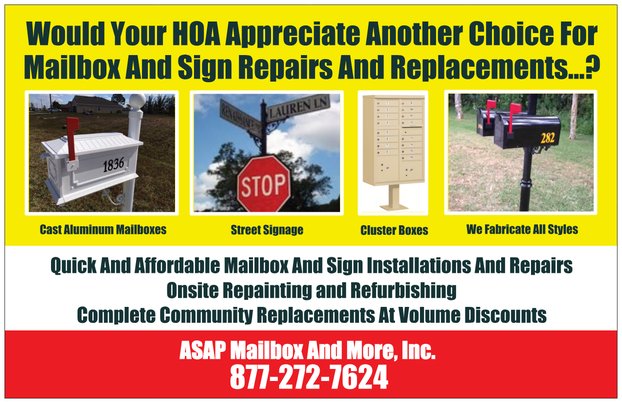
Professional mailbox installation and repair company servicing all Florida counties
ASAP Mailbox and More, Inc. supplies and installs all types of residential curbside mailboxes and all styles of cluster box units ( CBU’s) We are a one-stop source for everything related to installing a new mailbox. From removal of the existing mailbox, to the installation of the new one in concrete, to the address numbering, we handle everything and provide our services in all Florida counties.
ASAP Mailbox And More, Inc.’s main facility is located in Cape Coral, Florida. From this main warehouse and fabrication location, we are able to sell and ship our mailboxes WITH INSTALLATION INCLUDED Nationwide in conjunction with our network of local dealers located in each county.
We take pride in living up to our name “ASAP” when it comes to handling mailbox installs and repairs for HOA’s, property managers and individual homeowners.
From providing complete Community mailbox and signage replacement to repairing a broken bracket for a homeowner, we always handle the project professionally and in a timely manner.
If you need a Mailbox installed please fill out the form below, when filling out the form, make sure to select “I Need A Mailbox Installed” in the select box.
If your need is urgent (mailbox installation, repairs or other needs), please call us at 877-272-7624.
An effective portal solution for managing electronic communications with features that increases the resident experience. In this article, we look at how our Resident Experience Management platform can help you deliver superior resident experiences and help you exceed resident expectations.
Due to pandemic restrictions, many management offices were inaccessible to residents. This caused a greater reliance on telephone and e-mail communication. For many residents, failure of management to respond to their queries in a proper way created distrust and a perception that the management company is incompetent. The root cause to this problem is the lack of an effective portal solution for managing electronic communications with features that increases the resident experience. In this article, we look at how our Resident Experience Management platform can help you deliver superior resident experiences and help you exceed resident expectations.
Efficient maintenance request process
The main responsibility of any management company is to ensure that community associations are well maintained. Residents should be able to report maintenance requests as soon as possible from wherever they are. While calls and text messages can get your attention, residents might not be able to explain the situation entirely. However, via Concierge Plus’ Service Request feature, they can give details of their concern and even upload pictures or videos to aid their explanation.
Requests are always tracked by unit, so you’ll always be able to access a history of what happened. And full reporting features mean you can very quickly generate all the information you need to update your board or your residents.
Transparency in association governance
Since the tragic Surfside condo collapse in Miami, residents are asking for more transparency from their elected board members. Transparency is characterized by visibility or accessibility of information concerning association practices.
Board members can use Concierge Plus as a platform for keeping residents in the loop with regards to anything related to building maintenance. Since the tragic Surfside condo collapse, we’ve been told that residents are particularly asking for their board’s plan on risk mitigation.
Board members can share documents such as a Reserve Study with unit owners using our File Sharing feature. This is a password-protected repository for important documents and is a great place to store articles of incorporation, meeting minutes, rules and regulations.
Virtual owner meetings and AGMs
As the pandemic eases and we resume in-person gatherings, hybrid meetings are slowly becoming a permanent part of how community associations function.
Board members can easily add HD web conferencing, automate attendance, enable eligible owners to vote online, and more through our all-in-one virtual meeting platform integration with GetQuorum.
Advanced and real-time electronic voting allows owners to vote securely on important meeting matters before or during the meeting using GetQuorum’s dynamic online platform.
Electronic voting offers substantial cost savings, improved efficiency and significantly reduces errors associated with traditional paper-based voting.
Efficient package management
Community managers, security guards and concierges everywhere are fighting a losing battle trying to keep up with the unrelenting wave of incoming parcels during the holiday season. When staff members spend more time accepting, storing and retrieving parcels, they can’t focus on their security duties.
With Concierge Plus’ Notification feature, you can avoid ending up with front desk congestion and angry residents. Use Concierge Plus to manage package deliveries with automated emails and an easy tracking process. Residents can select to be notified by text message (SMS) or by an automated phone call, which is perfect for urgent and timely notifications.
With our barcode scanner your team can quickly scan every package that arrives, and when residents come to pick-up their packages, they simply sign on a digital signature pad to confirm their identity permanently and securely.
Last but not least, we also offer beautifully designed, 40″ digital lobby display screens which you can use to alert residents that items are available for pick-up.
Secure resident and visitor parking
For most residents, the safety factors associated with condo living are a huge consideration in choosing life in a community association.
Concierge Plus can help you manage who is coming in and out, where they are parking, and if they have permission to enter the building. Our integrated hardware offerings alleviate confusion with parking pass printers that clearly denote who is parking where.
The printer connects easily to your computer and facilitates tracking of visitor vehicle details such as license plate number, make, and color. A parking pass receipt will print automatically for visitors to display on their dashboards.
All In One System – manage so many devices on you properties. you control access for owners and guests at your fingertips!
Simple Installation, Wirelessly connects to the Internet using plain WiFi without the need to pay for land lines, POTS, VOIP, SIP, nor LTE.
Surveillance Camera Integration, Pull images from other camera(s) mounted near by the entrance for a multi-directional view of the access w/ event in the entry log.
Create temporary guest codes for pre-authorized visitors using the phone app.
Conveniently manage your property with a browser from anywhere with Internet access.
Accept deliveries from any shipper, residents can collect packages 24/7. Mix and match from 9, 6, or 4 door models to suit your community.
Eliminate coins from communal washers, dryers, electric car charging stations, short term rentals of conference and party room












 ASAP Mailbox And More, Inc.’s