Become our Member : JOIN SFPMA TODAY   LogIn / Register: LOGIN/REGISTER

SFPMA Industry Articles | news, legal updates, events & education! 

Find Blog Articles for Florida’s Condo, HOA and the Management Industry. 

Condo HOA Loans / Your Trusted Community Association Financial Resource

Condo HOA Loans / Your Trusted Community Association Financial Resource

  • Posted: Oct 17, 2022
  • By:
  • Comments: Comments Off on Condo HOA Loans / Your Trusted Community Association Financial Resource

Condo HOA Loans

Your Trusted Community Association Financial Resource


Don’t go it alone. Whether your Community requires Conventional or Private Lending, CondoHOALoans can assist you in obtaining the necessary funds for Projects, Reserves, or Cash Flow.

When your Community Association works with our Law Firm to facilitate and secure financing, your Community will also have the optional benefit of receiving 100% FREE Delinquent Account Collection Services.

Not sure if financing is right for your Association? Download the Association Funding Options Infographic and take our Free Financial Health Survey to find out.

Click on the Ad below and Download the pdf.


Tags: , ,
Searching for Money: A Condominium Association’s Guide to Acquiring Financing by Becker

Searching for Money: A Condominium Association’s Guide to Acquiring Financing by Becker

  • Posted: Sep 21, 2022
  • By:
  • Comments: Comments Off on Searching for Money: A Condominium Association’s Guide to Acquiring Financing by Becker

Searching for Money: A Condominium Association’s Guide to Acquiring Financing

by Steven B. Lesser  of Becker

A Condominium Association enjoys broad powers based upon Chapter 718, Florida Statutes, otherwise known as “The Florida Condominium Act.” Despite the guidance provided by the statute and case law which interprets it, little has been written to guide Condominium Associations when borrowing funds to finance various projects.

Associations often borrow money to build capital improvements such as clubhouses; perform extensive remedial work and to buy out recreational leases. Associations must be careful to review its own condominium documents to evaluate whether limitations exist on the right to borrow. This article will discuss the practical considerations to be addressed by a Condominium Association when borrowing funds.


Review Of The Condominium Documents
The condominium documents including the Declaration of Condominium, Articles of Incorporation and By-laws dictate how money can be raised to fund certain projects. the procedure to be followed depends upon the purpose for raising such funds. To the extent that the Association desires to perform maintenance work to its own property or common elements, money can be raised by passing a special assessment on its unit owners pursuant to Section 718.116, Florida Statutes. Most condominium documents provide the Association with the authority to borrow funds for such purposes without acquiring unit owner consent. However, to the extent that the Association desires to buy out a recreation lease, build a clubhouse or otherwise perform material alterations or acquire substantial additions to the common elements or to Association property, unit owner approval is necessary. Section 718.113, Florida Statutes provides that if the Declaration of Condominium is silent on the percentage of unit owners required to approve such activities seventy-five (75%) percent shall govern.


Where To Seek Financing
Once the Association has determined the purpose in raising funds, a source of financing must be located. Financing is often sought when the Association is unable to raise sufficient funds through a special assessment of its members. In many instances, some or all members may not have the money to pay a large lump sum assessment. Typically, an Association will first attempt to look to acquire financing from the bank that handles its operating account. However, the Association should not view the bank as its only source. Often times, members of the Association’s Board of Directors or unit owners may have personal contacts with a lender that is able to provide more favorable rates and flexibility in terms of structure and cost of financing. In some circumstances, a willingness to shift the Association’s operating account to another lender will provide the Association with leverage to acquire the most favorable financing program.


Structuring The Deal
Once the Association has acquired authorization to borrow money and has located a lending institution, structuring the deal becomes the next significant step.

It is not unusual for an Association to borrow in excess of $ 1 Million to finance the purchase of recreational lands from a Developer or to perform significant renovation work to remedy structural defects such as those associated with balconies located in close proximity to the ocean. Lending institutions, with the assistance of counsel for the Association, can be creative in formulating a plan to achieve the financial goals of the Association. The most significant aspect is how the lending institution will secure its loan to the Association.

Unlike other private entities and individuals, a Condominium Association has the statutory right to raise money by a special assessment of its members. Under this scenario, a unit owner’s failure to pay a special assessment will constitute a lien on each condominium parcel for any unpaid assessments. The lien for unpaid assessments will also be subject to an award of interest and reasonable attorney’s fees incurred by the Association to collect or enforce the lien. This statutory right to pass and enforce a special assessment provides security to a lending institution that elects to lend money to an Association. Consequently, a lender will often accept an Assignment of the Association’s right, title and interest in and to all current and future assessments made by the Association against its unit owner members for the purposes of timely payment of all sums due to a lender. For example, an agreement for the purchase of a recreation lease and underlying property between an Association and lender will often include an Assignment which provides as follows:

“The Association hereby irrevocably and unconditionally assigns all of its right, title and interest in and to all special assessments now existing or hereinafter levied by the Association against its unit owner members which are made for the purposes of repayment of the loan or the payment of rent under any lease or lease on real property owned by the Association.”

The foregoing procedure provides the lender with assurance that the loan will be repaid. However, financing a special assessment is expensive when considering loan and interest charges. Certain unit owners may be opposed to being assessed finance charges when they are financially capable of paying the special assessment in a lump sum at the time the loan is acquired. Should a number of unit owners have the ability to pay the special assessment in a lump sum, this process would reduce the total amount of money to be borrowed by the Association along with incidental finance charges.

As a special assessment constitutes an encumbrance on property, the Association would negotiate elimination of any prepayment penalty charges should the loan in whole or in part be paid early. Consequently, elimination of a pre-payment penalty clause would enable the Association or a unit owner to avoid additional finance charges should they pay off the debt prior to the maturity date.


Typical Costs Associated With Financing
Should the Association elect to mortgage its property to acquire financing the following fees will be generated:

Bank loan fees, Bank counsel fees, corporate searches, Survey, Title insurance costs, accounting costs, Documentary stamps, Intangible documentary stamps on the amount of the note and mortgage, Environment assessment of property, Recording charges, The cost of amending the condominium documents if additional property is acquired by the Association.

The Association and its counsel should attempt to discuss and negotiate the above-listed fees with the lending institution prior to signing a commitment letter. The Association should never sign a commitment letter without first consulting with counsel. Once the commitment letter is signed, the Association may be obligated to pay a non-refundable fee. Moreover, attempting to re-negotiate the terms of the loan may delay the process as it would require reconsideration by the loan committee.


Conclusion
In closing, a condominium Association must identify its purpose in raising funds. The purpose of raising funds will dictate the procedure to be followed. If funds are to be raised for maintenance repairs, a special assessment can be passed without unit owner consent. Condominium documents typically authorize the Board of Directors of a Condominium Association to borrow funds without owner consent. However, certain condominium documents may require unit owner approval. To the extent that the Association elects to borrow funds to perform material alterations or to acquire a substantial addition to Association property, the condominium documents will govern the procedure to be followed. If the condominium documents are silent, seventy-five (75%) percent unit owner approval must first be acquired before a special assessment can be passed pursuant to Section 718.113 (2), Florida Statutes.

When attempting to acquire financing, look to the members of Association’s board of directors and its unit owners to identify lender’s that can provide the most favorable rate. The bank handling the Association’s operating account is often the best source of financing and may be willing to negotiate certain costs associated with financing. Likewise, conferring with an attorney that specializes in association work can often assist you in reducing the costs associated with obtaining a loan.

Most importantly, shop around and take advantage of the collective financial strength of the Association and its unit owner members.


Steven B. Lesser

Shareholder

 SLESSER@beckerlawyers.com


Tags: , ,
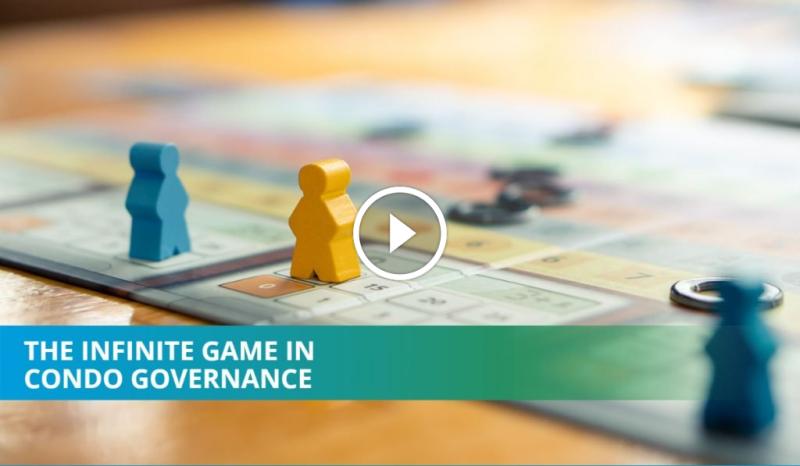
The Infinite Game in Condo Governance by Mitch Drimmer of Axela Tech.

The Infinite Game in Condo Governance by Mitch Drimmer of Axela Tech.

In 1986, Professor James P. Carse presented the concept of finite and infinite gaming. He said, “there are at least two kinds of games: finite and infinite.

A finite game is played for the purpose of winning, an infinite game for the purpose of continuing the play.” Sports games, like football and baseball, are clearly finite games. They have specified chunks of time in which one is expected to do better than the other. An infinite game has no winners and no time length. Instead, it’s just a set of rules and expectations you must continue to participate in without end.

Simon Sinek took this game theory and applied it to the planning and continued success of a business enterprise. Businesses are not time-restricted games. You don’t have a year or five or ten in which to complete some kind of final objective. Sure, there are benchmarks and points of obvious success, but there is no end to business.

Now apply that kind of thinking to the HOA and condo industry: community associations, and in particular, condo governance. A condominium should be run with an “infinite game” mentality, with the goal of the structure being maintained to reach the ripe old age of eternity. Can a structure last infinitely? Maybe not, but even so, that is how it should be governed. There is no shelf life on a condominium building.

Keeping Score in Condo Governance is Playing a Finite Game

Condominiums all too often live on a budget-to-budget basis (or a special assessment to special assessment basis) with very little regard for the future. This kind of condo governance manifests itself in an inadequate capital improvement plan or a functioning preventative maintenance protocol.

Many condominiums are run by a seat-of-the-pants mentality–the pinnacle of finite thinking. This budget-to-budget, board-to-board, manager-to-manager mentality is destructive and a clear blueprint for a condominium’s demise. It pits past, present, and future against one another, each one keeping a score of who did what and who should be responsible for what comes next. Often, this means everyone is passing the buck, and no one is actually accomplishing anything. Managers and board members need to think in terms beyond their tenure with the community and consider the far future in their planning and attitude.

Recently, we have witnessed the results of a condominium playing a finite game. Could there be a better example of misguided short-term planning than what happened in Surfside, Florida? Reports all indicated that the board of directors thought about only the short-term struggles–their time in office, the quickly-mounting immediate expenses, the inconvenience of a serious construction project–and played a finite game with disastrous consequences.

But the board is not alone in their fault. They had no direction from their law firm (which was fined $31 million dollars), which should have known better. This tragedy did not happen in a vacuum.

Sustaining Through an Infinite Game

As extreme as an example Surfside is, the thinking remains endemic. It is not an anomaly, it is only the worst-case scenario and a scenario many buildings are facing after so many years of neglectful condo governance.

It all begins with a reserve study. A quality reserve study can start the process of future planning for a condo building. Ideally, the results will physically lay out what the future may hold. It won’t be perfectly spot-on, but it is at least there as an initial guide.

This is how communities play the infinite game–a good reserve study is not a one-and-done event. A proper reserve study requires long-term maintenance and updating as inflation, and other infrastructural issues inevitably erode the previous year’s budget. Playing an infinite game in condo governance will ensure its longevity, value, comfort, and positive residential experience.

Start Playing an Infinite Game

A condominium that has a good reserves program, maintains an honest budgetpursues delinquencies, seeks out stability in management, and continues to embrace new technologies to reduce expenses is playing the infinite game.

It’s election season for boards of directors, so why not campaign on governing with an infinite mentality? Govern and manage your building like it is supposed to last forever. For more advice on condominium fiscal management and collections, contact us today.


Tags: , ,
Webinar: Loans and Borrowing Money – What Community Associations Need to Know

Webinar: Loans and Borrowing Money – What Community Associations Need to Know

Webinar: Loans and Borrowing Money – What Community Associations Need to Know

WEDNESDAY, AUGUST 10, 2022 AT 10 AM-11AM

There is a lot of confusion when it comes to obtaining a loan as a community association. This webinar is intended to clear the confusion and provide you with the necessary tools to obtain a loan.
You will learn:
• What is and is not collateral for a community association loan
• What type of loan documents to avoid
• The borrowing process from beginning to end
• When to get your attorney involved
This program is not eligible for CEU credit or certificate of completion.
________________________________________
This is going to be presented on Zoom! Full live viewing instructions will be sent to all registrants.
________________________________________

REGISTER NOW:


Florida Senate Bill 2-D and 4-D: What You Need to Know!  by Cohen Law Group

Florida Senate Bill 2-D and 4-D: What You Need to Know! by Cohen Law Group

  • Posted: Jun 08, 2022
  • By:
  • Comments: Comments Off on Florida Senate Bill 2-D and 4-D: What You Need to Know! by Cohen Law Group
At Cohen Law Group, It’s About Justice!
It’s more than a slogan, it’s our firm’s mantra. We are zealous in protecting your rights. We offer 24-hour availability through our answering service. Call us today.
(407) 478-4878
The age of a CommunityAssociation opting not to fund reserves is coming to an end

The age of a CommunityAssociation opting not to fund reserves is coming to an end

  • Posted: May 30, 2022
  • By:
  • Comments: Comments Off on The age of a CommunityAssociation opting not to fund reserves is coming to an end

The age of a CommunityAssociation opting not to fund reserves is coming to an end, and some homeowners could be facing a steep rise in assessments. Becker Shareholder Howard Perl surveys the landscape and offers a few suggestions of how to prepare.

After the Surfside tragedy, everyone wanted to know how such a tragedy could happen and what steps could be taken to avoid similar incidents in the future. What caused the collapse? Could it have been avoided? Why were repairs not made? Why did local governments allow repairs to drag on? Why were repairs not made in a timely fashion? Unfortunately, none of these questions can be answered quickly, and proper answers will require years of study and analysis.

The above questions, and attempts to enact legislative reform to address some of these questions, were a hot topic for the Florida legislature this year. Several counties and the Florida Bar convened task forces in the aftermath of the Surfside tragedy. Primary among the suggested legislative changes for multifamily buildings were periodic engineering inspections, reserve studies, and reserve funding mandates. While all agreed generally in regard to these reforms, at the end of the day, the Senate and House could not agree on the reserve funding issue and, as a result, nothing passed. Currently Florida law can allow for owners to opt to fund less than required reserves, or no reserves. Most legislative proposals included mandatory reserve funding of one type or another. The sticking point was how quickly to implement such mandatory reserves, without the option of owners being able to waive such requirements. Whether to implement immediately, effective in 2022, or over the next three or five years, to allow a gradual implementation, is ultimately what led to nothing being passed. Rather than compromise, which seems to be a forgotten word in Tallahassee these days, legislators could not, or refused, to come to an agreement for the benefit of all condominium and cooperative residents in Florida.

These issues are certain to be re-examined next year. As such, your association should begin recognizing what is most likely coming down the pike and preparing the association and its residents now. Most likely the days are gone when owners will have an opportunity to fully waive reserves. I anticipate mandatory reserve funding of some type will be implemented. Whatever version is implemented, the result will be an increase in annual maintenance assessments. Depending on what is implemented and your association’s current reserve funding situation, some owners may be looking at a significant increase in your 2024 assessments (as the laws I am discussing would be passed in 2023, and most likely effective for the 2024 association budget).

The association should be anticipating and working on these items now. For example, some sort of reserve study requirement is most likely coming. Budget for one now. Get proposals now. Have the study done now. Once mandated by statute, demand will go up, availability will go down, and of course prices will go up. We are seeing exactly that scenario now in regard to structural engineers and 40/50-year recertifications.

In regard to reserve funding, take a good look at your reserve schedules. Get updated estimates of repair costs. Factor in inflation when projecting 10 and 20 year replacement items such as painting, roofing, etc. Any effort to increase your 2023 reserve balances will help lessen any blow of 2024 mandated reserves. Explain these issues to your residents now. Many associations are understandably involved with 40/50-year recertification requirements and other life-safety related issues. Obviously these issues need to be addressed immediately and on an expedited basis. But associations and their members should keep their eye on long-term remedial requirements as well. More oversight; more required inspections; more required repairs; and more required reserves. All of these are good things for 40–50-year-old buildings in a saltwater environment in Florida.

The outcome of the 2022 legislative session once again underscores the inherent problem when all community association ideas are placed in only one omnibus bill. Until our legislators acknowledge this problem and start using stand-alone bills for important proposals, there is always the risk that needed reforms will not pass.

Contact your legislators, tell them you welcome these types of reforms, but they need to be addressed as needed, not all under one take it or leave it omnibus bill. Work with your association leaders on the above discussed items. Don’t be surprised by increased annual assessments, special assessments, and other upcoming expenses. They are coming. Prepare now.


Howard Perl is a Shareholder in Becker’s Community Association practice and has been involved in all aspects of community association law, including transactional, collections, mediation, arbitration, construction defects and litigation. He is also Florida Bar Board Certified in Condominium & Planned Development Law.

We are excited to announce to the Falcon team our new Chief Financial Officer, Clifton McElyea!

We are excited to announce to the Falcon team our new Chief Financial Officer, Clifton McElyea!

  • Posted: Mar 24, 2022
  • By:
  • Comments: Comments Off on We are excited to announce to the Falcon team our new Chief Financial Officer, Clifton McElyea!

We are excited to announce to the Falcon team our new Chief Financial Officer, Clifton McElyea! 

Clif brings 20+ years of experience in progressive leadership roles, including serving as CFO of a major provider of advanced technology solutions across the federal, state, municipal, commercial, and petrochemical refinery markets, and extensive experience with A/E firms. He has a wide technical accounting foundation with experience in public accounting, US GAAP, controls, reporting, systems, FP&A, corporate development, and treasury and strong penchant for building consensus, creating effective relationships, and negotiation skills. 

Clif is passionate about solving dynamic problems with creative solutions and will be responsible for driving the company’s overall financial strategy, including growth plans as we continue to expand our footprint. He will be playing an important role building a strong finance team with deep expertise and assisting with all 10 of Falcon’s offices. The dedication he’s shown throughout his career in unlocking business potential is invaluable to this next chapter with the Falcon Team.

Welcome to the team Clif!

CONTACT US (through our SFPMA Membership Page)

The Falcon Group
95 Mount Bethel Road
Warren, NJ 07059
(908) 595-0050
www.thefalcongroup.us

When home and unit owners don’t pay their association fees and dues, the Board is challenged with handling the collection of those delinquent funds.

When home and unit owners don’t pay their association fees and dues, the Board is challenged with handling the collection of those delinquent funds.

  • Posted: Mar 23, 2022
  • By:
  • Comments: Comments Off on When home and unit owners don’t pay their association fees and dues, the Board is challenged with handling the collection of those delinquent funds.

Self-Managed condominium associations and HOAs are governed by well-meaning volunteer leaders who keep a close eye on the association’s finances. When home and unit owners don’t pay their association fees and dues, the Board is challenged with handling the collection of those delinquent funds. Running a tight ship often leads to no available cash for unforeseen problems. Hiring an attorney to handle a collection matter is expensive and just doesn’t make sense. Axela Technologies collection solution offers the self-managed association Board a collection solution at no cost or risk to the association. Licensed and insured collection services from Axela Technologies lets the self-managed association keep their budget intact while collecting the delinquent funds they are owed and need to run the association. That’s just smart!

Attorneys can be very useful to self-managed condominium associations and HOAs when they need legal assistance. However, using an attorney when a homeowner has fallen behind in their dues and assessments is not a frugal choice. Whether successful or not at resolving the problem, the attorney will require payment. After all, they are providing legal services at a billable hourly rate. Smart self-managed condominium and HOA Boards know that they have a collection problem, not a legal problem. Employing Axela Technologies to solve the collection problem makes sense. Unlike an attorney, there are no hourly fees and the low reasonable fees that are charged by the collection agency are passed through to the delinquent homeowner, where they belong. After all, it was their failure to produce timely payment of their fees and assessments that put the association in this predicament to begin with. It wouldn’t be fair to force the good-paying home and unit owners within the self-managed association to foot the bill for the association to collect the monies it is owed.

Using an outsourced collection agency like Axela Technologies is in the best interest of all involved. Forward thinking Board members of self-managed condominium associations and HOAs know that spending as little money as possible is in the best interests of all association members. That is one of the reasons they chose to self-manage in the first place. Axela Technologies provides a perfect solution to a potentially expensive problem. The collection fees passed through to homeowners from Axela are far less than those of an expensive attorney who charges by the hour. Not only does the self-managed association save money, their homeowners also benefit from a less expensive solution to correcting their indebtedness.

Axela Technologies handles all collections on a merit-based system. Visit our website at https://www.axela-tech.com today and ask to speak to one of our delinquency collection experts.

SFPMA’s Reserve Funding for your Communities

SFPMA’s Reserve Funding for your Communities

  • Posted: Oct 29, 2021
  • By:
  • Comments: Comments Off on SFPMA’s Reserve Funding for your Communities

Reserve Funding 101

Reserve Funding for your Communities

A reserve fund is a special account for the long-term repair and replacement of commonly-owned property in a community association.

A good example of this is the roof of a condominium building. All of the unit owners in the building share ownership of the roof. Every 50 or so years, the singles and other items will need to be replaced. The condo association will set aside a specific amount of money each year to go towards replacing/repairing the roof.

When an association plans for a reserve fund, they call on trained experts known as reserve specialists. These assess examine every detail of the association’s common areas to determine their lifespan and condition. They also include factors such as inflation to determine the cost of replacement at the end of the item’s lifespan.

Finally, the last step is to determine how much money the association needs to set aside each year. There are three basic plans for reserve funding: baseline, threshold, and full funding. These determine how prepared the HOA or condo will be when the item’s lifespan is up.

Full funding offers the least amount of risk for owners. With full funding, the replacement item in question will be fully funded by the end of its lifespan. With threshold funding, the association plans to have a certain limit, say 50%, of the item paid for by the end of its lifespan. The up-side to this is cheaper dues. The down-side is that is puts the owners at a greater risk of reaching the end of the item’s lifespan without having the proper funds available to repair or replace it. Finally, baseline funding aims to keep the reserve fund above a $0 balance at the end of the item’s lifespan.

Whichever path the association decides to take, the funds needed are figured in the budget. A portion of the regular assessments paid by homeowners or unit owners goes towards the reserve fund. Some states require associations to maintain a reserve fund by law. Most of the mortgage loans on condos are underwritten by the Federal Housing Administration. The FHA requires that a minimum of 10% of the association’s budget be designated for the reserves. If an association is not allocating at least 10% of its budget, it loses it’s FHA certification. This will almost always have negative consequences for the unit/home values.

Aside from that, who really wants to buy into an association that isn’t planning ahead? That isn’t executing good judgement, and should be a red flag to potential buyers. Adequately maintaining a reserve fund will mean higher assessments over the course of time. However, this is much better than the alternative of a large special assessment. If you community association needs guidance when it comes to reserve funding, trust the financial experts at Clark Simson Miller. We’re not reserve specialists, but we have over 100 years of combined experience in the association management industry. We’ll be glad to schedule a consultation and assess your community’s overall financial health.


Private money loans from Gelt Financial can be the ideal solution when you are financing an “out of the box” real estate transaction. Whether you need to close fast, have a distressed asset, or need a non recourse loan, Gelt Financial can offer a competitive loan program just for you. Gelt Financial is a nationwide lender on all types of existing real estate including office, retail, multifamily, self storage, industrial, NNN, mobile home parks and more

Gelt Financial is a commercial non-bank mortgage lender, focusing on mortgages between $50K and $5MM.
Since 1989, Gelt has closed over 10,000 loans

BRIDGE & SHORT TERM LOANS

Whether historic cash-flow or a distressed value-add property, we can secure bridge loans at competitive rates.

HARD MONEY LOANS

Need a quick boost of cash flow?
Gelt can secure you financing on numerous types of collateral.


Tags: , , ,