SFPMA

SFPMA Industry Articles | news, legal updates, events & education! 

Find Blog Articles for Florida’s Condo, HOA and the Management Industry. 

Sunshine Laws” for Condominium Associations

Sunshine Laws” for Condominium Associations

  • Posted: Nov 16, 2021
  • By:
  • Comments: Comments Off on Sunshine Laws” for Condominium Associations

Sunshine Laws” for Condominium Associations

by Becker

Florida’s Sunshine in the Government Act, (“Sunshine Laws”) requires transparency and disclosure in government and business. Although the Sunshine Laws do not apply to condominium associations, the Florida Condominium Act (“Act”) found in Chapter 718, Florida Statutes, contains its own set of “sunshine” requirements for these communities, with transparency being the key to compliance. Issues generally arise in condominiums when there is or appears to be a lack of transparency between the board of directors and the association members.

First, boards need to determine which gatherings must be open to association members. While boards may desire to avoid certain topics in open meetings, the Act requires board meetings to be open to members; in fact members have a statutory right to attend such meetings. A “meeting” of the board occurs when a quorum of the board members is present. There are two statutory exceptions to the requirement that board meetings must be open to the members: 1) meetings with the association’s attorney to discuss proposed or pending litigation, if the meeting is held for the purpose of seeking or rendering legal advice, and 2) when “personnel matters” are under discussion. Personnel matters should be limited to discussions of specific issues pertaining to association employees. So, can individual board members meet or call one another to discuss association business as long as the meeting or phone call comprises less than a quorum of the board? Yes. However, remote meetings of a quorum of the board still constitute meetings that must be open to members. Notwithstanding the foregoing, the Act provides that members of the board of administration may use e-mail as a means of communication but may not cast a vote on an association matter via e-mail.

The second important “sunshine” law is the noticing of meetings. The requirement that meetings be open to members is of little benefit if owners do not know when or where the meetings are taking place. Under the Act, notice of all board meetings must be posted conspicuously on the condominium property for at least 48 hours before the meeting. However, certain meetings, such as meetings where non-emergency special assessments or amendments to rules regarding unit use are considered, require notices to be mailed, delivered, or electronically transmitted to the unit owners AND posted conspicuously on the condominium property not less than 14 days prior to the meeting. The notices also need to clearly identify the agenda items that will be discussed at the meeting.

The Act also provides owners certain rights at board meetings. Owners have a right to speak at all open board meetings on all designated agenda items. The right to speak does not mean that every unit owner is entitled to endlessly debate motions, but it does mean that the owners are entitled to be heard regarding matters the board intends to consider at the meeting. The association may adopt written reasonable rules governing the frequency, duration and manner of unit owner statements. Owners may also record or videotape such meetings.

What about committees? The sunshine laws also apply to committees that are empowered to take final action on behalf of the board, or committees that make recommendations to the board regarding the association budget. Under the Act, all committees are subject to sunshine requirements unless the association bylaws specifically exempt committees from the sunshine laws.
If you have questions about these laws and how to handle meetings in your community, contact your community association attorney.


Don’t Want Your Association to Be the Next Rental Community? by KBRLegal

Don’t Want Your Association to Be the Next Rental Community? by KBRLegal

  • Posted: Nov 16, 2021
  • By:
  • Comments: Comments Off on Don’t Want Your Association to Be the Next Rental Community? by KBRLegal

Don’t Want Your Association to Be the Next Rental Community?

Many community associations throughout Florida struggle to deal with the increase in overnight and short-term rentals caused by the proliferation of online websites such as VRBO and Airbnb. As such, many communities fear being turned into “rental communities,” especially with so many large corporations buying homes in the South Florida area for the express purpose of renting them. These transient rentals can present nuisance and safety issues and can easily change the composition of your community. The good news, however, is that there are steps your association can take to help protect the community from becoming the next transient rental community by having the necessary language in the declaration of restrictions, as further discussed below.


There are two types of restrictions which work together to help achieve this goal. First, corporate (or business entity) ownership must be fully addressed. Second, specific criteria for approval of purchasers, tenants, and occupants residing in the community for longer than 30 days (or such other time period) must be adopted. Finally, a brief discussion regarding the applicability of the statutory provisions set out in Chapter 718 of the Florida Statutes, more commonly referred to as the Condominium Act, and Chapter 720 of the Florida Statutes, more commonly referred to as the Homeowners Association Act, is in order.


To avoid ownership for purely investment purposes, an amendment to the declaration that prohibits ownership by a corporation, limited liability company, partnership, trust, or other entity or company should be considered. However, certain carve-outs are recommended to ensure that the owners can use these types of entities for their estate planning purposes, to ensure that the rights of mortgagees are not adversely affected, and to ensure the association still has the authority to purchase units as a result of foreclosure or in other appropriate circumstances. In addition to restrictions on ownership, the association can consider adopting an amendment restricting the number of units that can be owned by a person or entity.


The association must ensure that its authority to approve transfers of title to lots and units is not an “unreasonable restraint on alienation.” In other words, the association must have the express authority to deny transfers of title, and the restrictions on such sales must be reasonable.


In Aquarian Foundation v. Sholom House, 448 So.2d 1166 (Fla. 3d DCA 1984), Florida’s Third District Court of Appeal considered the validity of a condominium association’s transfer restrictions. In its analysis, the court noted that “restrictions on a unit owner’s right to transfer his property are recognized as a valid means of insuring [sic] the association’s ability to control the composition of the condominium as a whole.” The court explained that while an association can adopt restrictions on transfers, that right must be balanced with the individual owner’s right to transfer his property. In Aquarian Foundation, the association had the right to deny a sale “arbitrarily, capriciously, and unreasonably” with no obligation to provide an alternate purchaser in the event of such denial. The court held that the association’s authority to deny for any reason whatsoever without the obligation to provide an alternate purchaser was an unreasonable restraint on alienation. However, the court explained that while a condominium association has “considerable latitude in withholding its consent to a unit owner’s transfer, the resulting restraint on alienation must be reasonable.” Therefore, we can glean from this case that a provision authorizing the association to approve or disapprove transfers is acceptable where the restraint is reasonable.


In 1993 Florida’s Fourth District Court of Appeal considered another challenge to an association’s approval authority. In Camino Gardens Association, Inc., v. McKim, 312 So.2d 636 (Fla. 4th DCA 1993), the declaration prohibited the sale, lease, or occupancy of any lot in the subdivision to anyone other than a duly admitted member in good standing of the association. The court held that because the restriction prohibited transfer to anyone except existing owners, the restriction was an unreasonable restraint on alienation and was invalid.


In Coquina Club v. Mantz, 342 So.2d 112 (Fla. 2d DCA 1977), Florida’s Second District Court of Appeal considered an age restriction contained in the declaration (which was lawful at the time). The applicant did not meet the age requirement and was therefore “facially disqualified.” The court held that, in light of the facial disqualification, the association did not have an obligation to provide the otherwise required substitute purchaser.


In light of the foregoing case law, any provision which grants the association limitless power of denial is likely invalid. If the association has the right to deny a purchaser, but the declaration is void of any standards by which such decisions should be made, the restriction can still be easily found to be invalid. However, if the declaration requires the association provide a substitute purchaser or allows for denial based on “good cause,” the provision is likely valid and enforceable. If an association has the right to deny “for good cause,” then to withstand judicial scrutiny, the governing documents, preferably the declaration, should provide standards as to what “for good cause” means.


As discussed above, the first step is to ensure that the declaration provides authority for the screening and approval process. The second step is to ensure there is meaningful written criteria by which to evaluate prospective purchasers, tenants, and even occupants residing for longer than 30 days (or other time period). If the declaration contains general language for purchaser and tenant approval but does not provide the standards and procedures necessary to make such a decision, then the association’s approval authority is vulnerable to judicial challenge and likely faces an uphill and expensive court battle. The association may be interested in adopting criteria, allowing rejection based on “good cause,” such as the following:


  • A record of financial irresponsibility
  • A guilty plea or conviction of a crime of moral turpitude
  • A history of being a “bad tenant”
  • A false statement on the application
  • Failure to comply with the request of the board of directors for a personal interview


(Please note this abbreviated list was provided for example purposes only and should not be utilized by any association without consultation with the association’s lawyer as additional language is necessary.)


Providing specific written criteria on which the association can base its denial of a proposed sale, lease, or other transfer helps protect the association from claims that it is not acting reasonably in denying a transfer. However, before disapproving a proposed sale or lease, the association should be sure that the disapproval does not run afoul of the provisions of the Fair Housing Act at the federal, state, and county levels. The federal Fair Housing Act prohibits discrimination in the sale, rental, and financing of dwellings, and in other housing-related transactions, based on race, color, national origin, religion, sex, familial status, and disability. State law and, sometimes, local ordinances provide additional protected classes.


While the authority to approve lessees is an important step, adopting additional leasing restrictions addressing the frequency and type of leases permitted in the community should also be included in the declaration if these issues are a concern for the community. Associations that would like to minimize the number of short-term leases might consider amendments to the declaration limiting leasing as follows:


  • No lot or unit may be rented or leased for a 12-month period (o longer) following the closing date (or date of recorded deed) of a sale of that lot or unit.
  • Owners are restricted to one rental or lease per calendar year.
  • After approval by the association, only entire lots or units can be rented, provided occupancy is only by the lessee and those individuals listed as occupants in the lease agreement.
  • No rooms may be rented, and no transient tenants may be accommodated.
  • No owner may list the owner’s lot or unit on any website (e.g., and without limitation, Airbnb, VRBO), print or online publication advertising the owner’s lot or unit for short-term rental
  • No lot or unit may be subleased.


Statutory provisions must be considered as well regarding whether a new lease restriction amendment will apply to all owners or only those who vote in favor of the amendment or who acquire title to their unit or home after the effective date of the amendment (these issues will need to be reviewed with association counsel). For instance, we note the following:


  • As to condominium associations, effective on October 1, 2004, the Florida legislature first adopted §718.110(13), which has since been amended, and this section provides that “[a]n amendment prohibiting unit owners from renting their units or altering the duration of the rental term or specifying or limiting the number of times unit owners are entitled to rent their units during a specified period applies only to unit owners who consent to the amendment and unit owners who acquire title to their units after the effective date of that amendment.”
  • As to homeowners associations, effective on July 1, 2021, the Florida legislature adopted §720.306 (1)(h) which provides that, “[e]xcept as otherwise provided in this paragraph, any governing document, or amendment to a governing document, that is enacted after July 1, 2021, and that prohibits or regulates rental agreements applies only to a parcel owner who acquires title to the parcel after the effective date of the governing document or amendment, or to a parcel owner who consents, individually or through a representative, to the governing document or amendment. …Notwithstanding… an association may amend its governing documents to prohibit or regulate rental agreements for a term of less than 6 months and may prohibit the rental of a parcel for more than three times in a calendar year, and such amendments shall apply to all parcel owners.”

As you have likely discerned, the leasing restrictions of the Homeowners Association Act are broader than those set out in the Condominium Association Act. However, the real issue is whether these provisions apply to all associations that are already in existence or only to those that have adopted “Kaufman language” into their declaration and those declarations that are recorded after the effective date of the statute.


Kaufman language refers to having a provision in the declaration that it is subject to the relevant Chapter “as it is amended from time to time.” If the declaration contains such language, then there is no question that the statutory leasing provisions do apply. On the other hand, if there is no Kaufman language set out in the declaration, then what? There are those who take the position that these statutory leasing provisions are “procedural;” if so, then they would apply to an existing declaration. But, if the statutory leasing provisions are changing existing “substantive rights,” then, absent Kaufman language, the statutory provisions likely do not apply to the declaration at issue. By way of an oversimplified explanation, this is because the declaration is a contract, and the legislation in effect at the time a contract is executed is the law to which the contract is subjected.


Thus, we must ask the question, are the statutory leasing provisions disturbing existing substantive rights? Likely so, though it may take an appellate court decision to bring needed clarity. Clearly, this is an issue which must be discussed with the association’s legal counsel.


To ensure your association is properly protected against unwanted transient rentals, you should consult with association’s legal counsel who can review the governing documents to ensure necessary language is included and make recommendations to better protect the association from the likes of VRBO, Airbnb, and other short-term rentals, and at the same time shore up the association’s approval powers over owners, tenants, and occupants.


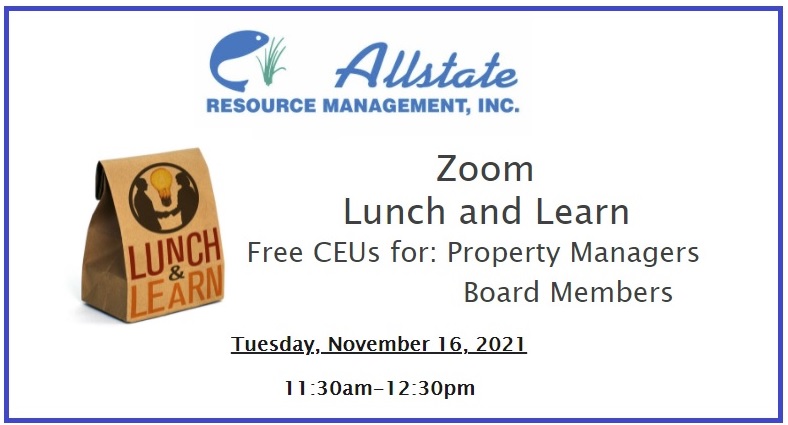
AQUATIC RESOURCE MANAGEMENT / Lunch and Learn

AQUATIC RESOURCE MANAGEMENT / Lunch and Learn

November 16 @ 11:30 AM – 12:30 PM

AQUATIC RESOURCE MANAGEMENT / Lunch and Learn

WEBINAR Florida

AQUATIC RESOURCE MANAGEMENT  1 CEU – COURSE NUMBER: 9628717 Zoom Lunch and Learn Free CEUs for: Property Managers Board Members Tuesday, November 16, 2021 11:30am-12:30pm Ever wondered what is going on with your lake? This course will help you better understand lakes on property, native plants, fish stocking, stormwater maintenance, erosion issues, and more!

Sign up here! RSVP: CSullivan@AllstateManagement.com


Tags: ,
CONGRATS, you survived Hurricane Season…BUT did your ROOF?

CONGRATS, you survived Hurricane Season…BUT did your ROOF?

  • Posted: Nov 11, 2021
  • By:
  • Comments: Comments Off on CONGRATS, you survived Hurricane Season…BUT did your ROOF?

CONGRATS, you survived Hurricane Season…BUT did your ROOF?

The 2021 Atlantic hurricane season runs from June 1 through November 30. According to the National Oceanic and Atmospheric Administration (NOOA), this year is predicted to be another above-normal season.

The 2021 Hurricane season starts on June 1 but it’s never too early to prepare. Damage from a hurricane can be costly for all businesses and can pose hazards for you and your employees. Fortunately, there are ways that you can fortify your business against a hurricane to minimize losses and reduce risks for workers.


As part of “Planning Ahead” for a Disaster, the SBA encourages you to consider taking these simple steps to prepare: Assess your risk; Create a plan, Execute your plan. Statistics show that 25% of small businesses don’t re-open after a disaster. Visit the SBA’s Prepare for Emergencies website to learn more about how to prepare and recover if a disaster strikes.

NOOA officials also encourage consumers to take the following steps:

  • Visit Ready.gov and Listo.gov for useful and valuable disaster preparation resources including checklists and templates for your business and your home.
  • Download the FEMA app to sign-up for a variety of alerts and to access preparedness information.
  • Consider purchasing flood insurance.

Visit the National Hurricane Center’s website at hurricanes.gov throughout the season to stay current on watches and warnings.


Statewide Professionals ready to Handle Storm Damage & Claims for Condo and HOA Properties!

These Trusted Legal Firms, Public Adjusters, Roofing Engineering & Service Companies will work with you on Storm Related Damage.

Use the Form..Contact us Today!


Has your Condo or HOA Sustained Property Damage?

SFPMA has a team of Legal Experts, adjusters, estimators and claim specialists for the benefit of the Condo and HOA’s who sustained damage from the storms and fire, water or mold.

With the know-how and experience to analyze, evaluate, and negotiate the best settlement for your Insurance Claim!

“Get the maximum settlement for your damage claim!”


Employment Law Change That Community Associations Should Be Aware Of : by Ned Bassen, Jamie B. Dokovna

Employment Law Change That Community Associations Should Be Aware Of : by Ned Bassen, Jamie B. Dokovna

  • Posted: Nov 11, 2021
  • By:
  • Comments: Comments Off on Employment Law Change That Community Associations Should Be Aware Of : by Ned Bassen, Jamie B. Dokovna

Employment Law Change That Community Associations Should Be Aware Of

by Ned Bassen, Jamie B. Dokovna of Becker Lawyers

Senate Bill 1532 amending §409.2576, Florida Statutes went into effect. Previously, only employers with 250 or more employees were required to report newly hired and re-hired individuals to Florida’s State Directory of New Hires within 20 days of hiring. Independent contractors were excluded. Now, as of October 1, any employer, regardless of the number of employees that is a “service recipient” defined as “a person engaged in a trade or business who pays an individual for services rendered in the course of such trade or business” must report all new hires and re-hires to the State’s database. Additionally, employers must report their independent contractors who are paid $600 or more during a calendar year.


The purpose of the statute is to provide information to the Florida Child Support Program to facilitate the collection and disbursement of child support payments and to monitor and enforce child support payments. The statute, however, is silent regarding penalties for failing to report. That said, employers with less than 250 employees should update their onboarding process to include the new reporting requirements and all employers regardless of size should determine whether reporting requirements exist for any independent contractor used by them, update onboarding policies to reflect the changes in the law and provide training for those who perform onboarding and payroll, so they are aware of these changes.

by Ned Bassen, Jamie B. Dokovna ( Learn more click our V Cards )


Tags: , ,
GET READY FOR SOME STICKER SHOCK  By Eric Glazer, Esq.

GET READY FOR SOME STICKER SHOCK By Eric Glazer, Esq.

  • Posted: Nov 11, 2021
  • By:
  • Comments: Comments Off on GET READY FOR SOME STICKER SHOCK By Eric Glazer, Esq.

GET READY FOR SOME STICKER SHOCK

By Eric Glazer, Esq.

In the last 24 hours I was told of two different association annual budgets going up massively for the coming year.  We are talking about over 35% increases in the budget.  Think about that.  If your assessments are already $600.00 per month, you probably can expect going to $850.00 per month.  If you’re already at $800.00 per month, you’re about to go over a thousand.

It’s actually worse though, on a smaller scale.  People that are only paying $400.00 per month will now be going to around $550.00 per month.  It’s going to hurt them the most.  It always hurts the poorer people the most.

Add this on to the rising costs of gasoline, food, utilities and insurance and we are looking at a real crisis coming up.  Just remember, we can also expect that The Florida Legislature will likely be passing laws this year making it impossible to completely waive the funding of your reserve accounts.  So, on top of everything we just mentioned, get ready for your assessments to go up even hire when you are forced to pay in advance for future repairs.

For those of you that have not started addressing your budget for next year yet, I would get busy immediately.  You’re fooling yourself if you think that by avoiding it, things won’t change.  They will.  Unfortunately, all of these causes are coming together like a perfect storm.  Thank heavens most people don’t have adjustable rate mortgages any longer because if they did and mortgage rates started going up, things would be even worse.

I’m telling you what’s definitely coming.  The question is…..are there any solutions to prevent these increases.  I don’t think there are.  What things can you cut from your budget to offset these increases?  What steps can you take to curb costs?  I’m open to suggestions but I just don’t see good things on the horizon.  I can tell you that at least in my office, it’s starting to feel like foreclosures and delinquencies are already on the rise.  How do we put the brakes on another foreclosure crisis?


Tags: ,
Community Association Meeting Guidelines by Concierge Plus

Community Association Meeting Guidelines by Concierge Plus

  • Posted: Nov 11, 2021
  • By:
  • Comments: Comments Off on Community Association Meeting Guidelines by Concierge Plus

Community Association Meeting Guidelines

by Concierge Plus

Very involved community associations often have large contentious meetings when there is a hot button issue.

We’ve created the following guidelines for meetings so everyone participating knows what to expect.

Association Pledge & Basic Meeting Protocol

It’s only a “meeting” if it is organized and a good meeting conduct is important regardless of purpose. There should be an opening statement by the chairman (or a selected member) as to the main purpose (topic) of the meeting.

The ground rules for the meeting; address the chair, the chair decides who speaks, and for how long.

Many community associations start their meetings with their Association Pledge & Basic Meeting Protocol. See an example below:

The Board encourages all to abide by this pledge of conduct: While we might disagree, we will be respectful of one another. We will direct our comments to the issues, avoid personal attacks and abstain from acts or remarks which may interfere with the work of association management, employees, support, and board officers.

Owners are asked to submit questions on topics before the meeting and the presiding hosts will answer those questions. Observers will be afforded 3-minutes per comment to add anything missed in discussion. Only agenda topics will be discussed.

With our File Sharing feature, you can securely store and share your Association Pledge document with permission-based access.

Questions for the meeting

Owners should be notified about upcoming meetings ahead of time either via your newsletter, community calendar or display screens installed in the elevators or/and lobbies. Owners should be able to submit questions before the meeting so they can be answered during the presentation. If anyone want to “add” something, they can ask unanswered questions or make a new point during the meeting.

You should always record the meetings and you should always prepare minutes.

On-Demand Webinar

We recently had a webinar with our friends at GetQuorum titled What It Takes to Run a Great Hybrid Meeting.

We shared insight on how to navigate the complex nature of hybrid meetings, and shared tips & tricks for more effective hybrid meetings.


Tags: ,
ARE CONDO FEES BAD?

ARE CONDO FEES BAD?

  • Posted: Oct 29, 2021
  • By:
  • Comments: Comments Off on ARE CONDO FEES BAD?

ARE CONDO FEES BAD?

by Steven J. Weil, Ph.D., EA, LCAM, President

Royale Management Services, Inc.


Your maintenance fees cover many of the same things you would need to pay for as a homeowner.

What’s included?   As a condo owner, it’s useful to know how your maintenance fees are determined. No one is profiting from these fees. They are determined by the board of directors who are elected by the owners and charged with responsibility for operating the association. They represent your share of the common expenses as agreed to in the governing documents.

What you pay is determined by estimating the costs for operation and maintenance for the budget year. These costs include controllable costs — those over which the board can exercise control, e.g., wages of association employees, improvements, along with the cost services offered to owners and residents — as well as non-controllable costs, e.g. insurance, water, garbage collection, electricity, repairs, and existing long-term contracts such as bulk cable agreements.

Each year the board and management review the prior year’s costs and do everything in their power to project the cost for the coming year. These costs become the budget’s expense line items; and once they are calculated, any income from other sources (such as laundry and outside rental income) is taken into account. The total projected expenses are then reduced by the outside income, and whatever is left becomes the maintenance for the coming year. After that, it’s a simple matter of calculating each unit owner’s share of this amount based on the formula set forth in the governing documents.


In many associations, non-controllable expenses make up the majority of the expenses, with insurance often being more than a quarter of the total expenses. Add to this, utilities (which varies), long-term contracts, and required repairs and upkeep, and you can see that the expenses the board can control can be limited often to less than 20% of the total expenses.

The board must also fully fund reserves based on the current replacement cost of reserve items. Reserves may not be waived or reduced by the board. They can, however, be reduced or waived by a vote of the owners. Reserve funding is added to the cost of the maintenance fees already calculated and becomes part of the regular maintenance payment.  Reserves cover the wear and tear on items with a useful life of more than one year, such as roofs, painting, and paving, along with other major items that will wear out over time.

Each association’s budget is different. Accordingly, maintenance fees generally reflect things that are unique to each association. For example, associations with 24-hour security personnel, bulk cable contracts that include the internet, and expensive-to-maintain lobbies will have higher maintenance fees than those that provide fewer services and amenities.

[AdSense-A]

Tags: , , , , , ,
Electronic Board of Directors and Membership Meetings in a Post-Covid-19 World

Electronic Board of Directors and Membership Meetings in a Post-Covid-19 World

  • Posted: Oct 26, 2021
  • By:
  • Comments: Comments Off on Electronic Board of Directors and Membership Meetings in a Post-Covid-19 World

Electronic Board of Directors and Membership Meetings in a Post-Covid-19 World


Well, it is not quite a post-COVID-19 world yet, but hopefully, it will be one day soon. We are, however, living in a post-governor-ordered-state-of-emergency world, meaning that the emergency powers granted to condominium, cooperative, and homeowners’ associations’ boards of directors by virtue of the governor’s emergency orders have come to an end, with this caveat: The emergency authority granted to community association boards of directors after the expiration of the governor’s emergency orders is, generally speaking, “limited to that time reasonably necessary to protect the health, safety, and welfare of the association and the owners and their family members, tenants, guests, agents, or invitees, and to mitigate further damage and make emergency repairs.” As such, each passing day diminishes the arguments supporting a board’s reasonable reliance on the utilization of these emergency powers. However, given the recent uptick in Covid cases plus ever evolving CDC guidance issued towards the end of July, 2021, some community associations may consider relying on the continuance of the emergency powers provision. If so, it is strongly recommended that such a community association receive proper guidance from its legal counsel.


Interestingly, until July 1, 2021, electronic meetings of community association members and boards of directors were not specifically addressed in the legislative grant of emergency powers which could be used during a governor-declared state of emergency. Rather, the emergency powers of days gone by provided that association boards of directors could conduct board meetings and membership meetings with notice given in as practicable a manner as possible, including publication, radio, United States mail, the Internet, public service announcements, and conspicuous posting on the common property or any other means the board deems reasonable under the circumstances. Notice of board decisions may be similarly communicated. In addition, the board could cancel and reschedule any association meeting. Under certain circumstances, decisions could be made on the spot, so to speak, without the need for a noticed meeting. The legislative emergency powers can be found in §718.1265, §719.128, and §720.316 of the Florida Statutes for condominium, cooperative, and homeowners’ associations, respectively. Nowhere in the pre-July 1, 2021 version of the emergency powers legislation did these powers set forth the clear right of the association to conduct solely electronic board and membership meetings, though due to life safety reasons, such power was inferred. However, it should be noted that effective July 1, 2021 the emergency powers legislation was significantly revised to provide for the use of electronic meetings during a governor declared state of emergency.


BOARD MEETINGS

With this as our backdrop, without a declared state of emergency can community associations continue to hold electronic board  meetings via platforms such as zoom? Let us examine the relevant legislation that bears on this important inquiry. As to condominium board meetings,

[a] board or committee member’s participation in a meeting via telephone, real-time videoconferencing, or similar real-time electronic or video communication counts toward a quorum, and such member may vote as if physically present. A speaker must be used so that the conversation of such members may be heard by the board or committee members attending in person as well as by any unit owners present at a meeting… Meetings of the board of administration at which a quorum of the members is present are open to all unit owners… The right to attend such meetings includes the right to speak at such meetings with reference to all designated agenda items… [§718.112(2), Fla. Stat. (2020), Emphasis added]. Note that similar provisions are provided for cooperative associations in §719.106), Fla. Stat. (2020).]


As to homeowners’ association board meetings,

[a] meeting of the board of directors of an association occurs whenever a quorum of the board gathers to conduct association business. Meetings of the board must be open to all members, except for meetings between the board and its attorney with respect to proposed or pending litigation where the contents of the discussion would otherwise be governed by the attorney-client privilege. A meeting of the board must be held at a location that is accessible to a physically handicapped person if requested by a physically handicapped person who has a right to attend the meeting… Members have the right to attend all meetings of the board. The right to attend such meetings includes the right to speak at such meetings with reference to all designated items. [§720.303(2), Fla. Stat. (2020), Emphasis Added.]

In addition, the “Florida Not For Profit Corporation Act,” set out in Chapter 617, Florida Statutes, which applies, in large part, to condominium, cooperative, and homeowners’ associations, so long as not in conflict with Chapters 718, 719, and 720 of the Florida Statutes (and certain other exceptions not relevant to this analysis), provides that,

Unless the articles of incorporation or the bylaws provide otherwise, the board of directors may permit any or all directors to participate in a regular or special meeting by, or conduct the meeting through the use of, any means of communication by which all directors participating may simultaneously hear each other during the meeting. A director participating in a meeting by this means is deemed to be present in person at the meeting. [§617.0820(4), Fla. Stat. (2020).]

Mixing all of these ingredients together so that they all have meaning clearly implies that the community association board can conduct its board meetings via electronic means, like Zoom.  However, in our opinion, a more prudent approach is to also make on-site accommodations available to those who wish to attend in person. This can be easily accomplished by ensuring the meeting is noticed in a physical location where the non-board member owners can listen and participate through use of an on-site speaker phone or computer that is preferably provided or otherwise arranged for by the association. (Reminder that Zoom also has a call in feature for those who do not access to, or are not comfortable with, a computer).


MEMBERSHIP MEETINGS

As to all community association membership meetings, members have a right to speak at meetings of the membership. Pursuant to §718.112(2)(d)7 and §719.106(1)(d)4, Florida Statutes, members of condominium and cooperative associations, respectively, have the right to participate in meetings of the unit owners with reference to all designated agenda items. Pursuant to §720.306(6), Florida Statutes, members of a homeowners’ association have the right to speak with reference to all items opened for discussion or included on the agenda. During elections and other meetings where a vote of the membership is at issue, members should be able to observe the tallying of ballots.


As to condominium associations, membership meeting requirements include the following:

An annual meeting of the unit owners must be held at the location provided in the association bylaws and, if the bylaws are silent as to the location, the meeting must be held within 45 miles of the condominium property… [§718.112(2)(d)1, Fla. Stat. (2020).]


As to cooperative associations, membership meeting requirements include the following:

There shall be an annual meeting of the shareholders… The bylaws must provide the method for calling meetings, including annual meetings… [§719.106(1)(d), Fla. Stat. (2020).]


As to homeowners’ associations, membership meeting requirements include the following:

The association shall hold a meeting of its members annually for the transaction of any and all proper business at a time, date, and place stated in, or fixed in accordance with, the bylaws. The election of directors, if one is required to be held, must be held at, or in conjunction with, the annual meeting or as provided in the governing documents… [§720.306(2), Fla. Stat. (2020).]


Furthermore, and of great importance, there is the following provision from the Florida Not For Profit Corporation Act, a/k/a Chapter 617, Florida Statutes:

If authorized by the board of directors, and subject to such guidelines and procedures as the board of directors may adopt, members and proxy holders who are not physically present at a meeting may, by means of remote communication participate in the meeting and be deemed to be present in person and vote at the meeting if:

1)    the corporation implements reasonable means to verify that each person deemed present and authorized to vote by means of remote communication is a member or proxy holder; and

2)    the corporation implements reasonable measures to provide such members or proxy holders with a reasonable opportunity to participate in the meeting and to vote on matters submitted to the members, including an opportunity to communicate and to read or hear the proceedings of the meeting substantially concurrent with the proceedings, and

3)    if any member or proxy holder votes or takes other action by means of remote communication, a record of that member’s participation in the meeting must be maintained by the corporation in accordance with §617.1601.

[§617.0721(3), Fla. Stat. (2020); internal numbering, punctuation, capitalization, and formatting removed; emphasis added.]


Therefore, the members at a membership meeting can participate electronically so long as the board has authorized it and has adopted appropriate procedures. Consultation with the association’s attorney is strongly encouraged, most especially if there will be any “live” voting at the membership meeting.


How members vote at an electronic membership meeting when the member attends virtually is an interesting question. Presently, there is no definitive procedure set out in the law for the member to cast their vote “live” during a zoom meeting. Rather, §617.0721(3) Fla. Stat. (2020), places the burden on the board of directors to adopt procedures in this regard.   Obviously, if your association has 400 members who all appear virtually at the membership meeting, live voting for all 400 members will prove to be logistically difficult, if not impossible. It may be far easier to have the members  vote i) in advance by proxy, limited proxy, absentee ballot as the case may be, or, ii)  if adopted by the association, vote electronically pursuant to the procedures as set out in §718.128, §719.129, or §720.317 (Fla. Stat. 2020). A hybrid approach could also be utilized where the association provides for electronic voting and proxy voting prior to the meeting and then only the remaining few voters who have yet to cast their ballot could cast their vote “live” during the meeting, subject to the requirements of §617.0721(3).

Practice tip 1: Remember, electronic voting can be used whenever a membership vote is needed, even if the meeting does not have a zoom type option for attendance so long as the association has followed the requirements to provide for electronic voting.

Practice tip 2 (For Homeowners’ Associations): If your association’s governing documents require or otherwise allow nominations from the floor of the election meeting, consider amending and removing this provision from the governing documents to clear the way for an electronic membership meeting and election.


IN SUMMARY

Perhaps the initial questions phrased above could be better asked as follows: Absent a declared state of emergency can a community association hold board and membership meetings exclusively via an electronic platform, such as Zoom? Unfortunately, this question has not been satisfactorily addressed by the legislature or the Florida Courts. However, in our opinion, the safer approach, and the one that will avoid the potential for a successful legal challenge by an owner, is to avoid holding meetings exclusively via Zoom when there is no declared state of emergency. Consider using the hybrid approach discussed above where both a physical location is provided along with an electronic component such as Zoom and where members are strongly encouraged to attend and participate electronically.

Can community association board meetings and membership meetings be both electronically and at a physical location for those that want to attend in person even if the business is primarily conducted electronically? The answer is “yes”, so long as certain procedural safeguards are put into place. e.g., the ability of the membership watching via Zoom to fully observe the counting of ballots.

Another approach is to consider amending the association’s bylaws to provide for electronic only board and membership meetings. However, doing so has not yet been legally tested in the Florida courts. Also, remember, too, that a homeowners’ association must provide for a physical location for its board meeting, if requested by a handicapped individual. Also, as these matters are not fully settled in the law, your association’s lawyer may have a different opinion and advise that the association may have electronic board and membership meetings without the need for a physical location.

This journey into the foray of electronic meetings demonstrates a clear need for the Florida Legislature to adopt legislation to make clear that both board and membership meetings may take place electronically without the need to also simultaneously provide for a physical location, most especially so long as the association provides a communal device on association property for not-so-tech-savvy members to observe and participate in the meeting. After all we are blessed to be living in the 21st century. Let’s take advantage of it and add a few tech savvy legislative provisions to our laws governing community associations.

It is recommended you consult with your association legal counsel on the adoption of reasonable rules to ensure your virtual/electronic meetings run smoothly while also ensuring that they are in compliance with the association’s governing documents and Florida Statutes, and for further discussion regarding amending the governing documents of the association to provide clear authorization for electronic board and membership meetings.


The Kaye Bender Rembaum Team Remains Available To You and Your Community Association

Visit KBRLegal.com for awesome free resources, including 2021 Legislation, news with Legal Morsels and Rembaum’s Association Roundup, and our Event Calendar, including upcoming free classes.


Tags: , ,
The more trouble your condo is in, the more developers may be interested in buying you out.

The more trouble your condo is in, the more developers may be interested in buying you out.

  • Posted: Oct 26, 2021
  • By:
  • Comments: Comments Off on The more trouble your condo is in, the more developers may be interested in buying you out.

The more trouble your condo is in, the more developers may be interested in buying you out.


DEVELOPERS ARE ON THE PROWL

By Eric Glazer, Esq.

I got a call this week from The Miami Herald.  They asked if I had heard about the prominent developer who approached the owners of the other Champlain Towers buildings that are still standing, offering to buy out all of their units.  I had not, but I’m not surprised in the least about it.  In fact, it’s going to be happening more and more.  Developers are going to be approaching lots of owners in condominiums that are distressed.


Why approach the owners in the remaining Champlain Towers condominiums?  I’m sure the developer is thinking that these owners may now have a hard time selling their condo units on the open market because there may not be many buyers interested in purchasing a unit in a condominium by that name.  The Champlain Towers will forever be remembered as the building that collapsed and where nearly a hundred innocent people died.  I think the developer is right.  It will be tough to sell your units in the remaining Champlain Towers condominiums.


The truth is……if that’s the case…and it is next to impossible to now sell your condo unit in these buildings, the developer can look like a knight in shining armor, if the price they offer is fair and reasonable.  It may very well make sense for the owners to seriously consider the developer’s offer.  At the remaining Champlain Towers buildings, the developer’s offer is contingent upon 95% of the owners agreeing to sell to the developer.  If less than 95% of the owners agree to sell, the deal is off the table.  That’s because if at least 5% of the owners vote against a plan of “termination” the developer’s plan to “terminate” the condominium, knock it down and build a more expensive one fails.  So, the developer needs to acquire at least 95% to ensure their plan succeeds.


We know that it’s about to get more expensive to live in a condominium because it looks like it will become more difficult to waive reserves and buildings will be undergoing more frequent inspections.  Repairs will be needed more than ever before which means money will be needed like never before.  When unit owners don’t have the money or don’t want to spend the money on a building that’s already old, rest assured that developers will be there ready to make an offer to everyone so that the property can be bought, knocked down, rebuilt and sold.


Over the last few years the law has made it more difficult to terminate a condominium.  As a result of the tragedy at The Champlain Towers I certainly expect the pendulum to swing back the other way.  Terminations will become easier.  Developers will use their eyes and airs searching for the most vulnerable properties, meaning the ones that will require the greatest cost to repair.  The laws regarding termination continue to evolve, but if I am a developer I may want to be cautious about buying units in a condominium that requires 100% of the owners to agree to termination and that does not have Kaufman language or “as amended from time to time” language.  In these types of condominiums, one owner who refuses to sell may wind up screwing up the developer’s grand plans.


Tags: , ,