Become our Member : JOIN SFPMA TODAY   LogIn / Register: LOGIN/REGISTER

SFPMA Industry Articles | news, legal updates, events & education! 

Find Blog Articles for Florida’s Condo, HOA and the Management Industry. 

HB 657: The End of HOA Mediation? What This Means for Your Wallet

HB 657: The End of HOA Mediation? What This Means for Your Wallet

  • Posted: Mar 01, 2026
  • By:
  • Comments: Comments Off on HB 657: The End of HOA Mediation? What This Means for Your Wallet

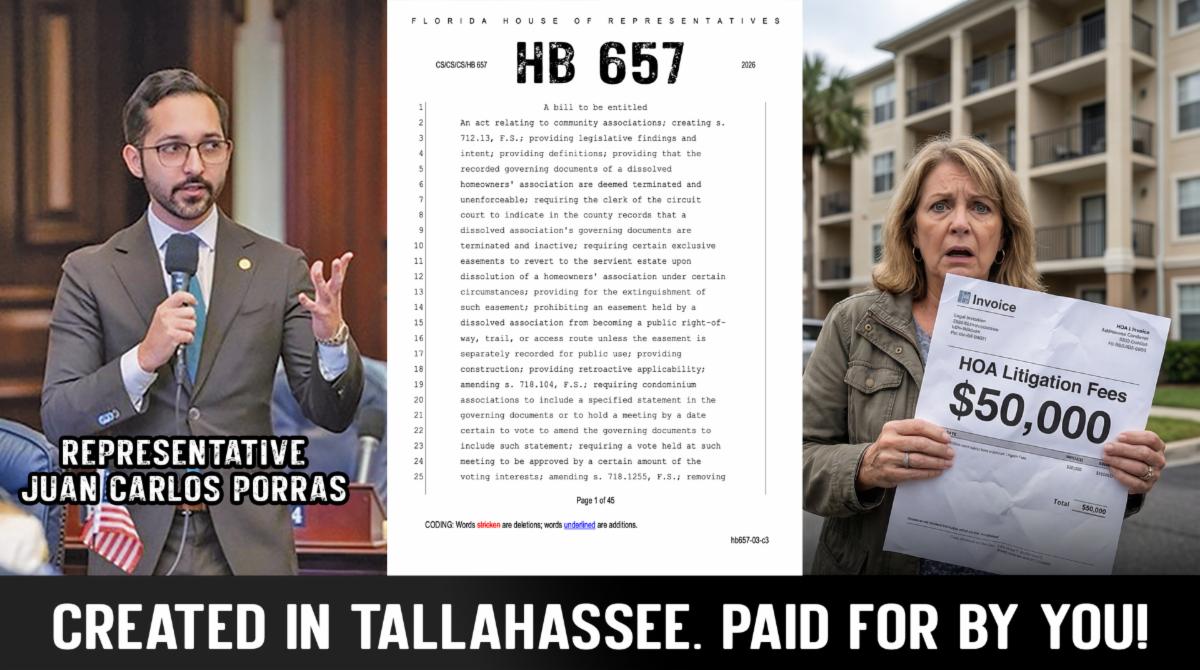
New episode of Condo Craze and HOAs watch now! click on pic below

HB 657: The End of HOA Mediation? What This Means for Your Wallet

click on pic below

Call us live at 717-GLAZER8 (717-452-9378) or leave your questions in the chat. Don’t miss this important discussion!

For decades, Florida required mediation before most HOA disputes went to court. It was designed to reduce lawsuits and control legal costs for homeowners.

HB 657 could change that.

If mediation is removed and disputes start in court, what happens next? More lawyers? More fees? More assessments?

We break down the bill, and what this could mean for condo and HOA owners across Florida.


HB 657 Will Hit HOA Owners Where It Hurts

HB 657 Will Hit HOA Owners Where It Hurts

  • Posted: Feb 24, 2026
  • By:
  • Comments: Comments Off on HB 657 Will Hit HOA Owners Where It Hurts

HB 657 proposes eliminating structured pre-suit mediation for HOA disputes and pushing owners straight into court.

That may sound procedural. It’s not. For decades, mediation has helped reduce lawsuits, legal fees, and financial exposure for homeowners. 

HB 657 changes that framework.

*If this bill passes, litigation becomes the starting point, not the last resort.

*Who pays when disputes go straight to court?

*Florida homeowners.

Read the full breakdown and decide for yourself.

If you believe HB 657 moves Florida in the wrong direction and could increase legal costs for homeowners, now is the time to speak up.

Legislators need to hear directly from the people who would be affected.

You can contact Representative Juan Porras here:

https://www.flhouse.gov/Sections/Representatives/contactmember.aspx?MemberId=4898

Be respectful. Be clear. Ask how eliminating structured mediation will protect homeowners from higher legal fees and increased litigation.

If you’re concerned about your pocketbook, don’t assume someone else will speak for you.


“Condo Craze & HOA’s” Watch us live on YouTube with Eric Glazer Sundays.

“Condo Craze & HOA’s” Watch us live on YouTube with Eric Glazer Sundays.

“Condo Craze & HOA’s”

Watch us live on YouTube with Eric Glazer

Sunday 11am

Eric Glazer graduated from the University of Miami School of Law in 1992 after receiving a B.A. from NYU. He has practiced community association law for more than 2 decades and is the owner of Glazer and Sachs, P.A. a five attorney law firm with offices in Fort Lauderdale and Orlando.

Eric is Board certified by The Florida Bar in Condominium and Planned Development Law and the first attorney in the State that designed a course that certifies both condominium and HOA residents as eligible to serve on a Board of Directors and has now certified more than 20,000 Floridians all across the state.

Mr. Glazer is certified as a Circuit Court Mediator by The Florida Supreme Court and has mediated dozens of disputes between associations and unit owners. Eric also devotes significant time to advancing legislation in the best interest of Florida community association members.

Join our YouTube Page and Watch the Show every Sunday 11am


The Florida Legislature just passed a 191-page bill that brings major changes for condo associations—especially when it comes to reserve funding.

The Florida Legislature just passed a 191-page bill that brings major changes for condo associations—especially when it comes to reserve funding.

FLORIDA LEGISLATURE GOES OUT WITH ONE BIG BILL FOR CONDOS

The Florida Legislature ended in a real blockbuster way in regards to new condo legislation.  In the end The Florida House and The Florida Senate agreed on ONE BIG BILL that is 191 pages long.  It passed the Senate unanimously and in the House there were only 2 opposed.  Obviously, we can’t talk about the entire contents of the bill in one blog.  It will take several, but today let’s discuss the big RESERVE FUND CHANGES.

As we know………….In 2021, The Champlain Towers collapsed in Surfside, killing 98 innocent men, women and children.  After that collapse The Florida Legislature did the right thing and for the first time, mandated that Florida condominium owners contribute toward funding a reserve account each year.  The vote was 110-0. 

Well…..that vote didn’t hold up to some extent.  Now, you can pay reserve funds by taking out loans, and in some circumstances you don’t have to pay reserves at all.  Let’s explain.

RESERVES BEING PAID BY LINES OF CREDIT

The Bill will allow funding reserves by using lines of credit. 

So year one you take out a line of credit to fund reserves.  You have to start paying it back with interest immediately, over a few years.

Year two you take out another line of credit to fund reserves……NOW YOU HAVE 2 LOANS WITH INTEREST

Year three you take out another line of credit to fund reserves…….NOW YOU HAVE 3 LOANS WITH INTEREST.

And this would now be allowed to go on year after year after year. 

As I previously wrote,  THIS IS LIKE PAYING YOUR MONTHLY CONDOMINIUM ASSESSMENTS BY USING A CREDIT CARD. 

AND………………….The money in reserves will eventually be used to pay for repairs, but all of these lines of credit  still need to be repaid each month.  It will be a never-ending process.  A never ending loan that all of the owners will have to re-pay with interest.  Eventually, the monthly payments will far exceed what the payments would have been if everyone was simply required to pay what the reserves required in the first place.   This is playing with fire and condominium owners will forever be in debt.  Count on it.

INVESTMENT OF RESERVE FUNDS

The Florida Legislature did agree with a blog we posted two weeks ago and which would have allowed reserve funds to be invested anywhere.  But as we stated – that was a bad idea and would have required an investment committee as well.

So the new law states:

A board shall, in fulfilling its duty to manage operating and reserve funds of its association, use best efforts to make prudent investment decisions that carefully consider risk and return in an effort to maximize returns on invested  funds.

(b) an association, including a multicondominium association, may invest reserve funds in one or any combination of certificates of deposit or in depository accounts at a community bank, savings bank, commercial bank, savings and loan association, or credit union without a vote of the unit owners.

A good bill – but it does leave open the question…..Suppose you do get the vote of the owners……can the owners vote to put the reserves in the stock market?   I don’t know.

AND HERE IS THE OTHER MASSIVE SURPRISE WHEN IT COMES TO RESERVE FUNDS

The new bill states:

For a budget adopted on or before December 31, 2028, (so this includes the association’s 2029 budget) if the association has completed a milestone inspection within the previous 2 calendar years, the board, upon the approval of a majority of the total voting interests of the  association, may temporarily pause, for a period of no more than two consecutive annual budgets, reserve fund contributions or reduce the amount of reserve funding for the purpose of funding repairs recommended by the milestone inspection. An association that has paused reserve contributions under this subparagraph must have a structural integrity reserve study performed before the continuation of reserve contributions in order to determine the association’s reserve funding needs and to recommend a reserve funding plan.

SO TO BE VERY CLEAR HERE……….THIS ONLY APPLIES TO ASSOCIATIONS THAT HAVE HAD THEIR MILESTONE INSPECTION, MEANING THEIR 25, 30, 35, 40, 45 OR 50 YEAR INSPECTION) WITHIN THE PREVIOUS 2 CALENDAR YEARS.  THIS DOES NOT MEAN THAT STARTING IMMEDIATELY, EVERY CONDO GETS TO PAUSE RESERVE FUND CONTRIBUTIONS FOR TWO YEARS.  THAT IS NOT WHAT THIS NEW LAW IS SAYING……. YOU ONLY GET TO PAUSE RESERVE FUND CONTRIBUTIONS FOR UP TO TWO YEARS, IF YOU HAD YOUR MILESTONE INSPECTION WITHIN THE LAST TWO YEARS.

AND THIS IS BEING ALLOWED IN ORDER THAT YOU HAVE THE FUNDS AVAILABLE TO MAKE THE REPAIRS REQUIRED BY THE MILESTONE INSPECTION.

In all honesty, this is not as bad as I originally thought it to be.  It gives owners the ability to make and pay for the necessary repairs while not simultaneously paying reserves —– but only for a two year period.

BUT I’M GOING TO GET A MILLION CALLS AND E-MAILS ASKING ME IF IT’S TRUE THAT WE DON’T HAVE TO PAY RESERVES IN OUR CONDOMIINIUM FOR THE NEXT TWO YEARS…….AND MY ANSWER IS GOING TO BE………..

ONLY IF YOU HAD YOUR MILESTONE INSPECTION WITHIN THE LAST TWO YEARS.

Again, this bill is massive.  We only scratched the surface.  Over the next few weeks, we’ll let you know what else is in the bill and we’ll let you know if Governor DeSantis signs it into law.

Tags:

HOUSE BILL 913 – Part Three

HOUSE BILL 913 – Part Three

HOUSE BILL 913 – Part Three by Eric Glazer

This bill, filed by Representative Vicki Lopez is even bigger than I originally thought and is going to take up more than 3 blogs.  It is packed with many potential changes to Florida Statute 718.  It already has passed one House Committee and there may be no stopping it.

CONFLICTS OF INTEREST

It is a conflict of interest for any person who performs a structural integrity reserve study or a milestone inspection to provide or contract to provide services for the repair or replacement of the condominium property that was the subject of such structural integrity reserve study or milestone inspection, or to have a financial interest with the person or entity providing the repair or replacement services.

RECALLS

Rejection of a unit owner’s recall agreement under this section applies when the recall agreement:

a. was improperly served;

b. was executed by a person who was not a unit’s record  owner or designated voter;

c. was previously marked for the removal of any board member;

d. does not contain any markings that indicate the selection by a unit owner to either remove or retain a board member; or 

e. does not contain the signature of the unit owner.

3. there is a rebuttable presumption that a unit owner executing the recall agreement is the designated voter for the unit.

An association may not enforce a voting certificate requirement if the association has not enforced such requirement in all matters requiring the use of voting certificates in the year immediately preceding service of the recall agreement.

4. A rescission or revocation of a unit owner’s recall  agreement must be in writing and delivered to the association before the association is served with the written recall agreement. this subparagraph must be liberally construed to ensure a unit owner is not disenfranchised by an association in a recall and to prevent an association from failing to certify a recall agreement on a technical omission which is not a part in the discharge of the unit owner’s voting rights.

Even if your right to vote was suspended — you still have the right to vote in a recall.

HURRICANE PROTECTION

Unless otherwise provided in the declaration as originally recorded, or as amended, a unit owner is not responsible for the cost of any removal or reinstallation of hurricane protection, including exterior windows, doors, or other apertures, if its removal is necessary for the maintenance, repair, or replacement of other condominium property or association property for which the association is responsible.

The board shall determine if the removal or reinstallation of hurricane protection must be completed by the unit owner or the association if the declaration as originally recorded, or as amended, does not specify who is responsible for such costs. if such removal or reinstallation is completed by the association, the costs incurred by the association may not be charged to the unit owner. if such removal or reinstallation is completed by the unit owner, the association must reimburse the unit owner for the cost of the removal or reinstallation or the association must apply a credit toward future assessments in the amount of the unit owner’s cost to remove or reinstall the hurricane protection.

Tags: ,
HOUSE BILL 913 – Part Two

HOUSE BILL 913 – Part Two

HOUSE BILL 913 – Part Two by Eric Glazer

As we said last week, it should come as no surprise that Representative Vicki Lopez came right out of the gate this year and filed a massive condo bill with House Bill 913. The bill covers many categories and we’ll break the bill down over the next few issues. It already has passed one House Committee and there may be no stopping it.

BOARD MEETINGS

Board of administration meetings.—in a residential condominium association of more than 10 units, the board of administration shall meet at least once each quarter. At least four times each year, the meeting agenda must include an opportunity for members to ask questions of the board, including questions relating to the status of any construction or repair projects, the status of all revenue and expenditures during the current fiscal year, and any other issues affecting the condominium..

RIGHT TO OBTAIN A LINE OF CREDIT

For an annual budget adopted on or before December 31, 2027, the members of a unit-owner-controlled association may approve, by a majority vote of the total voting interests of the association, the provision of a secured line of credit for up to 35 percent of the amount of the reserves required to meet the reserve funding schedule recommended by a structural integrity reserve study with respect to items with an estimated remaining useful life of greater than 10 years.

So if in the 2026 budget you have to reserve $200,000 for items with an estimated useful life of greater than 10 years —- the association can take out a $70,000.00 line of credit.

POOLING RESERVES

An association’s structural integrity reserves may be pooled for two or more required components. But may only be pooled with other components in the structural integrity reserve study. 

So what do you think?

Tags: ,
HOUSE BILL 913 – Part One

HOUSE BILL 913 – Part One

HOUSE BILL 913 – Part One by

It should come as no surprise that Representative Vicki Lopez came right out of the gate this year and filed a massive condo bill.  House Bill 913 covers many categories and we’ll break the bill down over the next few issues.  It already has passed one House Committee and there may be no stopping it.

INSURANCE

Citizens Insurance (the state’s insurance provider and the insurance company of last resort) may not issue or renew an insurance policy for a condominium unit owner or a condominium association unless the condominium association has complied with the inspection requirements in ss. 553.899 (milestone inspections) (and 718.112(2)(g) (structural integrity reserve study).

If you’re an advocate of safety you can’t disagree with this bill.

SPECIAL ASSESSMENTS AND LOANS FOR MAINTENANCE

In the interest of public safety and allowing the board members to meet its’ fiduciary duty that the board members owe to the owners – notwithstanding any provision to the contrary contained in an association’s declaration, articles of incorporation, or bylaws, the board of administration of an association may levy special assessments and obtain a loan to perform necessary maintenance, repair, or replacement of the condominium property as required by the milestone inspection report and structural integrity reserve study report without the approval of the membership in order to protect the health and safety of the unit owners and tenants of the property.

The courts were going in this direction already.  Let’s face it.  If the Board had to wait until the owners approved assessments and loans, neither would ever happen.

THE ASSOCIATION’S WEBSITE

The adopted minutes of all meetings of the association, the board of administration, and the unit owners over the preceding 7 years must now be on the association’s website.

Makes total sense.  The more transparency, the better.

So what do you think about HB 913?

Tags: ,
2025 –THE BEGINNING OF MASSIVE CHANGES TO OUR CONDO COMMUNITIES

2025 –THE BEGINNING OF MASSIVE CHANGES TO OUR CONDO COMMUNITIES


There are certain years that are more defining than others. Certain years that stand out. Well, if you live in a Florida condominium, 2025 will be that year. To understand why, we have to pay respect to another year that stands out more than any other ever will, and that is 2021, the year the Champlain Towers collapsed in Surfside, Florida killing 98 innocent men, women and children.


As a result of 2021, and The Florida Legislature’s promise to Floridians that another Surfside will never happen again, massive legislation was passed requiring mandatory inspections, mandatory repairs, mandatory education for Board members and perhaps the most important and controversial new law, the requirement to fund reserves for your condominium that is 3 stories or taller, based upon a Structural Integrity Reserve Study that needed to be prepared by an architect, engineer or someone with CAI credentials and completed by December 31st, 2024.


If you didn’t do it yet —– you’re late and in violation of Florida law.


Think about this…….any condominium budget you will ever pass again must include mandatory reserves based upon the results of that structural integrity reserve study. Here’s the new law:


For a budget adopted on or after December 31, 2024, the members of a unit-owner-controlled association that must obtain a structural integrity reserve study may not determine to provide no reserves or less reserves than required by Your Structural Integrity Reserve Study.


Here’s what a structural integrity reserve study is and how often it must be performed:


(g) Structural integrity reserve study.—

1. A residential condominium association must have a structural integrity reserve study completed at least every 10 years after the condominium’s creation for each building on the condominium property that is three stories or higher in height, as determined by the Florida Building Code, which includes, at a minimum, a study of the following items as related to the structural integrity and safety of the building:


a. Roof.

b. Structure, including load-bearing walls and other

primary structural members and primary structural

systems as those terms are defined in s. 627.706.

c. Fireproofing and fire protection systems.

d. Plumbing.

e. Electrical systems.

f.  Waterproofing and exterior painting.

g. Windows and exterior doors.

h. Any other item that has a deferred maintenance

expense or replacement cost that exceeds $10,000

and the failure to replace or maintain such item

negatively affects the above items as determined

by the visual inspection portion of the structural

integrity reserve study.


Yes – for those condo associations that have ignored funding reserves for years or decades — your bill has come due. And it’s going to be expensive. For those of you who thought it was a bad idea to put away money for a rainy day because you might not be alive at that time —- I guess the bad news is —–YOU LIVED!

 

Out With the Old, In With the New by Published by Eric Glazer, Esq.

Out With the Old, In With the New by Published by Eric Glazer, Esq.

The Presidential Inauguration is a reminder of how smoothly leadership transitions can happen at the national level. But in our community associations, things aren’t always so predictable. Discover insights into the often chaotic turnover of power in Florida condos and HOAs—and what it means for your community.

Whether you’re happy about today’s Presidential Inauguration or not, one thing is for sure and for certain; it’s going to happen. Since 1937, it has taken place at noon on January 20, the first day of the new term, except in 1957, 1985, and 2013, when January 20 fell on a Sunday. In those years, the presidential oath of office was administered on that day privately and then again in a public ceremony the next day, on Monday, January 21.

That consistency is a lot more than we can say for our community associations. How many of you have complained that our associations have not held an annual meeting or an election in forever, or at least not in the last year? What about complaints that the Board of Directors has simply changed the dates of our annual meeting on more than one occasion and extended their term in office?

The terms of Board members expire at the annual meeting. So when are you supposed to have an annual meeting and election? The date of your annual meeting is contained within your bylaws. But suppose the Board wants to have the annual meeting on another date for any variety of reasons? Can they do so? Not according to one court which held that the annual meeting must be held on the date contained in the association’s bylaws. Not to do so would be as if an amendment was made to those bylaws without the proper vote of the unit owners.

And despite this ruling, dozens, if not hundreds or maybe even thousands of condominium and HOAs won’t hold their annual meeting and election this year on the date mandated by their own documents.

The last few years has also brought drama to the country regarding the requirements of outgoing administrations to turn over official records. Trump got charged with a crime and Biden was found to have wrongfully retained official records but wasn’t charged with a crime.

When it comes to condominiums, “An outgoing board or committee member must relinquish all official records and property of the association in his or her possession or under his or her control to the incoming board within 5 days after the election. The division shall impose a civil penalty as set forth in s. 718.501(1)(d)6. against an outgoing board or committee member who willfully and knowingly fails to relinquish such records and property.” Surprisingly, there is no equivalent statute for HOAs, except if that director was removed by way of recall.

So today, pomp and circumstance and tradition will rule the day and like clockwork, one administration will hand off to the incoming administration. And in our community associations, no doubt tradition is likely to continue as well. Perhaps that’s a rare example of where the government works better than we think.


Eric is Board Certified by The Florida Bar in Condominium and Planned Development Law.

Since 2009, Eric has been the host of Condo Craze and HOAs, a weekly one-hour show airing at 7 p.m. each Thursday on YouTube. This show allows viewers to engage in live chats with Eric and other participants but also enables a broader audience to access free advice, making valuable insights more widely available.

See: www.condocrazeandhoas.com

Eric is the first attorney in the State of Florida that designed a course that certifies condominium and HOA residents as eligible to serve on a Board of Directors and has now certified more than 20,000 Floridians all across the state. He is certified as a Circuit Court Mediator by The Florida Supreme Court and has mediated dozens of disputes between associations and unit owners. Eric also devotes significant time to advancing legislation in the best interest of Florida community association members.


Tags: , ,