Become our Member : JOIN SFPMA TODAY   LogIn / Register: LOGIN/REGISTER

SFPMA Industry Articles | news, legal updates, events & education! 

Find Blog Articles for Florida’s Condo, HOA and the Management Industry. 

Condo Craze and HOAs Radio Show on 850 WFTL every Sunday 11am – 12pm  Is now live on YouTube!

Condo Craze and HOAs Radio Show on 850 WFTL every Sunday 11am – 12pm  Is now live on YouTube!

  • Posted: Jan 10, 2022
  • By:
  • Comments: Comments Off on Condo Craze and HOAs Radio Show on 850 WFTL every Sunday 11am – 12pm  Is now live on YouTube!

Condo Craze and HOAs Radio Show on 850 WFTL every Sunday 11am – 12pm  Is now live on YouTube!

Condo and HOA Boards and Owners you can now watch the show ask questions.  Each Sunday morning we will bring to you topics and discussions for out industry.

Subscribe to our YOU TUBE PAGE. 

Condo Craze and HOAs In 2009, Eric began a career in radio, starting and hosting the weekly Condo Craze and HOAs Radio Show on 850 WFTL. Eric answers questions from the callers week in and week out and the show has become incredibly popular throughout the state. For more information, and to listen to past shows.

Eric M. Glazer is a native of Brooklyn, New York Mr. Glazer obtained his B.A. in Political Science at New York University. While at N.Y.U., Mr. Glazer was employed in the Kings County District Attorney’s Office. Mr. Glazer obtained his Juris Doctorate at the University of Miami School of Law. In 1994 he established Glazer and Associates, P.A. and has focused his career on representation of community associations and their members.

Visit our Website: https://www.condocrazeandhoas.com Board Certification Classes Eric has certified over 12,000 board members in the State of Florida, who are now eligible to serve on either a condominium or homeowner association board.


Tags: , ,
Community Association Collections 101: What Happens When An Owner Files For Bankruptcy? by Axela’s / Mitch Drimmer

Community Association Collections 101: What Happens When An Owner Files For Bankruptcy? by Axela’s / Mitch Drimmer

  • Posted: Dec 10, 2021
  • By:
  • Comments: Comments Off on Community Association Collections 101: What Happens When An Owner Files For Bankruptcy? by Axela’s / Mitch Drimmer

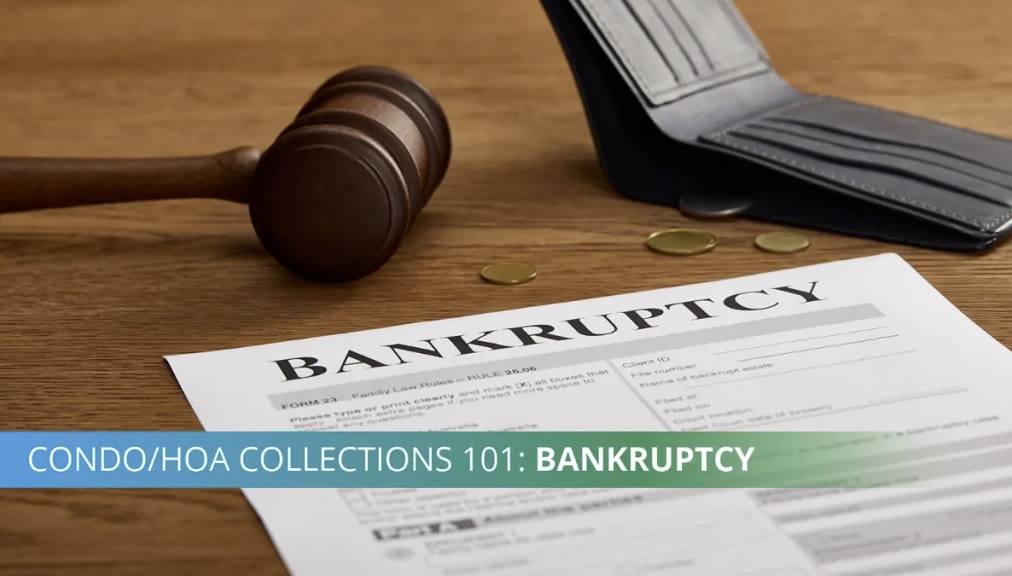
It seems as if bankruptcy will be the next big subject, this article is a step by step process for community associations

Community Association Collections 101:

What Happens When An Owner Files For Bankruptcy?

Bankruptcy NoticeThe collections process isn’t a fun one, and depending on what causes delinquency, it can get complicated. A homeowner who falls behind on just their association payments is one thing, but someone who’s so behind on all of their financials that they have to declare bankruptcy is a very different story. We’re asked all the time about what happens when a condo or HOA has to deal with homeowner bankruptcy. If your association is dealing with a bankrupt homeowner who is not paying their post-bankruptcy amounts, there are decisions to be made and steps that can be taken. Let’s review what must happen and how the community association can best navigate this situation.


Two LedgersWhat Happens When Bankruptcy is Filed?

Filing for bankruptcy isn’t a quick process. When a person, known as the “petitioner,” files for bankruptcy, they must file a list of their creditors with the bankruptcy court (which is a federal court). The creditors will be noticed with a “bankruptcy notification” and will be given a time frame by which to respond, usually under two months. Government claims can be submitted up to six months after the petition date (it’s good to be the government.)

There is no requirement that the response (or proof of claim) from the creditor must be submitted to the court via an attorney, which is good for you–the less an association is required to spend on costly attorney fees, the better. This proof of claim can be submitted by the association directly, the management company, or by a collections partner like Axela. Just be sure that everything that is legally owed to the association is included on that proof of claim–this should include assessments, late fees, late interest, fines and violations, special assessments, and any other sundry items that have been charged to the property. Be sure to double-check the ledger because it is expensive to get a second bite at that apple if you find you want to amend your claim with the court.

From there, the bankruptcy court will hold a “341 meeting,” which is a meeting between the debtor and the creditors but it is not mandatory for any creditor to attend. Then comes the really complicated part.


Types of Bankruptcy

It is important to know what type of homeowner bankruptcy you are dealing with as this knowledge will direct your business decisions going forward. When a property goes bankrupt in a community association, the community needs to prepare two ledgers: a pre-petition ledger and a post-petition ledger. You cannot add the post-petition amounts to the bankruptcy claim because next month’s bills are not this month’s debts. Regardless of which kind of bankruptcy they have filed, the petitioner has an obligation to pay the post-petition amounts during the bankruptcy. If the delinquent owner is NOT paying their post-petition debts, the association needs to make a decision and take action immediately, and the type of bankruptcy will determine which steps to take


Chapter 7

Complete wipeoutChapter 7 bankruptcy, also known as “no-asset” bankruptcy, is a complete wipeout. This means that no money will be recovered from the pre-petition amounts.  A Chapter 7 bankruptcy case can take as little as six months to complete because there is no settlement to be made. Creditors can claim to the court that there are assets being hidden but, in most cases, it is all over fairly quickly. If the delinquent owner is not paying the post-petition amounts, then the association can wait until the case is discharged and then move forward with collections activity. If the owner has been paying their post-petition amounts, then the issue is resolved albeit the association has taken a hit.


Chapter 13

Wage Earner;s PlanChapter 13 bankruptcy is known as a “wage earners plan” and is a workout where the court will make a settlement and oversee it until the payment plan has been completed. This is when the association needs to make a business decision.

In a Chapter 13 bankruptcy case, the pre-petition debts will not be discharged for 3-5 years, and the petitioner remains in bankruptcy. If they are not paying the post-petition amounts, the association cannot submit the delinquency for collections or to an attorney for foreclosure. The only course of action is for the association to ask the court for an “injunctive stay of relief” which is essentially asking the court to allow the association to move forward with collections and or foreclosure efforts.


So What Needs to Be Done?

If a unit owner files for Chapter 13 bankruptcy and is not paying their current assessments, it is not a stretch to believe that most likely they will never pay. It is unfair that the association needs to wait three to five years until the pre-petition debts are paid, the delinquent owner is discharged from bankruptcy, and the association can finally move forward. As we mentioned above, if a delinquent owner has filed for Chapter 13 bankruptcy and is not paying their current assessments, the association should file with the court a motion for injunctive relief. During the gap period, section 1519(a) of the Bankruptcy Code states that a bankruptcy court has the power to grant provisional injunctive relief and certain other forms of relief where “relief is urgently needed to protect the assets of the debtor or the interests of the creditors.” Additionally, an order staying execution against the debtor can also be granted. If a property owner is not paying their assessments, then the case can be made that a stay order is required to protect the assets (the property).


How to Handle Homeowner Bankruptcy in Your Association

The same way you’d handle any other bankruptcy situation in your association: call a professional. Homeowner bankruptcy in your association can be managed and worked through, but it takes a lot of knowledge and a lot of time. Many times, when a management company or a board of directors is reviewing delinquencies, the units that are delinquent and are also in bankruptcy get glossed over. There is a feeling that once a delinquent owner files for bankruptcy, the association has no options other than to wait until the bankruptcy is discharged. This is not the case as there are options and every case is unique. Axela Technologies has the experience, knowledge, and experience to deal with all these contingencies. Call us today for a no-cost, no-obligation analysis, and review of your delinquencies.


About the Author

Mitch Drimmer is a respected thought leader in his field and has led numerous continuing education classes in collections, His articles have been published in key trade journals and newspapers, and he is a speaker at educational seminars.

As the President of Business Development for Axela Technologies, Drimmer works with community associations and their management companies to introduce innovative strategies to collect delinquent maintenance fees.

Throughout his career, Drimmer has worked with community associations to help them see their way through tough times, especially during the real estate crash. He is a passionate advocate for community associations and has participated in the legislative process over the years trying to bring fair and equitable legislation that serves community associations.

Drimmer earned a Bachelor of Arts in History from Hunter College in New York City, and has worked in the community association collections space since 2007.


Tags: , ,
Corey Parshall is the founder of Parshall Tree Care Experts, a full-service tree company offering reinvented solutions to outperform and challenge the industry

Corey Parshall is the founder of Parshall Tree Care Experts, a full-service tree company offering reinvented solutions to outperform and challenge the industry

  • Posted: Dec 03, 2021
  • By:
  • Comments: Comments Off on Corey Parshall is the founder of Parshall Tree Care Experts, a full-service tree company offering reinvented solutions to outperform and challenge the industry

Corey Parshall is the founder of Parshall Tree Care Experts, a full-service tree company offering reinvented solutions to outperform and challenge the industry.

They deliver services to residential, commercial, municipal, and utility clients in Michigan and Florida! With a desire to break stereotypes and bring the tree service industry into the 21st century, Corey designed a business with unparalleled service.

Entering the market, Corey saw opportunity in the outdated practices that ensnare other companies. He understood the pitfalls in the tree service industry and decided to do his part to change it. He saw under-serviced clients and poor service in general. Using his entrepreneurial spirit, he started his own company to address these problems. Leveraging changes in technology, Parshall Tree Care aims to challenge themselves with creative ways of thinking, always looking to push the industry further.

Corey’s biggest challenges are the unknowns. In the early stages of running his business he experienced a lot of trial and error, discovering this was the most expensive way to learn and grow. Rather than bleeding money, Corey started investing in resources to grow his team instead. He found mentors that could help with problem-solving and educate the team. Before he knew it he had a clear roadmap that prevented him from constantly having to relearn everything.


With a mind focused on the positive, Corey believes your goals are within reach. A negative outlook can erode your confidence in taking calculated risks, while a positive outlook brings opportunity. Corey has noticed that when he keeps a positive mindset relationships line up, doors open, and he is generally luckier as an entrepreneur. By overcoming his biggest obstacle of thinking small, he found great success by intentionally setting unobtainable goals just to see what he and his team can achieve. Corey pays attention to fears that creep up when goal-setting. To him, fear is a communicator that action is needed to reach the desired opportunity.

For anyone interested in starting their own business, Corey recommends setting outrageous goals. He recommends anything considered to be a “good goal” should be multiplied by 1000 because you will probably underestimate rather than overestimate. Low expectations lead to boredom and if your business is boring you’re more likely to give up. Once you have a plan set, Corey suggests finding mentors, even if you have to pay for them. Learning from the experience of others saves you time and money in the long run.

Success, to Corey, is building a team that includes his family. In doing so, they find freedom from being tied down by that which is out of their control. He finds financial freedom knowing he and his family enjoy a better quality of life, and he has a legacy to share with generations to come. He loves sharing his success with his team as they experience the same freedom. At the end of the day, Corey’s dream is to see the entire tree service industry revolutionized—that they can leave a generational impact and improve an outdated industry.

Corey is so grateful to his staff for everything they do to help carry out the company’s mission, and to his clients who trust him to provide his service. He knows he can’t make a difference in the tree industry without either piece missing. This company isn’t about Corey Parshall, but the Parshall Tree Care Experts revolution. Parshall Tree TV, a free educational platform, is the latest division of the company.


Parshall Tree Care Experts

also have plans to grow their new offices in Ohio and Indiana, then expand toward the eastern US to Florida. But Corey’s ultimate goal is to be known as the industry leader in the tree service community.

Corey Parshall
Founder
Parshall Tree Care Experts
corey@parshalltreecare.com
877-250-2060
http://parshalltreecare.com


Tags: , ,
Financial Screening of Purchasers: How Far Is Too Far? by KBRLegal

Financial Screening of Purchasers: How Far Is Too Far? by KBRLegal

  • Posted: Dec 03, 2021
  • By:
  • Comments: Comments Off on Financial Screening of Purchasers: How Far Is Too Far? by KBRLegal

Financial Screening of Purchasers: How Far Is Too Far?

A few months back a case came before the county court in the 20th Judicial Circuit for Collier County, wherein a prospective buyer challenged the validity of a board-adopted rule which required that all prospective buyers provide two years of tax returns with their application for ownership approval. This requirement was in addition to the background check and credit check that were also required. While this is only a county court case and, therefore, has no precedential value other than to the parties themselves, there are principles addressed of which associations and managers should be aware; even though many learned attorneys would opine that the conclusions of the court are legally flawed under the facts of the case and, if appealed, would likely be overturned. Nevertheless, there are still nuggets of knowledge that can be gleaned from this case.

In this case, Mech v. Crescent Beach Condominium Association, Inc., Case No. 19-SC-3498, decided June 2020, the purchaser, who was the plaintiff, was seeking to buy a unit at Crescent Beach Condominium for $400,000, which was to be paid in cash. The purchaser purportedly had a clean background and a credit score of 800. Nonetheless, the board required that, like all other prospective purchasers at the condominium, this purchaser needed to produce his tax returns in order for the association to approve the transfer. The purchaser refused to provide his tax returns and cited his good credit score and clean background as evidence enough for approval. Eventually, an impasse was reached, and the purchaser canceled the contract. Then he brought the county court lawsuit challenging the requirement. (Generally speaking, typically under current Florida law, the purchaser would not have legal standing to even bring the claim against the association; but it does not appear that this legal infirmity was raised by the association, which allowed the case to proceed.)

The purchaser challenged the rule, arguing that the rule was not within the scope of the association’s authority to adopt, nor did it reflect reasoned decision-making. (It is noteworthy to point out that, after the initiation of the lawsuit, the association amended its declaration of condominium to provide that the association may require tax returns in an application for approval of a sale. However, this is not relevant to the conclusions of the Court in this case since it occurred after the litigation was filed.)

The association argued that the tax returns are necessary because they provide more information than a credit report and could help ensure that the potential purchaser is “a good credit risk.” The Court, however, did not agree, calling the argument “nonsensical.” The Court goes on to identify what this judge considers to be the best indicator of a person’s financial history, and as a result, it is the only information the association is allowed to seek. (We note that this conclusion is also without a stated legal basis.)

In the final judgment, some might argue that the Court goes way beyond what proper judicial consideration and conclusions typically contain and indicates that she could find “NO justification for the invasive requirement that a full, or even partial, return would be required when, in fact, the board already requires a full background check and credit check.” While no legal support for the conclusion was provided, the Court held that the request for tax returns was invasive and unnecessary and that the requirement was “shocking.”

The Court objected to the blanket requirement that applied to every applicant regardless of the results of their background and credit checks. Had the tax returns only been required when an applicant’s credit history showed a history of financial instability or delinquencies, the rule may have been upheld by the Court. How-ever, the Court held that “to take a position that ‘every person’ who applies to be a member at is patently unreasonable and shall be stricken.” Lastly, also without a legal basis or ability, the Court ordered the association to strike all reference in its condominium documents which require potential purchasers to produce tax returns unless the association can show good cause to request the information.

A brief discussion regarding the adoption of rules and regulations is necessary to highlight lessons that can be learned from this case. Generally, both condominium and homeowners association governing documents will typically provide that the board of the directors has the authority to adopt rules and regulations for the community. While some governing documents may contain restrictions requiring a membership vote to approve new rules, it is common for the governing documents to provide the board with the authority to adopt rules and regulations. (Careful review of the documentary authority for each community is recommended as some may limit the rule-making authority to common areas only and not to the residential property within the community.)  Although the board is generally authorized to adopt rules and regulations, those rules and regulations must not conflict with any provision expressly set out in the governing documents or reasonably inferred from them, and they must be reasonable. (This should be contrasted with covenants recorded in the County’s official records, which may be unreasonable and still be legally enforceable under long-standing Florida case law.)

In Beachwood Villas Condominium v. Poor, et. al., a 1984 Fourth District Court of Appeal (4th DCA) case  in which several owners challenged rules enacted by their association’s board of directors, the Court noted that there could be two sources of use restrictions: (i) those set out in the declaration of condominium and (ii) those adopted by the board. As to the use restrictions set out in the declaration, the court held that such restrictions are “clothed with a very strong presumption of validity,” as initially provided in Hidden Harbor Estates v. Basso (a 1981 4th DCA case).

In examining board-adopted rules, the court first must determine whether the board acted within its scope of authority—in other words, whether the board had the express authority in the documents to adopt the rule in the first place. If the answer is “yes,” the second question to determine is whether the rule conflicts with an express provision of the governing documents or one that is reasonably inferred. (If the documents are silent on an issue, the inference is that it is unrestricted. Adopting a rule to restrict a topic that the declaration is otherwise silent about would conflict with the inferred unrestricted use and therefore be unenforceable.)  If these first two issues are found to exist, the court will then determine if the rule is reasonable. The board’s exercise of its reasonable business judgment in adopting a rule is generally upheld so long as the rule is not “violative of any constitutional restrictions and does not exceed any specific limitations set out in the statutes or condominium documents.”

In examining your own board-adopted rules, ask the following:

  • Did the board have the power to adopt the rule?
  • Is the rule in accord with with the declaration, articles of incorporation, or bylaws?
  • Is the rule reasonable under the circumstances? (While ultimately only a court can make this final determination, the board should use its best judgment, with assistance of its counsel, to reach this decision.)

If the answer to these three questions is “yes,” then the rule should be found to be valid and enforceable by the court upon an owner challenge.

Ultimately, what can be gleaned from Mech v. Crescent Beach Condominium Association Inc. is that even if the association acts reasonably when adopting rules and even when amending the declaration, a lower court judge can reach almost any decision it wishes. Had the provision at issue only required tax returns when the background or credit checks revealed that the prospective purchaser had a history of financial irresponsibility, the provision may have withstood judicial challenge by this particular judge. Additionally, had the provision requiring tax returns been set out in the declaration before the initiation of the lawsuit, the outcome may have been different under existing, well-established case law.

Bottom line, whenever the board is considering new rules, it is recommended that the board consult with the association’s legal counsel before adopting them.

(Reprinted with permission from KBR Legal)

Jeffrey Rembaum’s, Esq. of Kaye, Bender, Rembaum attorneys at law, legal practice consists of representation of condominium, homeowner, commercial and mobile home park associations, as well as exclusive country club communities and the developers who build them. Mr. Rembaum is a Certified Specialist in Condominium and Planned Development Law. He is the creator of ‘Rembaum’s Association Roundup’, an e-magazine devoted to the education of community association board members, managers, developers and anyone involved with Florida’s community associations.  His column appears monthly in the Florida Community Association Journal. Every year since 2012, Mr. Rembaum has been selected to the Florida Super Lawyers list and was also named Legal Elite by Florida Trends Magazine. He can be reached at 561-241-4462.

Tags: , ,
Royale Management Services, Inc., call today for a free quote and proposal!

Royale Management Services, Inc., call today for a free quote and proposal!

  • Posted: Dec 02, 2021
  • By:
  • Comments: Comments Off on Royale Management Services, Inc., call today for a free quote and proposal!

CONDOMINIUM, COOP & HOME OWNERS ASSOCIATION MANAGEMENT

Royale Management Services, Inc. is a full-service, Condo Association Management (CAM) licensed, residential property management company, specializing in management, consulting and accounting for Condominium Associations and Home Owners Associations in South Florida: Broward, Dade & Palm Beach County.


We provide the highest quality, most cost effective management services your community and homeowners will find anywhere.

Accounting & Bookkeeping

Financial Management

Property Management

Web Services

Royale Management Services, Inc., exists to meet the needs of association owners, board members, and officers by providing, with the highest quality and integrity, association management, accounting and financial services, while controlling costs and making each community a better place for every owner.

We offer unprecedented access and transparency to the owners, board members and officers of each community we serve. Association records are open and available 24 hours a day, 365 days a year for inspection via our secure web portal. These records include all check, invoices, contracts, receivables, deposits, payments and correspondence.  Our revenue comes from management fees and disclosed charges included in our management agreement. We do not provide or perform services through related companies or divisions that add additional margins and profits to our bottom line. We maintain no preferred contractor lists based on any form of revenue sharing or other fees and associations and their boards are free to use existing contractors or others outside service.

We aim for and reach superior, measurable standards of quality with every service we provide. We serve only local associations (Broward County) where owners, board members, and officers can have access to all our professional staff and where we can be sure that all activities are supervised by our senior staff.

Our clients will regard us not only as a national leader in the world of association management and financial problem solving but also as a trusted friend and ally; as a partner in the pursuit of their community goals and objectives.

The Royale Management Services name will be synonymous with superior service-superior not only in quality and quantity but also in spirit. Mere adequacy of quality and quantity of service is not sufficient to satisfy the commitment we have made to our clients. In fact, it’s the spirit in which we deliver our service that makes us unique. In a large part, it is the spirit which accounts for the Royale Management Services difference.


Tags: , ,
Real Estate Boom Meets the Crypto Boom Here in Miami – HUGO ALVAREZ

Real Estate Boom Meets the Crypto Boom Here in Miami – HUGO ALVAREZ

  • Posted: Nov 21, 2021
  • By:
  • Comments: Comments Off on Real Estate Boom Meets the Crypto Boom Here in Miami – HUGO ALVAREZ

Real Estate Boom Meets the Crypto Boom Here in Miami

Like our climate, there is no denying that South Florida’s real estate market has been scorching hot.  But while South Florida is well known for its real estate booms and busts, the current cycle is also running right into the latest technological wave – cryptocurrency.

Home prices have climbed to record numbers.  Those prices have been driven by a lack of supply but also by COVID related work and travel restrictions, which make year-round warm weather climates like South Florida very attractive.

At the same time, and while more people are staying at home to work, we have also seen a surge in cryptocurrency demand.  At the time this is posted, Bitcoin is trading at prices greater than $65,000 and analysts are predicting that its price will rise higher by year’s end and beyond.

Miami is currently undergoing a tech boom of its own.  This tech boom coincides with the ongoing and growing demand for cryptocurrency coupled with its unique geographic location.  Miami has hosted, and will continue to host, numerous high profile cryptocurrency events.  And with those high-profile events we will see more demand for our real estate.

All this to say, it is only a matter of time before using cryptocurrency to purchase real estate becomes routine.  We are not there yet but that day is coming.

Opening potential real estate transactions to crypto holders broadens the pool of buyers that sellers can sell to.  But doing so is not without risk.

Crypto is unregulated and prone to fraud.  Crypto transactions may violate certain laws and regulations intending to govern “traditional” transactions.  For instance, the anonymity associated with cryptocurrency may prove challenging when trying to trace the source of the funds which is often a requirement for a “traditional” real estate transaction.  Additionally, given the volatile nature of the crypto price fluctuations it may be difficult to peg the actual sales price of the real estate until the “very last minute.”  And then there are numerous tax implications associated with any crypto transaction that may further complicate a real estate transaction.

While there are numerous challenges in rendering a crypto transaction common place today, with the advent of Web 3.0, and the continued growth of cryptocurrency, it is only a matter of time before real estate transactions are routinely funded in this way.

And Miami, with its booming tech movement and thriving real estate market, will be at the forefront of this coming trend.

Feel free to contact me should you wish to discuss Miami’s ongoing tech movement, crypto, or real estate in general.


Hugo Alvarez

HALVAREZ@beckerlawyers.com

Tags: , , ,
Cohen Law Group is proud to once again support The Leukemia & Lymphoma Society’s / Members Can you also help!

Cohen Law Group is proud to once again support The Leukemia & Lymphoma Society’s / Members Can you also help!

  • Posted: Nov 11, 2021
  • By:
  • Comments: Comments Off on Cohen Law Group is proud to once again support The Leukemia & Lymphoma Society’s / Members Can you also help!


Cohen Law Group is proud to once again support The Leukemia & Lymphoma Society’s (LLS) mission to cure leukemia, lymphoma, Hodgkin’s disease and myeloma, and improve the quality of life of patients and their families through our participation in the Central Florida Light The Night. Light The Night is LLS’s annual fundraising event and the nation’s night to pay tribute and bring hope to people battling cancer.
As you may already know, my daughter Madison is a blood cancer survivor. See her story by clicking on the video below.
Madison Cohen and Harvey Cohen share their touching story of survival and hope.
The Leukemia & Lymphoma Society is an organization that I continue to support because I know first-hand that they are saving lives and I hope you can help us save lives as well.
Cohen Law Group has set an ambitious goal to raise $10,000 for the Central Florida Light The Night. We truly value the partnership that Cohen Law Group, has developed with you. We view you as a partner with Cohen Law Group in the effort to make our communities healthier.
I am asking you to please make a contribution to help us reach our goal.
I am confident that you will join us in stepping up to the challenge. Your tax-deductible contribution (LLS Federal Tax ID: 13-5644916) will greatly enhance these collective efforts. We also invite you to join Cohen Law Group at this year’s Light The Night virtual event on Friday, November 19.

Please join us in supporting an organization dedicated to saving and changing lives.

You can make a secure online donation by clicking on the link to our Team fundraising page

Click Here To Donate!

I look forward to your support of our efforts. Thank you and have a great day.


It’s more than a slogan, it’s our firm’s mantra. We are zealous in protecting your rights. We offer 24-hour availability through our answering service. Call us today.
(407) 478-4878
Tags: ,
Electronic Board of Directors and Membership Meetings in a Post-Covid-19 World

Electronic Board of Directors and Membership Meetings in a Post-Covid-19 World

  • Posted: Oct 26, 2021
  • By:
  • Comments: Comments Off on Electronic Board of Directors and Membership Meetings in a Post-Covid-19 World

Electronic Board of Directors and Membership Meetings in a Post-Covid-19 World


Well, it is not quite a post-COVID-19 world yet, but hopefully, it will be one day soon. We are, however, living in a post-governor-ordered-state-of-emergency world, meaning that the emergency powers granted to condominium, cooperative, and homeowners’ associations’ boards of directors by virtue of the governor’s emergency orders have come to an end, with this caveat: The emergency authority granted to community association boards of directors after the expiration of the governor’s emergency orders is, generally speaking, “limited to that time reasonably necessary to protect the health, safety, and welfare of the association and the owners and their family members, tenants, guests, agents, or invitees, and to mitigate further damage and make emergency repairs.” As such, each passing day diminishes the arguments supporting a board’s reasonable reliance on the utilization of these emergency powers. However, given the recent uptick in Covid cases plus ever evolving CDC guidance issued towards the end of July, 2021, some community associations may consider relying on the continuance of the emergency powers provision. If so, it is strongly recommended that such a community association receive proper guidance from its legal counsel.


Interestingly, until July 1, 2021, electronic meetings of community association members and boards of directors were not specifically addressed in the legislative grant of emergency powers which could be used during a governor-declared state of emergency. Rather, the emergency powers of days gone by provided that association boards of directors could conduct board meetings and membership meetings with notice given in as practicable a manner as possible, including publication, radio, United States mail, the Internet, public service announcements, and conspicuous posting on the common property or any other means the board deems reasonable under the circumstances. Notice of board decisions may be similarly communicated. In addition, the board could cancel and reschedule any association meeting. Under certain circumstances, decisions could be made on the spot, so to speak, without the need for a noticed meeting. The legislative emergency powers can be found in §718.1265, §719.128, and §720.316 of the Florida Statutes for condominium, cooperative, and homeowners’ associations, respectively. Nowhere in the pre-July 1, 2021 version of the emergency powers legislation did these powers set forth the clear right of the association to conduct solely electronic board and membership meetings, though due to life safety reasons, such power was inferred. However, it should be noted that effective July 1, 2021 the emergency powers legislation was significantly revised to provide for the use of electronic meetings during a governor declared state of emergency.


BOARD MEETINGS

With this as our backdrop, without a declared state of emergency can community associations continue to hold electronic board  meetings via platforms such as zoom? Let us examine the relevant legislation that bears on this important inquiry. As to condominium board meetings,

board or committee member’s participation in a meeting via telephone, real-time videoconferencing, or similar real-time electronic or video communication counts toward a quorum, and such member may vote as if physically present. A speaker must be used so that the conversation of such members may be heard by the board or committee members attending in person as well as by any unit owners present at a meeting… Meetings of the board of administration at which a quorum of the members is present are open to all unit owners… The right to attend such meetings includes the right to speak at such meetings with reference to all designated agenda items… [§718.112(2), Fla. Stat. (2020), Emphasis added]. Note that similar provisions are provided for cooperative associations in §719.106), Fla. Stat. (2020).]


As to homeowners’ association board meetings,

meeting of the board of directors of an association occurs whenever a quorum of the board gathers to conduct association business. Meetings of the board must be open to all members, except for meetings between the board and its attorney with respect to proposed or pending litigation where the contents of the discussion would otherwise be governed by the attorney-client privilege. A meeting of the board must be held at a location that is accessible to a physically handicapped person if requested by a physically handicapped person who has a right to attend the meeting… Members have the right to attend all meetings of the board. The right to attend such meetings includes the right to speak at such meetings with reference to all designated items. [§720.303(2), Fla. Stat. (2020), Emphasis Added.]

In addition, the “Florida Not For Profit Corporation Act,” set out in Chapter 617, Florida Statutes, which applies, in large part, to condominium, cooperative, and homeowners’ associations, so long as not in conflict with Chapters 718, 719, and 720 of the Florida Statutes (and certain other exceptions not relevant to this analysis), provides that,

Unless the articles of incorporation or the bylaws provide otherwise, the board of directors may permit any or all directors to participate in a regular or special meeting by, or conduct the meeting through the use of, any means of communication by which all directors participating may simultaneously hear each other during the meeting. A director participating in a meeting by this means is deemed to be present in person at the meeting. [§617.0820(4), Fla. Stat. (2020).]

Mixing all of these ingredients together so that they all have meaning clearly implies that the community association board can conduct its board meetings via electronic means, like Zoom.  However, in our opinion, a more prudent approach is to also make on-site accommodations available to those who wish to attend in person. This can be easily accomplished by ensuring the meeting is noticed in a physical location where the non-board member owners can listen and participate through use of an on-site speaker phone or computer that is preferably provided or otherwise arranged for by the association. (Reminder that Zoom also has a call in feature for those who do not access to, or are not comfortable with, a computer).


MEMBERSHIP MEETINGS

As to all community association membership meetings, members have a right to speak at meetings of the membership. Pursuant to §718.112(2)(d)7 and §719.106(1)(d)4, Florida Statutes, members of condominium and cooperative associations, respectively, have the right to participate in meetings of the unit owners with reference to all designated agenda items. Pursuant to §720.306(6), Florida Statutes, members of a homeowners’ association have the right to speak with reference to all items opened for discussion or included on the agenda. During elections and other meetings where a vote of the membership is at issue, members should be able to observe the tallying of ballots.


As to condominium associations, membership meeting requirements include the following:

An annual meeting of the unit owners must be held at the location provided in the association bylaws and, if the bylaws are silent as to the location, the meeting must be held within 45 miles of the condominium property… [§718.112(2)(d)1, Fla. Stat. (2020).]


As to cooperative associations, membership meeting requirements include the following:

There shall be an annual meeting of the shareholders… The bylaws must provide the method for calling meetings, including annual meetings… [§719.106(1)(d), Fla. Stat. (2020).]


As to homeowners’ associations, membership meeting requirements include the following:

The association shall hold a meeting of its members annually for the transaction of any and all proper business at a time, date, and place stated in, or fixed in accordance with, the bylaws. The election of directors, if one is required to be held, must be held at, or in conjunction with, the annual meeting or as provided in the governing documents… [§720.306(2), Fla. Stat. (2020).]


Furthermore, and of great importance, there is the following provision from the Florida Not For Profit Corporation Act, a/k/a Chapter 617, Florida Statutes:

If authorized by the board of directors, and subject to such guidelines and procedures as the board of directors may adopt, members and proxy holders who are not physically present at a meeting may, by means of remote communication participate in the meeting and be deemed to be present in person and vote at the meeting if:

1)    the corporation implements reasonable means to verify that each person deemed present and authorized to vote by means of remote communication is a member or proxy holder; and

2)    the corporation implements reasonable measures to provide such members or proxy holders with a reasonable opportunity to participate in the meeting and to vote on matters submitted to the members, including an opportunity to communicate and to read or hear the proceedings of the meeting substantially concurrent with the proceedings, and

3)    if any member or proxy holder votes or takes other action by means of remote communication, a record of that member’s participation in the meeting must be maintained by the corporation in accordance with §617.1601.

[§617.0721(3), Fla. Stat. (2020); internal numbering, punctuation, capitalization, and formatting removed; emphasis added.]


Therefore, the members at a membership meeting can participate electronically so long as the board has authorized it and has adopted appropriate procedures. Consultation with the association’s attorney is strongly encouraged, most especially if there will be any “live” voting at the membership meeting.


How members vote at an electronic membership meeting when the member attends virtually is an interesting question. Presently, there is no definitive procedure set out in the law for the member to cast their vote “live” during a zoom meeting. Rather, §617.0721(3) Fla. Stat. (2020), places the burden on the board of directors to adopt procedures in this regard.   Obviously, if your association has 400 members who all appear virtually at the membership meeting, live voting for all 400 members will prove to be logistically difficult, if not impossible. It may be far easier to have the members  vote i) in advance by proxy, limited proxy, absentee ballot as the case may be, or, ii)  if adopted by the association, vote electronically pursuant to the procedures as set out in §718.128, §719.129, or §720.317 (Fla. Stat. 2020). A hybrid approach could also be utilized where the association provides for electronic voting and proxy voting prior to the meeting and then only the remaining few voters who have yet to cast their ballot could cast their vote “live” during the meeting, subject to the requirements of §617.0721(3).

Practice tip 1: Remember, electronic voting can be used whenever a membership vote is needed, even if the meeting does not have a zoom type option for attendance so long as the association has followed the requirements to provide for electronic voting.

Practice tip 2 (For Homeowners’ Associations): If your association’s governing documents require or otherwise allow nominations from the floor of the election meeting, consider amending and removing this provision from the governing documents to clear the way for an electronic membership meeting and election.


IN SUMMARY

Perhaps the initial questions phrased above could be better asked as follows: Absent a declared state of emergency can a community association hold board and membership meetings exclusively via an electronic platform, such as Zoom? Unfortunately, this question has not been satisfactorily addressed by the legislature or the Florida Courts. However, in our opinion, the safer approach, and the one that will avoid the potential for a successful legal challenge by an owner, is to avoid holding meetings exclusively via Zoom when there is no declared state of emergency. Consider using the hybrid approach discussed above where both a physical location is provided along with an electronic component such as Zoom and where members are strongly encouraged to attend and participate electronically.

Can community association board meetings and membership meetings be both electronically and at a physical location for those that want to attend in person even if the business is primarily conducted electronically? The answer is “yes”, so long as certain procedural safeguards are put into place. e.g., the ability of the membership watching via Zoom to fully observe the counting of ballots.

Another approach is to consider amending the association’s bylaws to provide for electronic only board and membership meetings. However, doing so has not yet been legally tested in the Florida courts. Also, remember, too, that a homeowners’ association must provide for a physical location for its board meeting, if requested by a handicapped individual. Also, as these matters are not fully settled in the law, your association’s lawyer may have a different opinion and advise that the association may have electronic board and membership meetings without the need for a physical location.

This journey into the foray of electronic meetings demonstrates a clear need for the Florida Legislature to adopt legislation to make clear that both board and membership meetings may take place electronically without the need to also simultaneously provide for a physical location, most especially so long as the association provides a communal device on association property for not-so-tech-savvy members to observe and participate in the meeting. After all we are blessed to be living in the 21st century. Let’s take advantage of it and add a few tech savvy legislative provisions to our laws governing community associations.

It is recommended you consult with your association legal counsel on the adoption of reasonable rules to ensure your virtual/electronic meetings run smoothly while also ensuring that they are in compliance with the association’s governing documents and Florida Statutes, and for further discussion regarding amending the governing documents of the association to provide clear authorization for electronic board and membership meetings.


The Kaye Bender Rembaum Team Remains Available To You and Your Community Association

Visit KBRLegal.com for awesome free resources, including 2021 Legislation, news with Legal Morsels and Rembaum’s Association Roundup, and our Event Calendar, including upcoming free classes.


Tags: , ,
3 Common Lake & Pond Management Misconceptions by SOLitude Lake Management

3 Common Lake & Pond Management Misconceptions by SOLitude Lake Management

  • Posted: Oct 17, 2021
  • By:
  • Comments: Comments Off on 3 Common Lake & Pond Management Misconceptions by SOLitude Lake Management

3 Common Lake & Pond Management Misconceptions
Trent Nelson, Aquatic Specialist at SOLitude Lake Management


As an Aquatic Specialist with more than a decade of experience, I’ve assisted hundreds of property managers with their lake and stormwater pond management needs over the years. Despite the diverse types of lakes and ponds they oversee, I’ve noticed that many clients have the same set of concerns or misconceptions about their waterbodies. These often come to light as we work together to design a freshwater management program. Let’s take an in-depth look at some of these common assumptions. 

  • Lakes and ponds are permanent fixtures in the landscape

While lakes and ponds can be long-lasting features in our communities, they are not permanent. They fill with sediment that erodes from the shoreline or flows in during rainstorms. Weed growth and decomposition may lead to the development of muck. And trash, tree branches, and other pollutants can build up over time. 

The aging of a lake or pond is a natural phenomenon, but can be highly accelerated through human activity and industry, reducing a waterbody’s life by decades. If left unmanaged over the years, your waterbody could eventually fill up until it becomes a marsh or puddle. This is a process called lake and pond succession. 

The best way to prevent this inevitable decline is through proactive, ongoing management aimed at reducing erosion, nutrient pollution, muck development, and nuisance aquatic vegetation. These benefits are two-fold. In addition to prolonging the depth and overall lifespan of your lake or pond, you’ll also help prevent problems like algae, toxic cyanobacteria growth, bad odors, murkiness, invasive species infestations, fish kills, and more.


  • Herbicides pose a danger to non-targeted plants and animals

The most eco-friendly and long-lasting lake and pond management programs lean on holistic, natural solutions, but sometimes herbicides and algaecides are necessary to set your waterbody up for success. Herbicides tend to be a point of concern for property owners, but I’ve found that once they better understand the strict scientific processes surrounding the use of herbicides, their fears are alleviated. 

Herbicides used in the lake management industry are designed to exclusively target specific weed and algae species without impacting desirable plants and animals. They do so by interfering with the unique growth mechanisms identified in nuisance species that are not found in beneficial ones. Likewise, the concurrent use of eco-friendly compounds called surfactants helps confine herbicides and algaecides to the affected area without migrating elsewhere. Historically, herbicides have been applied by licensed professional ground crews, but new industry technologies like drones are making it possible to remotely apply products with more accuracy and efficiency, particularly in areas that are hard to reach or unsafe to navigate by foot. 

All herbicides must be evaluated and registered by the Environmental Protection Agency (EPA). In addition to collaborating with scientific authorities throughout the US, the EPA also carries out bilateral cooperative programs with the World Health Organization (WHO) and many other countries around the world. Once approved, all herbicides are subject to compliance monitoring and periodic reevaluation processes to ensure lasting safety and success. 


  1. All freshwater management programs are the same

It’s not uncommon for a property manager to assume that the solutions used on a friend or colleague’s lake or pond will work on theirs. Unfortunately, there’s no one-size-fits-all approach to lake and pond problems because no two aquatic ecosystems are the same. 

Your waterbody’s unique makeup and the way it responds to different treatments can be dictated by many factors, including water use, location, surroundings, plant and animal presence, pollution, and weather – just to name a few. Likewise, every stakeholder has different goals and budget requirements. That’s why freshwater management programs are most effective when customized for your unique aquatic environment. 

Typically, the program design process begins by establishing a baseline of your waterbody through a visual survey of the property and comprehensive water quality testing. Your Aquatic Specialist should work with you to identify the challenges your aquatic ecosystem is facing and determine the best course of action based on your needs and limitations. And because all of these factors can change over time, these conversations should continue on a regular basis. 


The management of lakes and ponds is truly a science and should be treated as such. When considering a management program, look for a freshwater management firm that prioritizes getting to know you and your aquatic ecosystem before implementing any services. Seek out an Aquatic Specialist who is educated about the responsible use of herbicides and is capable of sharing that knowledge with you in a clear manner. Our lakes and ponds are valued features that our communities rely on every day. If you oversee the management of these water resources, make sure you’re investing in both the present and its future.


Trent Nelson is an Aquatic Specialist at SOLitude Lake Management, the nation’s leading freshwater management firm specializing in the management of lakes, stormwater ponds, wetlands, and fisheries. Learn more about this topic at www.solitudelakemanagement.com/knowledge


Tags: , ,