SFPMA

SFPMA Industry Articles | news, legal updates, events & education! 

Find Blog Articles for Florida’s Condo, HOA and the Management Industry. 

 “2022 Legal Update” educational webinar with Michael Bender from Kaye Bender Rembaum

 “2022 Legal Update” educational webinar with Michael Bender from Kaye Bender Rembaum

  • Posted: Sep 23, 2021
  • By:
  • Comments: Comments Off on  “2022 Legal Update” educational webinar with Michael Bender from Kaye Bender Rembaum

 “2022 Legal Update” educational webinar with Michael Bender from Kaye Bender Rembaum to discuss recent legislation.

The webinar covered:

  • Senate Bill 602: Business Organizations (3:33)
  • Senate Bill 56: Assessment Notices (8:04)
  • Senate Bill 630: Community Associations (22:57)
  • Senate Bill 1966: Department of Business and Professional Regulation (1:28.29)
  • and More!

Click here to watch the recorded webinar or Watch it below now.

https://www.youtube.com/watch?v=OYek0k9Per0

Tags: , ,
TO ARBITRATE OR MEDIATE?  By Eric Glazer, Esq.

TO ARBITRATE OR MEDIATE? By Eric Glazer, Esq.

  • Posted: Sep 21, 2021
  • By:
  • Comments: Comments Off on TO ARBITRATE OR MEDIATE? By Eric Glazer, Esq.

TO ARBITRATE OR MEDIATE?

By Eric Glazer, Esq.

Prior to July 1st, 2021 if a condominium dispute arose, the parties were forced to first arbitrate the matter before the Department of Business and Professional Regulation.  The law has now changed and reads as follows:

(a) Before the institution of court litigation, a party to a dispute, other than an election or recall dispute, shall either petition the division for nonbinding arbitration or initiate presuit mediation.

As you can see, now the plaintiff has a choice to start the matter in arbitration or mediation.  So which one do you choose?

If you decide to go to arbitration, your case will be assigned to an arbitrator in Tallahassee.  The arbitrator will read the briefs, hold hearings and ultimately enter an order.  Someone will win and someone will lose.  The loser will pay the winner’s attorney’s fees.  The loser can then file in court for a trial de novo.  In effect, it’s an appeal of the arbitrator’s order and the case starts all over again.  The winner of the trial de novo gets their attorney’s fees and costs from the loser, including the arbitration fees.

So….the risk in going to arbitration is that if you lose, you may wind up not only paying your lawyer, but the other side’s lawyer too.

The alternative is to mediate the dispute.  I have been certified since 2007 as a Circuit Court mediator.  I truly enjoy mediating cases and helping the parties resolve their disputes.  At mediation, the parties appear with their attorneys.  The mediator explains that today is a good day to settle the case on mutually agreeable terms, rather than leave your fate up to a judge or jury.  If an agreement is reached, it is enforceable in a court of law.  The mediator allows the parties to make opening statements, then separates the parties and goes back and forth trying to achieve a settlement.

There is very little risk in going to mediation.  There is no “winner” or “loser” at mediation, so neither party has to worry about paying the other side’s attorney’s fees.  The parties split the cost of the mediator.

When I act as a mediator, I explain to the parties that neither side will get everything they want today, and that if at the end of the day both parties feel a little miserable, I probably achieved a fair result.


Tags: , , ,
Omnibus Bill (SB 630) Brings Changes for Florida Condos, Cooperatives and HOAs

Omnibus Bill (SB 630) Brings Changes for Florida Condos, Cooperatives and HOAs

  • Posted: Sep 09, 2021
  • By:
  • Comments: Comments Off on Omnibus Bill (SB 630) Brings Changes for Florida Condos, Cooperatives and HOAs

This year’s large community association omnibus bill will likely become law. This bill, which bears an effective date of July 1, 2021, contains changes which will impact condominiums, cooperatives and HOAs. At more than 100 pages, we will discuss only some of those changes in today’s CALL Alert. This bill, along with all the others CALL has been tracking throughout the 2021 Legislative Session, will be summarized in our year-end Legislative Guidebook.


Several of the Condominium changes include:

  • If a condominium association’s insurance policy does not provide rights for subrogation against the unit owners in the association, an insurance policy issued to an individual unit owner may not provide rights of subrogation against the condominium association. This will help prevent the rash of unfounded negligence claims against associations we’ve seen filed by at least one insurance company operating in Florida but may unfortunately result in increased premiums if subrogation against the culpable party in a loss is no longer possible.
  • Bids for work to be performed must be maintained for at least 1 year after receipt of the bid. Previously bids had to be maintained from the inception of the association.
  • A renter would have the right to inspect and copy only the declaration of condominium and the association’s bylaws and rules. Previously, a renter was only allowed to inspect and copy the Bylaws and rules.
  • An association may not adopt rules requiring a member to demonstrate any purpose or state any reason for a record inspection.
  • For condominiums with 150 or more units, an association, in lieu of posting copies of certain required documents to a website, may make those documents available through an application that can be downloaded on a mobile device.
  • Condominium associations may extinguish a discriminatory restriction in the governing documents (e.g., a provision which restricts ownership, occupancy or use of real property on the basis of race, color, national origin, religion, gender or disability) by board vote alone.
  • Confirms that board term limits are intended to be prospective with the service start date being on or after July 1, 2018.
  • Transfer fees will be increased to not exceed $150.00 (from the current $100.00 cap) and may be adjusted every 5 years in accordance with the Consumer Price Index (CPI).
    • Petitioners in recall disputes may now choose to either go directly to court with the dispute or to arbitration.
  • Contracts with a service provider that is owned or operated by a board member (or certain relatives with a financial relationship) are no longer prohibited.
  • The board may not prohibit the installation of a natural gas fuel station, and unit owners installing such stations must comply with all federal, state, and local laws.
  • A board may make available, install, or operate an electric vehicle charging station or a natural gas fuel station on the common elements or association property and establish the charges or the manner of payments by the unit owners, residents, or guests who use such stations. The station installation, repair, or maintenance will not constitute a material alteration or substantial addition to the common elements or association property.
  • Labor performed on or materials furnished for the installation of a natural gas fuel station or electric vehicle charging station may not be the basis for filing a lien against the association.
  • A challenge to a plan of termination may be handled via arbitration or mediation of the dispute.
  • This new law would allow the parties in a condominium dispute to now choose either presuit mediation (which has been used in HOA disputes) or arbitration through the Division of Condominiums, Timeshares and Mobile Homes (“Division”).
  • For election and recall disputes, mediation will not be an option, and such disputes must be arbitrated by the Division or filed in court.
  • The board can use emergency powers in response to damage or injury caused by or anticipated in connection with any occurrence, or threat thereof, whether natural, technological, or manmade, in war or in peace, which results or may result in substantial injury or harm to the population or substantial damage to or loss of property. This language was expanded to include emergencies caused by contagion.
  • The board may exercise its emergency powers to conduct board meetings, committee meetings, elections, and membership meetings, in whole or in part by telephone, real-time videoconferencing, or similar real-time electronic or video communication with notice given as is practicable.
  • Such notice may be given in any practicable manner, including publication, radio, US mail, the internet, electronic transmission, public service announcements, and conspicuous posting on the condominium property or association property or any other means the board deems reasonable under the circumstances.
  • Based upon advice of emergency management officials or public health officials, or upon the advice of licensed professionals retained by or otherwise available to the board, determine any portion of the condominium property or association property unavailable for entry or occupancy by unit owners, family members, tenants, guests, agents, or invitees to protect the health, safety or welfare of such persons.
  • The board may mitigate further damage, injury or contagion, including taking action to contract for the removal of debris and to prevent or mitigate the spread of fungus or contagion. This section may be used to justify heightened sanitation protocols.
  • The board can contract, on behalf of any unit owner or owners, for items or services which are necessary to prevent further injury, contagion, or damage, including, without limitation, sanitizing the condominium property or association property.
  • The emergency powers are limited to that time reasonably necessary to protect the health, safety, and welfare of the association and the unit owners and the unit owners’ family members, tenants, guests, agents, or invitees and shall be reasonably necessary to mitigate further damage, injury, or contagion and make emergency repairs.
  • Most importantly, when it comes to the changes to the emergency powers provisions in 718.1265, F.S., an association may NOT prohibit owners, tenants, guests, agents, or invitees of a unit owner from accessing the unit and common elements and limited common elements appurtenant thereto for if such access is needed to facilitate the sale, lease or other transfer of title to the unit. Presumably this language was included at the urging of the real estate industry because many associations restricted open houses and other in person showings of property during the height of the COVID-19 pandemic as well as in move-ins and move-outs in some cases.
  • Specifies that fines are due 5 days after notice of the approved fine is provided to the unit owner and, if applicable, to any tenant, licensee or invitee of the unit owner. Previously, fines were due 5 days after the date of the Fining Committee meeting at which the fine was approved.
  • Multicondominium associations may adopt consolidated or combined declaration of condominium but cannot merge the condominiums or change the legal descriptions of the condominium parcels, unless accomplished in accordance with law. This change applies to associations existing on July 1, 2021.
  • Expands the Division’s jurisdiction to now investigate complaints related to the maintenance of association records.

Several of the Cooperative changes include:

  • The definition of “Unit” is amended to state that “an interest in a unit is an interest in real property”.
  • The association may not require a member to demonstrate any purpose or state any reason in order to inspect the official records.
  • A board or committee member participating in a meeting via telephone, real-time video conferencing, or similar real-time electronic or video communication counts towards a quorum and such member may vote as if physically present.
  • The Petitioner in a recall dispute may choose to either go directly to court or to pursue arbitration with the Division.
  • Cooperative associations may extinguish a discriminatory restriction in their governing documents by Board vote alone. See the definition of a discriminatory restriction in the Condominium section above.
  • The same changes to the emergency powers language discussed above in Chapter 718 are also set forth in Chapter 719, F.S.

Several of the HOA changes include:

  • The definition of Governing Documents will no longer include Rules and Regulations.
  • In addition to the authorized means of providing notice of a board meeting, the association may also adopt a rule for posting the meeting notice and agenda on the association’s website or an application and must send an electronic notice including the hyperlink to the website or application to members whose e-mail addresses are included in the association’s official records.
  • The association must maintain for at least 1 year after the date of the election, vote, or meeting the ballots, sign-in sheets, voting proxies, and all other papers and electronic records relating to the parcel owners’ voting.
  • Information obtained in a gated community in connection with guests’ visits to parcel owners or community residents are records not accessible to members or parcel owners.
  • Reserves will only be considered mandatory if they are approved by a majority of the total voting interests or if the declaration, articles or bylaws obligate the developer to create reserves.
  • If the budget does not provide for reserve accounts under Section 720.303(6)(d), or the declaration, articles or bylaws do not obligate the developer to create reserves, and the association is responsible for the repair and maintenance of capital improvements that may result in a special assessment if reserves are not provided or are not fully funded, each financial report for the preceding year must contain certain disclosure language in conspicuous type.
  • The Petitioner in a recall dispute may choose to go directly to court or pursue arbitration with the Division.
  • Specifies that fines are due 5 days after notice of the approved fine is provided to the parcel owner and, if applicable, to any tenant, licensee or invitee of the parcel owner.
  • Removes the requirement that notices required by Section 720.306, Florida Statutes, be sent to the address on property appraiser’s website-notices only have to be sent to the mailing addresses found in the official records of the association.
  • Transports over the grandfathering of rental rights which has been in the Condominium Act for many years to the HOA Act. Any governing documents or amendments that prohibit or regulate rental agreements will apply only to owners who acquire title to the parcel after the effective date of the governing document or amendment, or to a parcel owner who consents, individually or through a representative, to the governing document or amendment. Existing owners who vote “no” or don’t vote on the rental restriction will not be governed by same. This restriction, however, does NOT apply to amendments or governing documents which seek to prohibit or regulate rentals for terms of less than six (6) months or to limit parcel rentals to no more than three (3) times per year. It will be important for HOAs with more than 15 parcels (this grandfathering of rental rights does not apply to associations with 15 or fewer parcels) who wish to impose other rental restrictions to do so before July 1 if they wish those restrictions to apply to all members.
  • For purposes of determining the applicability of a rental amendment or rental restriction, a change in ownership does not occur when a parcel owner conveys the parcel to an affiliated entity, when beneficial ownership of the parcel does not change, or when an heir becomes the parcel owner.
  • The Petitioner in an election or recall dispute now has the option to file for arbitration or file in court. These disputes are not eligible for presuit mediation.
  • Clarifies that turnover of control of an HOA will be triggered three months after 90 percent of the parcels in all phase of the community that will ultimately be operated by the homeowners’ association have been conveyed to members other than the developer.
  • HOA boards may extinguish a discriminatory restriction in their governing documents by board vote alone. See the definition of a discriminatory restriction in the Condominium section above.
  • The same changes to the emergency powers language discussed above in Chapters 718 and 719 are also being added to Chapter 720, F.S.

The foregoing are just some of the changes this bill creates for your association operations. Florida’s Legislative Session is scheduled to end on April 30th. Stay tuned for additional CALL Alerts and as promised, our comprehensive Legislative Guidebook.


DONNA DIMAGGIO BERGER

Contact: dberger@beckerlawyers.com

Donna DiMaggio Berger is a member of the College of Community Association Lawyers (CCAL), a prestigious national organization that acknowledges community association attorneys who have distinguished themselves through contributions to the evolution or practice of community association law and who have committed themselves to high standards of professional and ethical conduct in the practice of community association law. Ms. Berger is also one of only 129 attorneys statewide who is a Board Certified Specialist in Condominium and Planned Development Law.


Tags: ,
The Subtle and Not-So-Subtle Differences Between Homeowners and Condominium Associations Posted  by rembaumlaw

The Subtle and Not-So-Subtle Differences Between Homeowners and Condominium Associations Posted by rembaumlaw

  • Posted: Aug 27, 2021
  • By:
  • Comments: Comments Off on The Subtle and Not-So-Subtle Differences Between Homeowners and Condominium Associations Posted by rembaumlaw

Florida has created an abundance of legislation governing homeowners’ and condominium associations. You would think that, by now, laws affecting both types of communities would have more parity than they actually do. (Please note that that commercial condominiums are not addressed in this article.)

Perhaps the most appreciative difference between a homeowners association and a residential condominium association is that the homeowners association exists in common law, but the condominium only exists because of legislation adopted by the Florida Legislature. That said, homeowners associations are subject to Chapter 720, Florida Statutes, and condominium associations are subject to Chapter 718, Florida Statutes. There is both parity and significant differences between these two Acts, the latter of which are further addressed below. We begin by examining bidding.

Bidding: A homeowners association is only required to obtain bids if the aggregate cost of the project (referring to the materials, work, and/or services) exceeds 10 percent of the total budget including reserves, if any. On the other hand, condominium associations are required to obtain bids if the aggregate cost of the project exceeds 5 percent of the total budget including reserves, if any. Please note, there is no requirement in the legislation for a community association to obtain a definitive number of a bids. Therefore, at least two would be appropriate. Also remember, there are exceptions to the bidding requirement for professional services such as attorneys, accountants, and landscape architects.

Certified Written Inquiry: A condominium association owner has the right to send a certified written inquiry to the board, and the board is obligated to answer it within 30 days (or 60 days if the certified written inquiry is provided to the community association’s lawyer to respond to). A failure to respond means that if the owner files a legal action over the item for which certified written inquiry was provided and loses, the owner will not be responsible to pay for the association’s prevailing party attorneys’ fees. There is no similar provision for a homeowners association.

Common Areas: Common areas in a homeowners association are owned by the association itself. In other words, no owner can claim an ownership interest in a homeowner association’s common areas. However, as to condominiums, the equivalent of the homeowner association’s common area is referred to as “common elements”. All of the unit owners of the condominium association own an indivisible interest in the common elements.

Disputes: In a homeowners association, disputes between an association and a parcel owner regarding use of or changes to the parcel or the common areas and other covenant enforcement disputes, disputes regarding amendments to the association documents, disputes regarding meetings of the board and committees appointed by the board, membership meetings not including election meetings, and access to the official records of the association must be the subject of a demand for pre-suit mediation served by an aggrieved party before the dispute is filed in the local court. Before a homeowners association can commence litigation where the amount in controversy is in excess of $100,000, the approval of a majority of a quorum of the membership is required. There is no similar provision as applied to condominium associations.

In a condominium association, prior to the institution of court litigation, a party to a “dispute” (as such term is hereinafter defined) must petition the Division of Florida Condominiums, Timeshares, and Mobile Homes of the Department of Business and Professional Regulation for non-binding arbitration or, as of July 1, 2021, avail themselves of the presuit mediation process as set out in Chapter 720.  “Disputes” subject to mandatory arbitration or presuit mediation include 1) the authority of the board of directors, under this chapter or association document to: i) require any owner to take any action, or not to take any action, involving that owner’s unit or the appurtenances thereto ii) alter or add to a common area or element; or 2) the failure of a governing body, when required by this chapter or an association document, to: i) properly conduct elections ii) give adequate notice of meetings or other actions iii) properly conduct meetings iv) allow inspection of books and records; and 3) a plan of termination pursuant to §718.117, Fla. Stat.

Elections: Elections in a homeowners association take place as per the bylaws, while elections for condominiums take place following the regime set out in chapter 718, Florida Statutes, more specifically §718.112, Fla. Stat., and the provisions of the Florida Administrative Code. In order to hold a homeowners association election, a quorum must be attained unless the bylaws provide otherwise. No quorum is required to hold a condominium election, but rather 20 percent of the eligible voters need to cast a ballot in order to hold the election. In a condominium association of more than 10 units, co-owners of a unit cannot serve on the board at the same time unless there are not enough candidates, or they own more than one unit. Commencing July 1, 2018, condominium association board members cannot serve more than eight consecutive years absent certain exceptions (note, this statute is not retroactive in its application). There is no similar co-owner prohibition and term limit restriction for homeowners associations.

Elections by acclimation: In a condominium association if the same number of candidates, or less, run for the board as the number of seats available, then there is no need to have the election. This is referred to as an “election by acclimation” which means, those candidates will comprise the present board upon the annual meeting. If the election is contested because there are more candidates than seats available and at least 20 percent of the eligible voters do not cast a ballot, then last year’s board rolls over.

As to homeowners associations, if the election process allows candidates to be nominated in advance of the meeting, the association is not required to allow nominations at the meeting. An election is not required unless more candidates are nominated than vacancies exist. If an election is not required because there are either an equal number or fewer qualified candidates than vacancies exist, and if nominations from the floor are not required pursuant to the statute or the bylaws and write-in nominations are not permitted, then the candidates who nominated themselves in advance shall commence service on the board of directors regardless of whether a quorum is attained at the annual meeting. Otherwise, if those conditions are not met and a quorum is not attained for a homeowners association’s election, then last year’s board rolls over to this year’s board.

Elections, Voting: Unless otherwise set out in the bylaws, homeowners association members vote in the election for the board by proxy and/or ballot. On the other hand, condominium association owners cannot vote for the election of directors by proxy but rather must vote themselves by secret absentee ballot using the the inner and outer envelope system. A homeowners association only needs to use the inner and outer envelope system when the bylaws call for secret absentee ballots.

Fines: A condominium association cannot levy a fine greater than $1,000 for any one violation and cannot lien and foreclose the fine under any circumstances. In a homeowners association, an association can foreclose to collect a fine if both i) the fine is $1,000 or more and ii) the authority to lien is set out in the declaration.

Frequently Asked Questions and Answers Sheet: As to condominium associations §718.504, Fla. Stat., requires that a “Frequently Asked Questions and Answers” sheet be made available to prospective purchasers and to owners who request it. It must be updated annually and must include the following questions along with the answers to these questions: 1) What are my voting rights in the condominium association? 2) What restrictions exist in the condominium documents on my right to use my unit? 3) How much are my assessments to the condominium association for my unit type, and when are they due? 4) Do I have to be a member in any other association? If so, what is the name of the association and what are my voting rights in this association? Also, how much are my assessments? 5) Am I required to pay rent or land use fees for recreational or other commonly used facilities? If so, how much am I obligated to pay annually? 6) Is the condominium association or any other mandatory membership association involved in any court cases in which it may face liability in excess of $100,000? If so, identify each such case. There is no similar provision or requirement for homeowners associations.

Leasing Restrictions: Effective July 1, 2021  as to HOA leasing restrictions, any restriction that prohibits or regulates rental agreements applies only to (i) an owner who acquires title to a parcel after the effective date of the governing document or amendment, or (ii) an owner who consents, individually or through a representative, to the governing document or amendment.  As to condominium associations, according to §718.110(13), Fla. Stat., an amendment prohibiting unit owners from renting their units or altering the duration of the rental term or specifying or limiting the number of times unit owners are entitled to rent their units during a specified period, applies only to unit owners who consent to the amendment and unit owners who acquire title to their units after the effective date of the amendment.

Liens and Foreclosures: In a homeowners association, prior to recording a lien against a delinquent owner’s lot, the owner must be provided a statutorily compliant warning letter at least 45 days prior to recording the lien, warning the homeowner that if the assessment is not paid a lien may be recorded. Then, the owner must be provided a second letter at least 45 days prior to filing the foreclosure lawsuit warning that if the lien is not satisfied (paid-off), then a lawsuit to foreclose the lien may be filed anytime thereafter. For a condominium association the warning/waiting periods for both letters was 30 days. Effective July 1, 2021 this was changed to 45 days.

Material Alterations: Unless otherwise provided in the declaration of covenants and restrictions, a material alteration to a homeowners association’s common area is decided by the board. In condominium associations, material alterations require 75 percent approval of all unit owners unless the declaration provides otherwise.

Official Records Requests: In a homeowners association, official record requests must be made by certified U.S. mail to create the rebuttable presumption the association willfully failed to respond. There is no similar requirement for a condominium association. Every community association should adopt specific rules governing official records requests, how often they can be made, and where they must be delivered. If your association has not done so, you are urged to discuss this with the association‘s lawyer.

Quorums: A quorum of the membership for a homeowners association membership meeting consists of 30 percent of the entire membership unless a lower number is provided for in the bylaws. A quorum for a condominium association membership meeting occurs when there is a majority of the voting interests present unless a lower number is provided for in the bylaws.

Reserve Accounts: A homeowners association only has restricted reserve accounts if initially created by the developer or voted on and approved by a majority of the entire membership. In a condominium association, the budget must include reserve accounts for capital expenditures and deferred maintenance. These accounts must include, but are not limited to, roof replacement, building painting, and pavement resurfacing, regardless of the amount of deferred maintenance expense or replacement cost, and any other item that has a deferred maintenance expense or replacement cost that exceeds $10,000. Condominium boards and homeowners association boards with restricted reserves may propose lower or no reserves to the membership which is subject to approval by a majority of a quorum of the members. However, neither board is obligated to propose lower reserves. A condominium association board and a homeowners association board with restricted reserves must fully fund those reserves in the budget each year as must homeowners association boards whose association has adopted restricted reserves.

Transfer Fees: As per §689.28, Fla. Stat., transfer fees when buying and leasing a home in the state of Florida are prohibited. But, there are exceptions for both homeowners and condominium associations with this caveat. There is no cap, per se, that a homeowners association can charge a prospective member as a part of acquiring their property, but such fee must be authorized in the declaration (or other recorded document). However, as per §718.112 Fla. Stat., a condominium association can only charge up to $150 per applicant. A husband/wife or parent/dependent child are considered one applicant. A condominium association can only charge a transfer fee if it has the authority to approve transfers, and the authority for the transfer fee, specifically, must be set out in the declaration or bylaws (and as set forth above, as of July 1, 2021 it is presently limited to a maximum $150.00).

Warranties: A developer and general contractor of a condominium provides statutory warranties to buyers of units as further detailed in Chapter 718, Fla. Stat. There are no similar statutory warranties set out in Chapter 720, Fla. Stat., for buyers of a home within a homeowners association. A developer of a condominium, pursuant to relevant law, also provides an implied warranty of habitability. As to a homeowners association, §553.835, Fla. Stat., provides in relevant part that there is no such warranty for off-site improvements (i.e., the common areas) with a small exception for the shared components of a townhome type community.

Websites: A condominium association that has a condominium with 150 or more units must host an association website and post certain official records to it. Homeowners associations have no similar requirement.

If you have any questions in regard to these matters be sure to discuss them with an attorney of your choosing.

Tags: , ,
EVERYONE IS AN EXPERT  By Eric Glazer, Esq.

EVERYONE IS AN EXPERT By Eric Glazer, Esq.

  • Posted: Aug 12, 2021
  • By:
  • Comments: Comments Off on EVERYONE IS AN EXPERT By Eric Glazer, Esq.

EVERYONE IS AN EXPERT

By Eric Glazer, Esq.


I agree that a “reserve study” should be done by an accredited firm following the industry standard guidelines. We have used both Association Reserves and Reserve Advisors. The fact remains that both these and most other competent firms are in fact comprised of engineers and architects.

There is an larger issue in this: In a majority of cases, board members are qualified in NOTHING: Not in construction, not in finance, not in personnel management, etc. Which is why they should use a management company. And even so, how can they possibly assess the value of an opinion issued to them by a construction expert, a financial advisor etc…
Being a board member is a huge responsibility, and I always thought they should be qualified or certified before being admitted in a board.


Imagine a world where accountants can examine your heart and give you an opinion regarding its condition and your life expectancy.  Suppose an auto mechanic can examine your kidneys and liver and give his opinion on whether or not they are healthy.  Perhaps one day you can walk into my office and one of the attorneys here can take your blood and talk to you about your blood pressure, sugar and cholesterol.  If this all sounds crazy, it should.  This is exactly how the health of our buildings are determined.  Not by qualified experts like architects, engineers and general contractors, but by former cab drivers, teachers, nurses and the like.  Now these people may be the absolute best in their trained professions, but they certainly are not qualified to make a determination of the condition of the condominium property and the life expectancy of things like the roof, structure and electrical systems. Yet, this is what is going on in Florida as we speak.

For about a two year period of time, condominiums were required to have a reserve study performed by an architect or engineer.  But in 2010 Governor Charlie Crist signed a bill which repealed that requirement.  So since then, the reserve study analysis can be performed by the butcher, baker and candle stick maker.

We all know that the analysis is a joke.  If a new Board comes in that wants to save money and decrease assessments, suddenly the roof has a greater life expectancy than before.  Somehow, like fine wine, the roof got better with age.  It’s a miracle!

The current law is dangerous on so many levels.  It’s so obvious that it would be insulting to all of you to even have to explain further.

Next legislative session I urge all of you to contact your legislators and demand that Florida Statute 718 be amended to again require that reserve studies be performed by an architect or engineer.  Unless your Board has an architect or engineer serving, the Board is simply not qualified to do the analysis.


Tags: , ,
The Subtle and Not-So-Subtle Differences Between Homeowners and Condominium Associations

The Subtle and Not-So-Subtle Differences Between Homeowners and Condominium Associations

  • Posted: Jul 20, 2021
  • By:
  • Comments: Comments Off on The Subtle and Not-So-Subtle Differences Between Homeowners and Condominium Associations

The Subtle and Not-So-Subtle Differences Between Homeowners and Condominium Associations

Florida has created an abundance of legislation governing homeowners’ and condominium associations. You would think that, by now, laws affecting both types of communities would have more parity than they actually do. (Please note that that commercial condominiums are not addressed in this article.)

Perhaps the most appreciative difference between a homeowners association and a residential condominium association is that the homeowners association exists in common law, but the condominium only exists because of legislation adopted by the Florida Legislature. That said, homeowners associations are subject to Chapter 720, Florida Statutes, and condominium associations are subject to Chapter 718, Florida Statutes. There is both parity and significant differences between these two Acts, the latter of which are further addressed below. We begin by examining bidding.


Bidding: A homeowners association is only required to obtain bids if the aggregate cost of the project (referring to the materials, work, and/or services) exceeds 10 percent of the total budget including reserves, if any. On the other hand, condominium associations are required to obtain bids if the aggregate cost of the project exceeds 5 percent of the total budget including reserves, if any. Please note, there is no requirement in the legislation for a community association to obtain a definitive number of a bids. Therefore, at least two would be appropriate. Also remember, there are exceptions to the bidding requirement for professional services such as attorneys, accountants, and landscape architects.


Certified Written Inquiry: A condominium association owner has the right to send a certified written inquiry to the board, and the board is obligated to answer it within 30 days (or 60 days if the certified written inquiry is provided to the community association’s lawyer to respond to). A failure to respond means that if the owner files a legal action over the item for which certified written inquiry was provided and loses, the owner will not be responsible to pay for the association’s prevailing party attorneys’ fees. There is no similar provision for a homeowners association.


Common Areas: Common areas in a homeowners association are owned by the association itself. In other words, no owner can claim an ownership interest in a homeowner association’s common areas. However, as to condominiums, the equivalent of the homeowner association’s common area is referred to as “common elements”. All of the unit owners of the condominium association own an indivisible interest in the common elements.


Disputes: In a homeowners association, disputes between an association and a parcel owner regarding use of or changes to the parcel or the common areas and other covenant enforcement disputes, disputes regarding amendments to the association documents, disputes regarding meetings of the board and committees appointed by the board, membership meetings not including election meetings, and access to the official records of the association must be the subject of a demand for pre-suit mediation served by an aggrieved party before the dispute is filed in the local court. Before a homeowners association can commence litigation where the amount in controversy is in excess of $100,000, the approval of a majority of a quorum of the membership is required. There is no similar provision as applied to condominium associations.


In a condominium association, prior to the institution of court litigation, a party to a “dispute” (as such term is hereinafter defined) must petition the Division of Florida Condominiums, Timeshares, and Mobile Homes of the Department of Business and Professional Regulation for non-binding arbitration or, as of July 1, 2021, avail themselves of the presuit mediation process as set out in Chapter 720.  “Disputes” subject to mandatory arbitration or presuit mediation include 1) the authority of the board of directors, under this chapter or association document to: i) require any owner to take any action, or not to take any action, involving that owner’s unit or the appurtenances thereto ii) alter or add to a common area or element; or 2) the failure of a governing body, when required by this chapter or an association document, to: i) properly conduct elections ii) give adequate notice of meetings or other actions iii) properly conduct meetings iv) allow inspection of books and records; and 3) a plan of termination pursuant to §718.117, Fla. Stat.


Elections: Elections in a homeowners association take place as per the bylaws, while elections for condominiums take place following the regime set out in chapter 718, Florida Statutes, more specifically §718.112, Fla. Stat., and the provisions of the Florida Administrative Code. In order to hold a homeowners association election, a quorum must be attained unless the bylaws provide otherwise. No quorum is required to hold a condominium election, but rather 20 percent of the eligible voters need to cast a ballot in order to hold the election. In a condominium association of more than 10 units, co-owners of a unit cannot serve on the board at the same time unless there are not enough candidates, or they own more than one unit. Commencing July 1, 2018, condominium association board members cannot serve more than eight consecutive years absent certain exceptions (note, this statute is not retroactive in its application). There is no similar co-owner prohibition and term limit restriction for homeowners associations.


Elections by acclimation: In a condominium association if the same number of candidates, or less, run for the board as the number of seats available, then there is no need to have the election. This is referred to as an “election by acclimation” which means, those candidates will comprise the present board upon the annual meeting. If the election is contested because there are more candidates than seats available and at least 20 percent of the eligible voters do not cast a ballot, then last year’s board rolls over.


As to homeowners associations, if the election process allows candidates to be nominated in advance of the meeting, the association is not required to allow nominations at the meeting. An election is not required unless more candidates are nominated than vacancies exist. If an election is not required because there are either an equal number or fewer qualified candidates than vacancies exist, and if nominations from the floor are not required pursuant to the statute or the bylaws and write-in nominations are not permitted, then the candidates who nominated themselves in advance shall commence service on the board of directors regardless of whether a quorum is attained at the annual meeting. Otherwise, if those conditions are not met and a quorum is not attained for a homeowners association’s election, then last year’s board rolls over to this year’s board.


Elections, Voting: Unless otherwise set out in the bylaws, homeowners association members vote in the election for the board by proxy and/or ballot. On the other hand, condominium association owners cannot vote for the election of directors by proxy but rather must vote themselves by secret absentee ballot using the the inner and outer envelope system. A homeowners association only needs to use the inner and outer envelope system when the bylaws call for secret absentee ballots.


Fines: A condominium association cannot levy a fine greater than $1,000 for any one violation and cannot lien and foreclose the fine under any circumstances. In a homeowners association, an association can foreclose to collect a fine if both i) the fine is $1,000 or more and ii) the authority to lien is set out in the declaration.


Frequently Asked Questions and Answers Sheet: As to condominium associations §718.504, Fla. Stat., requires that a “Frequently Asked Questions and Answers” sheet be made available to prospective purchasers and to owners who request it. It must be updated annually and must include the following questions along with the answers to these questions: 1) What are my voting rights in the condominium association? 2) What restrictions exist in the condominium documents on my right to use my unit? 3) How much are my assessments to the condominium association for my unit type, and when are they due? 4) Do I have to be a member in any other association? If so, what is the name of the association and what are my voting rights in this association? Also, how much are my assessments? 5) Am I required to pay rent or land use fees for recreational or other commonly used facilities? If so, how much am I obligated to pay annually? 6) Is the condominium association or any other mandatory membership association involved in any court cases in which it may face liability in excess of $100,000? If so, identify each such case. There is no similar provision or requirement for homeowners associations.


Leasing Restrictions: Effective July 1, 2021  as to HOA leasing restrictions, any restriction that prohibits or regulates rental agreements applies only to (i) an owner who acquires title to a parcel after the effective date of the governing document or amendment, or (ii) an owner who consents, individually or through a representative, to the governing document or amendment.  As to condominium associations, according to §718.110(13), Fla. Stat., an amendment prohibiting unit owners from renting their units or altering the duration of the rental term or specifying or limiting the number of times unit owners are entitled to rent their units during a specified period, applies only to unit owners who consent to the amendment and unit owners who acquire title to their units after the effective date of the amendment.


Liens and Foreclosures: In a homeowners association, prior to recording a lien against a delinquent owner’s lot, the owner must be provided a statutorily compliant warning letter at least 45 days prior to recording the lien, warning the homeowner that if the assessment is not paid a lien may be recorded. Then, the owner must be provided a second letter at least 45 days prior to filing the foreclosure lawsuit warning that if the lien is not satisfied (paid-off), then a lawsuit to foreclose the lien may be filed anytime thereafter. For a condominium association the warning/waiting periods for both letters was 30 days. Effective July 1, 2021 this was changed to 45 days.


Material Alterations: Unless otherwise provided in the declaration of covenants and restrictions, a material alteration to a homeowners association’s common area is decided by the board. In condominium associations, material alterations require 75 percent approval of all unit owners unless the declaration provides otherwise.


Official Records Requests: In a homeowners association, official record requests must be made by certified U.S. mail to create the rebuttable presumption the association willfully failed to respond. There is no similar requirement for a condominium association. Every community association should adopt specific rules governing official records requests, how often they can be made, and where they must be delivered. If your association has not done so, you are urged to discuss this with the association‘s lawyer.


Quorums: A quorum of the membership for a homeowners association membership meeting consists of 30 percent of the entire membership unless a lower number is provided for in the bylaws. A quorum for a condominium association membership meeting occurs when there is a majority of the voting interests present unless a lower number is provided for in the bylaws.


Reserve Accounts: A homeowners association only has restricted reserve accounts if initially created by the developer or voted on and approved by a majority of the entire membership. In a condominium association, the budget must include reserve accounts for capital expenditures and deferred maintenance. These accounts must include, but are not limited to, roof replacement, building painting, and pavement resurfacing, regardless of the amount of deferred maintenance expense or replacement cost, and any other item that has a deferred maintenance expense or replacement cost that exceeds $10,000. Condominium boards and homeowners association boards with restricted reserves may propose lower or no reserves to the membership which is subject to approval by a majority of a quorum of the members. However, neither board is obligated to propose lower reserves. A condominium association board and a homeowners association board with restricted reserves must fully fund those reserves in the budget each year as must homeowners association boards whose association has adopted restricted reserves.


Transfer Fees: As per §689.28, Fla. Stat., transfer fees when buying and leasing a home in the state of Florida are prohibited. But, there are exceptions for both homeowners and condominium associations with this caveat. There is no cap, per se, that a homeowners association can charge a prospective member as a part of acquiring their property, but such fee must be authorized in the declaration (or other recorded document). However, as per §718.112 Fla. Stat., a condominium association can only charge up to $150 per applicant. A husband/wife or parent/dependent child are considered one applicant. A condominium association can only charge a transfer fee if it has the authority to approve transfers, and the authority for the transfer fee, specifically, must be set out in the declaration or bylaws (and as set forth above, as of July 1, 2021 it is presently limited to a maximum $150.00).


Warranties: A developer and general contractor of a condominium provides statutory warranties to buyers of units as further detailed in Chapter 718, Fla. Stat. There are no similar statutory warranties set out in Chapter 720, Fla. Stat., for buyers of a home within a homeowners association. A developer of a condominium, pursuant to relevant law, also provides an implied warranty of habitability. As to a homeowners association, §553.835, Fla. Stat., provides in relevant part that there is no such warranty for off-site improvements (i.e., the common areas) with a small exception for the shared components of a townhome type community.


Websites: A condominium association that has a condominium with 150 or more units must host an association website and post certain official records to it. Homeowners associations have no similar requirement.


If you have any questions in regard to these matters be sure to discuss them with an attorney of your choosing.

(Reprinted with permission from the April 2021 edition of the Florida Community Association Journal and updated to reflect  recent legislation effective July 1, 2021)


Tags: , ,
If a 2008 Florida law that required condos to plan for repairs had still been in place, “this never would have happened,” said the legislator who sponsored the law.

If a 2008 Florida law that required condos to plan for repairs had still been in place, “this never would have happened,” said the legislator who sponsored the law.

  • Posted: Jul 08, 2021
  • By:
  • Comments: Comments Off on If a 2008 Florida law that required condos to plan for repairs had still been in place, “this never would have happened,” said the legislator who sponsored the law.

If a 2008 Florida law that required condos to plan for repairs had still been in place, “this never would have happened,” said the legislator who sponsored the law.


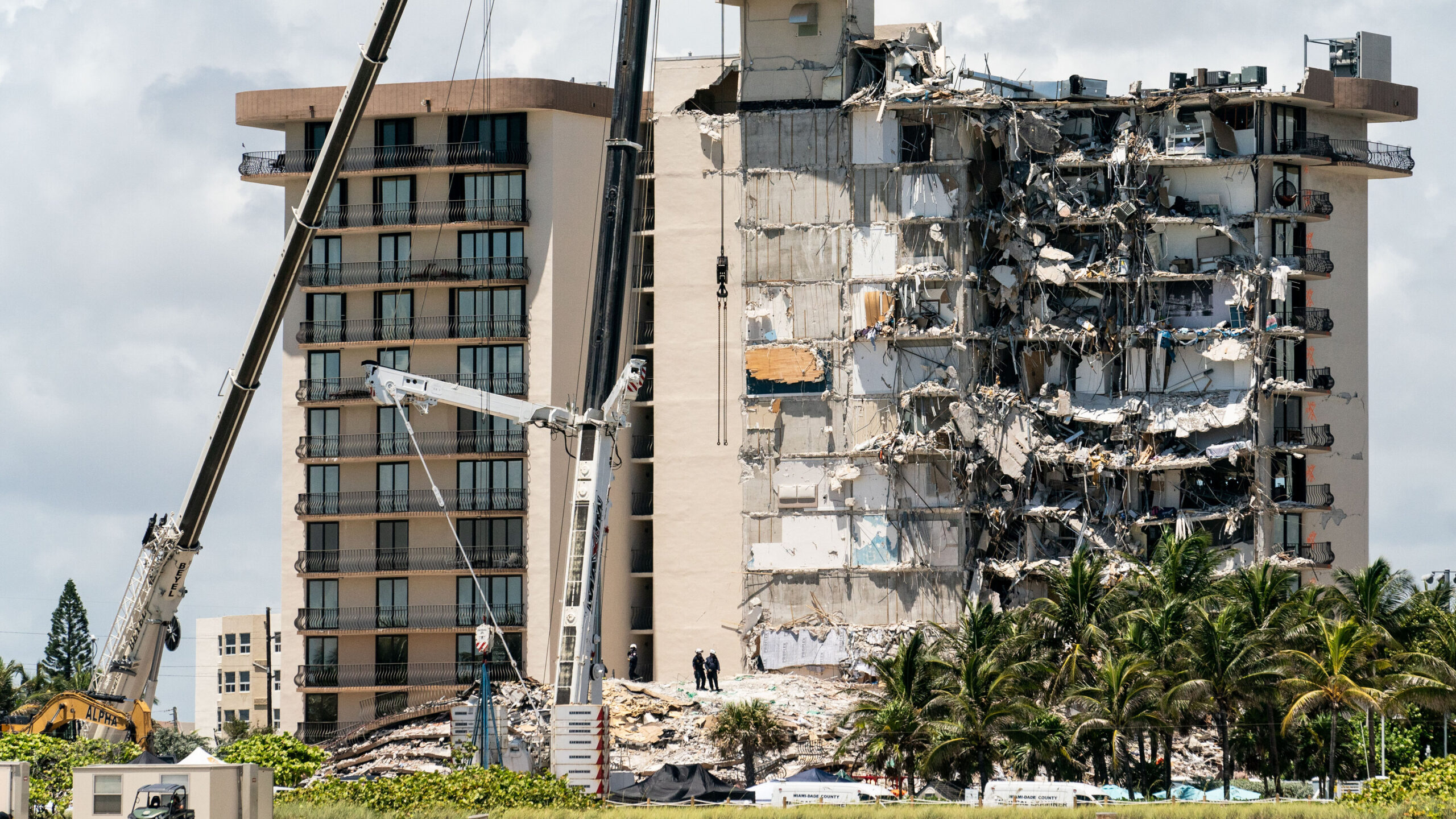
SURFSIDE, Fla. — Late last year, after years of delays and disputes, the Champlain Towers South Condominium Association began a desperate search for $16.2 million to fix major structural damage that was slowly threatening the Surfside high-rise — and that may have contributed to the building’s partial collapse June 24.

The obvious place to look was the building’s reserve fund — extra money socked away to cover the cost of future repairs. But the account held just $777,000, according to condo board documents — nowhere near enough to soften the blow.

The collapse, which killed at least 64 people and left 76 others missing, occurred before the condo board could collect the needed money from residents and begin repairs. The cause of the collapse is unknown, and investigators, experts and advocates are trying to determine whether the uncompleted repairs played a role, whether the board could have seen the problem coming earlier — and whether a Florida law regulating condo repairs that was repealed a decade ago could have made a difference.


One way to keep track of needed repairs is a “reserve study,” in which condo boards bring in experts like engineers or certified specialists every few years to inspect buildings and estimate how much the boards should collect from residents to prepare for future fixes. The building’s financial documents, obtained by NBC News and NBC 6 South Florida, show that Champlain Towers South had not done a professional reserve study since at least 2016. That decision was legal, but it meant that planning was left to the board, a shifting group of volunteers with little training in building maintenance.

“If the owners would have had a reserve study, if the board was proactive and had funded its reserves, this never would have happened,” said Julio Robaina, a former Republican state legislator.

Robaina sponsored a 2008 law requiring condo associations to hire engineers or architects to submit reports every five years about how much it would cost to keep up with repairs.

The law lasted just two years before it was repealed in 2010, after Robaina left office. Robaina blamed pushback from real estate lawyers and property managers, who he said claimed that the law was too burdensome for condo owners. The legislator who sponsored the repeal, former state Rep. Gary Aubuchon, a Republican real estate broker and homebuilder, did not reply to messages seeking comment.


The repeal left Florida’s condo residents less protected than those in nine states that legally require reserve studies, according to the Community Associations Institute, a nonprofit organization that advocates for condo associations. Thirty-one other states, including Florida, regulate reserves in some way — although Florida is one of three states with loopholes that enable owners to opt out of requirements, the nonprofit said. Ten states have no regulations about reserves at all.

“One of the steps that should be taken by a building, especially an aging building, is having adequate funds available so that when you have to face significant cost challenges there’s an appropriate amount of money available,” said Gary Mars, a South Florida lawyer who represents condo associations.

survey last year by the Community Associations Institute found that most homeowners associations are hesitant to increase residents’ fees, anticipating opposition, and therefore fail to plan for long-term infrastructure fixes.

“In postponing inspections, reserve studies, and — ultimately — complete repairs or renovations, boards often end up facing an exponentially more comprehensive and expensive project in the long run,” the report said.


Maxwell Marcucci, a spokesman for the Champlain Towers South Condominium Association, declined to comment on reserve studies. In a previous statement to NBC News, he said the condo board was doing its best to ensure the building was safe. “They are not engineers and not building safety experts,” Marcucci said. “They hired experts, trusted experts, and at no point did the experts indicate that there was a threat of imminent collapse.”

The lack of a professional reserve study is a departure from what many experts say is best practice for condominiums, particularly older ones on the coast — like Champlain Towers South, built in 1981 — that have been exposed for decades to corrosive salt and water.

Robaina, who co-owns a property management company, said maintaining healthy reserves “is the single most important action that a condominium board needs to take.”

Florida law requires condo boards to maintain reserves for repairs over $10,000, but it does not say exactly how much to set aside. That means condo boards have some flexibility in avoiding saving for repairs that do not need to be made right away.

In addition, the law allows condo buildings to waive the reserve requirement altogether. Once it has passed its annual budget, a condo board can give residents the opportunity to opt out of collecting reserves by a vote of a majority of unit owners. The votes are common in Florida condo buildings, condo lawyers say.

That is what it appears Champlain Towers South did, lawyers and reserve experts said.

The experts pointed to the board’s reliance on special assessments — additional fees on top of residents’ normal monthly payments — to fund needed repairs. The board imposed a $1 million special assessment in 2016 for hallway renovations and a $350,000 special assessment in 2019 for work on a generator, a fuel pump and a fuel tank. Such lump-sum levies are indicative of a building whose owners have decided not to set aside enough reserves through regular monthly fees, choosing instead to wait until a big-ticket repair is needed to ask residents to pay for it, experts said. Many associations make that choice by repeatedly voting to waive or reduce the funding of their reserves.

“I can’t help but think that the building did that for years and years, which is why there was not enough funds available,” said Matthew Kuisle, Southeast regional director for Reserve Advisors, which prepares reserve studies. “Why would they do that? So they have lower fees. But in the long run, the fees are a small price to pay.”

The shortcomings of that approach started to become clear in 2018, when the board began inspecting the building before a checkup mandated by Miami-Dade County for buildings that reach 40 years old. In an October 2018 report, engineer Frank Morabito alerted the board to “major structural damage” to concrete slabs underneath the building’s pool deck and its entrance drive. He blamed a “major error” in the building’s construction and years of corrosion. He estimated the cost of repairs at $9 million.

Reeling from sticker shock, the board invited a Surfside building official to its November 2018 meeting. The official told the board that the building was “in very good shape,” according to minutes of the meeting. Some residents have said that led them to believe the situation was not dire.

Even so, the board began trying to find a way to repair the damage — and to pay for it.

Disagreements over the costs frustrated board members. Five members quit over two weeks in fall 2019. The condo association has had four presidents since 2018.


By late last year, the board had accepted that there was no safe way forward without doing the massive reconstruction Morabito recommended, along with repairs to a deteriorating roof. Morabito began preliminary work and found that the damage discovered in 2018 had gotten worse. The bill rose to more than $16 million.

The board scrambled for money. It found $707,000 left over from the previous special assessments and $777,000 more in reserves. But a quarter of the reserves were designated for insurance deductibles, leaving $556,000. The board chose not to tap the reserves just in case there was another emergency. That meant the building was short by $15.5 million, which the board voted in April to raise through a special assessment. The cost to residents would be $80,000 to $360,000 per unit.

“A lot of this work could have been done or planned for in years gone by. But this is where we are now,” board President Jean Wodnicki wrote to residents before the vote.

By last month, the board had started work on the roof, and it put other repairs out for bid. Responses were due July 7. Two weeks before the deadline, the building partly collapsed.

The board’s nearly three-year struggle to start work on the concrete replacement project has loomed over the catastrophe’s aftermath. Investigators have not determined what caused the failure; the deteriorating supports are among the possibilities.

Experts say the extent of disrepair documented in the 2018 report raises questions about how the damage went unnoticed previously.

“I read the report, and I wondered how long the building looked that way,” said Robert Nordlund, founder and CEO of Association Reserves, a reserve study firm based in California. “Did it look that way in 1998? 2008? Because clearly there was some significant deterioration in that 2018 report.”


Documents reviewed by NBC News and NBC 6 South Florida, including audits, budgets, financial statements and board meeting minutes, do not indicate when the structural issues noted by Morabito started, though the board did pay to replace leaking pipes in the building’s parking garage in 2016. But the documents do show that the board did not perform professional reserve studies and instead relied on board members to determine how much to set aside for repairs. In 2016, an accountant performing a year-end audit noted that “an independent study has not been conducted to determine the adequacy of the current funding” and that “the estimates for future replacement costs are based upon estimates provided by the budget committee.”

Audits conducted by the same accountant in 2017, 2018 and 2019 included the same language. Last year, a different accountant provided a similar disclaimer.

Mars, the lawyer who represents condo associations, said he believes that the note was “the CPA saying, ‘We don’t have any official documentation to rely on.'”

The accountants who conducted the audits did not respond to messages seeking comment.


Jeffrey Rembaum, another lawyer for condo associations, pointed to figures in the audits that showed that from 2016 to 2020, the board did not update the amount of money needed to replace balconies and concrete. Each year, the board estimated needing $320,000 for the work, even after Morabito’s report found that much more extensive and costly repairs were needed.

“We know the building had millions in concrete repairs on the horizon,” Rembaum said. “So how did it come up with $320,000 for their current needs? If they’d had a reserve study and an engineer looked at what they had, they would have come up with a higher number. That suggests the board wasn’t regularly updating it.”

He added: “This is the effect of the Florida Legislature not requiring a reserve study by qualified people.”

More than a decade since his short-lived law on reserve studies was repealed, Robaina said he hopes lawmakers will change course and reimpose the mandate.

“This is a window of opportunity,” he said, “and unfortunately it took a tragedy that could have been prevented.”

Jon Schuppe reported from New York; Phil Prazan reported from Surfside, Florida

By Jon Schuppe and Phil Prazan, NBC 6 South Florida


Tags: ,
Is It Time To Amend Your Condominium Declaration? by Becker

Is It Time To Amend Your Condominium Declaration? by Becker

Is It Time To Amend Your Condominium Declaration?

BY   / Becker


Does your Declaration of Condominium still refer to Chapter 711 as the Florida Condominium Act? Well, maybe it is not that old, but perhaps it has been a decade since it has been revised. If that is the case, then it may be time to amend the governing documents to ensure that they include the most recent amendments to the Condominium Act and address changes in your community’s needs which have developed over time.

Section 718.110(1)(a), Florida Statute, provides that if a declaration fails to provide a method of amending the document, it may be amended, as to most matters, if the amendment is approved by owners of not less than two-thirds (2/3rd) of the units. There are two major exceptions, however. First, changing any appurtenances to the unit or changing an owner’s percentage share in the common expenses requires the approval of all owners and all lienholders, unless the original declaration provides otherwise. Second, an association cannot amend a declaration to create timeshares without the approval of the all owners and all lienholders, unless the original declaration provides otherwise.

Now that you know the basics of an amendment, lets discuss “why” in terms of a growing issue in Florida (i.e., short term rentals). If the goal is to amend the declaration to address the onslaught of short term rentals popping up with more and more frequency in condominiums, Section 718.110(13) must be considered. This statute provides that any amendment prohibiting owners from renting their units, altering the duration of the rental term, or limiting the number of times owners are entitled to rent will only apply to owners who agree to the amendment and to owners who purchase their unit after the effective date of the amendment. The amendment however limited it seems now, may be prudent today nonetheless. Why? Because it may take a bit for the new restrictions to apply to all owners and those short term rental investors while gaining momentum are still in the minority.

Amendments should not be taken lightly. If an amendment is done incorrectly, it will be deemed void or invalid. Once you have ideas as to what your Association needs in light of what the governing documents provide, it is important to meet with the Association’s attorney to discuss these. The attorney can then advise of those changes which would be permitted and craft language aimed at meeting the Association’s needs harmonizing those with the Condominium Act.


Robyn M. Severs

Shareholder / Orlando
904.423.5372
RSEVERS@beckerlawyers.com


Tags: , ,
LET’S NOT FOCUS ON BLAME – AND FOCUS ON CHANGE INSTEAD  By Eric Glazer, Esq.

LET’S NOT FOCUS ON BLAME – AND FOCUS ON CHANGE INSTEAD By Eric Glazer, Esq.

  • Posted: Jul 05, 2021
  • By:
  • Comments: Comments Off on LET’S NOT FOCUS ON BLAME – AND FOCUS ON CHANGE INSTEAD By Eric Glazer, Esq.

LET’S NOT FOCUS ON BLAME – AND FOCUS ON CHANGE INSTEAD

By Eric Glazer, Esq.

Published July 7, 2021


As they say…hindsight is 20/20. The tragedy in Surfside rips your guts out. I had to go there and see it for myself. I did. I then walked over to the memorial and saw pictures of the victims, including little kids, entire families and you wonder how anything like this could have possibly happened. Immediately you want to blame someone. You want justice. You want someone to pay for what happened here. It’s only natural to feel that way. But we need to try to calm down and think this out rationally.

It all starts with the fact that there has NEVER been a building collapse like this that anyone is aware of, not only in Florida, but anywhere in the entire country. Think about that. This has never happened before. There is no precedence for this disaster. Did the Board members have engineering reports warning them that the concrete would deteriorate exponentially if not replaced? Yes they did. Were they told the building would collapse if they don’t immediately fix it? No, they weren’t. In fact, it appears that the Chief Building Official in Surfside actually attended a board meeting and told the community that the building was fine and not in any danger.

The Board no doubt figured that this massive project needs an intense amount of planning. The association needs to apply for a loan. The board needs to prepare for a special assessment. Engineers need to prepare a bid package. The right contractor has to be chosen. This does not happen overnight and it appears that the Board accomplished almost all of these things. Those of you who live in condominiums also know that those board members must have also been fighting intense pressure from many unit owners not to pass a $15,000,000.00 special assessment in the middle of the COVID pandemic no less! While I’m sure the Board members knew that the more time it takes, the more damage would occur and additional repairs would be needed, none of them thought for a moment that delay would result in the collapse of the building. If they did, some of them wouldn’t have been there when the building collapsed. Had the Board members been told by professionals that this building could collapse, then I would change my tune. But there is no evidence that they were told.

Going forward, rest assured that from now on when an engineer inspects a condominium building and observes concrete spalling, the report will indicate that the building may collapse if not repaired promptly. There is nothing to lose by placing that in a report from now on, but perhaps a lot to lose if you fail to place that in a report.

We tend to forget that the average Joe or Sally on a Board of Directors is not an engineer, general contractor or condominium or construction attorney. Many of them have no experience whatsoever in how buildings are constructed and maintained. All they can do is rely on what their experts are telling them. I don’t see any experts telling this board at the Champlain Towers South that this building may collapse. How then can they be expected to know that it would?

Again, this tragedy provokes an automatic impulse in all of us that somebody must be held accountable here. Somebody must pay. Some have even called for criminal prosecution of the Board. As many of you know, being a board member is a thankless job. On your best day, you are harassed, yelled and cursed at, and always second guessed. It’s hard enough to get volunteers to serve on the Board. If you are going to hold directors individually or criminally liable when accidents happen, even tragic accidents, that have never before happened anywhere in any building you are headed down a very dangerous path where it would not make sense for anyone to take the thankless board member position out of fear of losing their money or even their liberty. You would have to be nuts to volunteer.

So while we all want some justice here and some answers, I urge everyone to take the focus off of the Board for a moment. They are too easy a target and should not be made the scapegoat here. Maybe we need to ask why buildings on the ocean don’t have to pass an annual inspection every year by the county or municipality. Maybe we need to ask if there should be stricter scrutiny of buildings built before massive changes to the South Florida Building Code were made after Hurricane Andrew, like the Champlain Towers South. Maybe we need to ask why municipalities are now asking their Building Departments to inspect tall buildings, but never required it previously. Maybe we need to find out why the elevators have to pass an annual inspection but not the structure of the building itself. Maybe we need to find out why the first time a building gets inspected is at the 40 year recertification requirement and why that is only a requirement in Miami-Dade and Broward Counties. If you want to find someone or something to blame for this catastrophe, this is where I would start.


Tags: , ,
Should Emails Between Board Members & Managers Be Considered Official Records Subject to Member Inspection?

Should Emails Between Board Members & Managers Be Considered Official Records Subject to Member Inspection?

  • Posted: Jun 28, 2021
  • By:
  • Comments: Comments Off on Should Emails Between Board Members & Managers Be Considered Official Records Subject to Member Inspection?

Should Emails Between Board Members & Managers Be Considered Official Records Subject to Member Inspection?


In today’s instant world, email allows us to express our thoughts anytime, anywhere. So often, emails serve as a substitute for making phone calls. If a phone call is made from a board member to a manager, absent a deposition of either party or a

contemporaneous note documenting the conversation, the content of the communication remains private. But, if the board member sends an email rather than calling the manager, that email is considered a written record of the association and is required to be produced as a part of a member’s official record request, with limited exception as discussed below.


With the sheer volume of emails received by a manager from owners, board members, purchasers, contractors, and lawyers, etc., there is no practical method of separating the emails which must remain confidential. This includes emails with respect to attorney-client privileged matters, personnel matters, information obtained in connection with a sale or lease, social security numbers, and medical information, etc., and separating these emails cannot occur without the manager or hired professional spending hours and hours and hours preparing such records for a member’s requested official record inspection primarily at the association’s expense. Moreover, if an outside professional is needed to prepare the emails for inspection, then the association will not be able to recoup the expenditure. While a condominium association cannot charge any amount to prepare for the inspection, a homeowners’ association is limited to $20.00 per hour for administrative time expended to retrieve requested records. Clearly, this needs a legislative remedy!


Generally speaking, for an association’s needs to be met, there must be solid communication between the board and the manager. However, requiring all but privileged and confidential emails to be official records subject to membership inspection stifles that free flow of communication. That said, it is understandable that some emails should be subject to a member’s inspection request, such as with regards to a bid package or contract.


More often than not, the emails to and from the manager are actually the property of the management company by whom the manager is employed. Absent discovery that takes place during litigation, typically a company’s emails are the private property of the company. A shareholder of General Mills’ stock cannot demand to see the president’s emails to its manager, so why should the community association president’s email to the manager be required to be produced? After all, overwhelmingly, community associations are “not-for-profit” corporations. At the end of the day, the need for transparency needs to be balanced against the practicality and costs of producing the emails.


There is limited guidance from the State of Florida Office of the Attorney General and the Division of Florida Condominiums, Timeshares, and Mobile Homes regarding the production of such emails. Let’s take a look at the limited guidance we do have.


On March 6, 2002, the then-Chief Assistant General Counsel of the Department of Business and Professional Regulation (“DBPR”) issued an opinion that “[c]ondominium owners do have the right to inspect e-mail correspondences between the board of directors and the property manager as long as the correspondence is related to the operation of the association and does not fall within the… statutorily protected exceptions… [The DBPR does not have] regulations expressly requiring archiving e-mails, but… if the e-mail correspondence relates to the operation of the association property, it is required to be maintained by the association, whether on paper or electronically, under Chapter 718, Florida Statutes.”


In Humphrey v. Carriage Park Condominium Association, Inc., Arb. Case No. 2008-04-0230 (Final Order / Campbell / March 30, 2009), an arbitrator of the Division of Florida Condominiums, Timeshares, and Mobile Homes held that “…e-mails… existing… on the personal computers of individual directors… are not official records of the association… Even if directors communicate among themselves by e-mail strings or chains about the operation of the association, the status of the electronic communication on their personal computer would not change. Similarly, an e-mail to an individual director or to all directors as a group, addressed only to their personal computers, is not written communication to the association.” The arbitrator reasoned that “[t]his must be so because there is no obligation to turn on [the] personal computer with any regularity, or to open and read emails before deleting them.”


In Harbage v. Covered Bridge Condominium Association, Inc., Arb. Case No. 19-03-6413 (Emails Are Written Records of Association Order Re-Framing Affirmative Defenses / Simms / January 2, 2020), an owner challenged an association’s failure to provide records requested pursuant to §718.111(12), Florida Statutes. The owner requested to inspect emails between the association and its property manager from 2017–2019. The association refused to provide the records, arguing that the emails were not written records subject to disclosure nor were they written records that are printed in the ordinary course of business. The arbitrator in the case dismissed the association’s argument that the emails were not written records, citing Black’s Law Dictionary, 11th Edition (2019), which explicitly includes emails in the definition of a “writing.” Additionally, the arbitrator pointed to the fact that emails are accepted in litigation as records of regularly conducted business activity pursuant to §90.803(6)(a), Florida Statutes, to dismiss the association’s claim that the emails are not subject to inspection because they are not printed in the ordinary course of business. The arbitrator held that the association’s position was “untenable on both counts,” finding that “emails are a written record subject to disclosure to unit owners.”


Simply stated, if one were to rely on the guidance cited herein, then emails solely between board members, even a board majority, are not part of the official records, but emails between a board member(s) and the manager are part of the official records and subject to member inspection unless containing information that is otherwise privileged or confidential. All other emails not protected by privilege or other duty of confidentiality are also subject to member inspection.


Where does it end? What about text messages and WhatsApp? Will they, too, one day be subject to inspection? Why one without the other? Better still, if text messages are not subject to member inspection, why should emails be subject to inspection? If emails remain subject to inspection, should not phone calls between board members and managers be statutorily required to be recorded? Why not? Because such a requirement is absurd.


In addition, what is missing from today’s legislation are laws protecting the free flow of communication between board members and the manager. Also patently missing from today’s legislation is the ability of the association to require the member requesting the record inspection to prepay for the actual time and cost necessary to prepare the records for inspection.


So, while it may make sense for certain vendor emails to remain as records of the association subject to member inspection, it is this author’s opinion that emails between the board and the association’s manager should remain private property of the sender and recipient, most especially if the manager’s computer is provided by the management company and not the association. However, if emails between board members and managers are going to remain as records which must be produced, absent privilege and confidentiality requirements, then at a minimum the association should at least be allowed to fully recover its expenses incurred in the record inspection. Perhaps a present or future Florida legislator will sponsor a long overdue bill to provide the association the lawful right to do so.  

Tags: