SFPMA

SFPMA Industry Articles | news, legal updates, events & education! 

Find Blog Articles for Florida’s Condo, HOA and the Management Industry. 

SOME OTHER NEW LAWS CONDOS MUST FOLLOW – PART TWO  By Eric Glazer, Esq.

SOME OTHER NEW LAWS CONDOS MUST FOLLOW – PART TWO By Eric Glazer, Esq.

SOME OTHER NEW LAWS CONDOS MUST FOLLOW – PART TWO

By Eric Glazer, Esq.

DISTRIBUTION OF THE INSPECTION REPORTS

Upon completion of a phase one or phase two milestone inspection and receipt of the inspector-prepared summary of the inspection report from the architect or engineer who performed the inspection, the association must distribute a copy of the inspector-prepared summary of the inspection report to each unit owner, regardless of the findings or recommendations in the report, by United States mail or personal delivery and by electronic transmission to unit owners who previously consented to receive notice by electronic transmission; must post a copy of the inspector-prepared summary in a conspicuous place on the condominium property; and must publish the full report and inspector-prepared summary on the association’s website, if the association is required to have a website.

THE DEVELOPER’S TURNOVER REPORT

Notwithstanding when the certificate of occupancy was issued or the height of the building, the developer must provide a milestone inspection report in compliance with s. 553.899 included in the official records, under seal of an architect or engineer authorized to practice in this state, and attesting to required maintenance, condition, useful life, and replacement costs of the following applicable condominium property common elements comprising a turnover inspection report:

  1. Roof.
  2. Structure, including load-bearing walls and primary structural members and primary structural systems as those terms are defined in s. 627.706. 
  3. Fireproofing and fire protection systems.
  4. Elevators.
  5. Heating and cooling systems.
  6. Plumbing.
  7. Electrical systems.
  8. Swimming pool or spa and equipment.
  9. Seawalls.
  10. Pavement and parking areas.
  11. Drainage systems.
  12. Painting.
  13. Irrigation systems.
  14. Waterproofing
  15. A copy of the association’s most recent structural integrity reserve study.


POWERS OF THE DIVISION

So let’s say the developer is ignoring all of these new safety laws.  Does the DBPR have any power to do anything about it?

(1) The division may enforce and ensure compliance with this chapter and rules relating to the development, construction, sale, lease, ownership, operation, and management of residential condominium units and complaints related to the procedural completion of milestone inspections under s. 553.899.

However, Once The Developer Has Turned Over…

(2) However, after turnover has occurred, the division has jurisdiction to investigate  complaints related only to financial issues, elections, and the maintenance of and unit owner access to association records under s. 718.111(12), and the procedural completion of structural integrity reserve studies under s. 718.112(2)(g).

So………..if your Board ignores these new safety laws and you want to do something about it…..it’s off to court.

OTHER NEW CONDO LAWS TO KNOW – PART ONE

OTHER NEW CONDO LAWS TO KNOW – PART ONE

  • Posted: Jul 26, 2022
  • By:
  • Comments: Comments Off on OTHER NEW CONDO LAWS TO KNOW – PART ONE

SOME OTHER NEW LAWS CONDOS MUST FOLLOW – PART ONE

By Eric Glazer, Esq.

We all know by now the myriad of new safety laws condos that are 3 stories or more are required to follow.  They include mandatory fire sprinklers or an engineered life safety system (for buildings 75 feet or higher only), a Phase One Milestone Inspection after 30 years and every ten years thereafter (25 years if the building is on the coast), a likely Phase Two Inspection which will result in required repairs to the structure and of course structural integrity reserve studies performed by an architect or engineer and the mandatory full funding of reserve accounts.

There’s actually more to know.

OFFICIAL RECORDS TO INCLUDE  AND BE POSTED ON THE ASSOCIATION’S WEBSITE:

  1. All audits, reviews, accounting statements,structural  integrity reserve studies, and financial reports of the association or condominium. Structural integrity reserve studies  must be maintained for at least 15 years after the study is completed.


A copy of the inspection reports for the milestone inspections and the structural integrity reserve studies  and any other inspection report relating to a structural or life safety inspection of the condominium property. Such record must be maintained by the association for 15 years after receipt of the report.

NO LONGER IS THERE THE ABILITY

TO WAIVE RESERVES OR USE THEM FOR OTHER PURPOSES


It was always ridiculously easy to waive the funding of the reserve account.  All it took was a lousy majority of a quorum.  Those days are now over and reserve accounts must be fully funded, like it or not.

The same rule finally applies to developers.  Before turnover of control of an association by a developer to unit owners other than a developer under 718.301, the developer-controlled association developer may not vote the voting interests allocated to its units to waive the reserves or reduce the funding of the reserves.

You can no longer vote to use reserves set aside for one category to be used to repair another category.  Effective December 31, 2024, members of a unit-owner controlled association may not vote to use reserve funds, or any interest accruing thereon, that are reserved for items listed in paragraph (g) for any other purpose other than their intended purpose.

(g) Structural integrity reserve study.

  1. An association must have a structural integrity reserve study completed at least every 10 years after the condominium’s creation for each building on the condominium property that is three stories or higher in height which includes, at a minimum,  a study of the following items as related to the structural integrity and safety of the building:
  2. Roof. 
  3. Load-bearing walls or other primary structural members.
  4. Floor. 
  5. Foundation.
  6. Fireproofing and fire protection systems. 
  7. Plumbing. 
  8. Electrical systems. 
  9. Waterproofing and exterior painting. 
  10. Windows.
  11. Any other item that has a deferred maintenance expense or replacement cost that exceeds $10,000 and the failure to replace or maintain such item negatively affects the items listed in subparagraphs a.-i., as determined by the licensed engineer or architect performing the visual inspection portion of the structural integrity reserve study.
  12. Before a developer turns over control of an association  to unit owners other than the developer, the developer must have a structural integrity reserve study completed for each building on the condominium property that is three stories or higher in height.


  1. Associations existing on or before July 1, 2022, which are controlled by unit owners other than the developer, must have a structural integrity reserve study completed by December 31, 2024, for each building on the condominium property that is three stories or higher in height.

BREACH OF FIDUCIARY DUTY – THIS IS SCARY


  1. If an association fails to complete a structural integrity reserve study pursuant to this paragraph,such failure is a breach of an officer’s and director’s fiduciary relationship to the unit owners under s. 718.111(1).  If you’re an officer or director, this new law should scare you to death.  If you fail to do the reserve study, you have automatically breached your fiduciary duty.  This could potentially result in individual liability against a director should the failure to do the reserve study result in collapse or injury.


(h) Mandatory milestone inspections.—If an association is required to have a milestone inspection performed pursuant to s. 553.899, the association must arrange for the milestone inspection to be performed and is responsible for ensuring compliance with the requirements of s. 553.899. The association is responsible for all costs associated with the inspection. If the officers or directors of an association willfully and knowingly fail to have a milestone inspection performed pursuant to s. 553.899, such failure is a breach of the officers’ and directors’ fiduciary relationship to the unit owners under s. 718.111(1)(a).  Again, If you’re an officer or director, this new law should scare you to death.  If you fail to do the milestone inspection, you have automatically breached your fiduciary duty.  This could potentially result in individual liability against a director should the failure to do the reserve study result in collapse or injury.

Tags:

What is an Estoppel Certificate and Why do you need one when buying a Condo or Home in an HOA?

What is an Estoppel Certificate and Why do you need one when buying a Condo or Home in an HOA?

  • Posted: Jul 20, 2022
  • By:
  • Comments: Comments Off on What is an Estoppel Certificate and Why do you need one when buying a Condo or Home in an HOA?

Generic legal definition that you should IGNORE: A legal principle that bars a party from denying or alleging a certain fact owing to that party’s previous conduct, allegation, or denial.

Layman’s description (not a legal description) of what estoppel means in a condo or homeowners association: an estoppel certificate is a document which describes outstanding fees that an owner owes to his/her association as of a certain date.

When a home is sold, the new owner and the old owner are “jointly and severally liable” for any amounts owed to the association. What this means in practice, is that any debt to the association stays with the property when a title transfers. These debts include: maintenance dues, late fees, fines, interest, legal fees and special assessments outstanding at the time of the transfer.

If the new owner does not obtain an estoppel certificate they will not be aware of any amounts owed to the association by the prior owner and they may be inheriting a huge debt which they are responsible for. This is why it is necessary to make sure any outstanding debt (or acknowledgement that no money is owed) is properly disclosed, via an estoppel certificate as a protection to the new owner. Often the title company will request an estoppel certificate on the owner’s behalf and any amounts owed will be paid off at closing.

Why does it cost money to get an estoppel? Someone has to take the time to do the research and prepare the certificate for the sale to happen. It is critical that the information is correct since the estoppel is legal proof of the amount owed. The owner (not the association) has to pay for this document, which is typically prepared by the management company, association staff, association attorney or bookkeeping company.

Estoppels are rarely as simple as providing an amount owed. In addition to listing any amounts owed to the association, the estoppel often contains other critical information such as:

  • Are there any outstanding violations on the property?
  • In addition to the regular maintenance, is there a special assessment ongoing?
  • Are there any pending special assessments that may not have been billed yet?
  • Is a capital contribution required?
  • Are there any other associations this property owner may owe money to?

These are just a few of the dozens of questions that are often asked by title companies on estoppel requests, which can become very time consuming.

Here is a short article that describes the law around estoppels.

Legal disclaimer: I am not an attorney. This should not be considered legal advice.

Thank You to Campbell Property Management


If you need help with an Estoppel Certificate and or Collection of outstanding Monies owed by an Owner for a Condo and or HOA:

Search our Directory: SFPMA Members Directory over 70 categories for everything you will need for your Florida properties.   Attorneys HOA Condo Associations   Accountants & Collections


[AdSense-C]

Tags: , , ,
Violation Remedies: Self Help vs. Injunction by Jeffrey Rembaum, Esq. of Kaye, Bender, Rembaum

Violation Remedies: Self Help vs. Injunction by Jeffrey Rembaum, Esq. of Kaye, Bender, Rembaum

  • Posted: Jul 14, 2022
  • By:
  • Comments: Comments Off on Violation Remedies: Self Help vs. Injunction by Jeffrey Rembaum, Esq. of Kaye, Bender, Rembaum

Imagine this scenario: you are on the board of directors of your association. The association has repeatedly requested that an owner pressure wash their dirty roof to bring it into compliance with the community standards, but the owner refuses to do so. The association has already sent a number of demand letters and even levied a fine and perhaps a suspension of use rights, too, but the owner still will not comply. What is the association’s next step?

  • Is it time to file a lawsuit to compel compliance? Chapters 718 (governing condominiums), 719 (governing cooperatives), a 720 (governing homeowners associations), Florida Statutes, authorize the association to bring an action at law or in equity to enforce the provisions of the declaration against the owner.

or

  • Is it time for the association to use its “self-help” remedy? In fact, many declarations contain such “self-help” language, which authorizes the association to cure the violation on behalf of an owner and even, at times, assess the owner for the costs of doing so. These “self-help” provisions generally contain permissive language, meaning that the association may, but is not “obligated” to, cure the violation.


Assume that the association’s declaration contains both the permissive “self-help” remedy and the right to seek an injunction from the court that orders the owner to clean their roof or else be in contempt of court. Thus, it would appear the association has a decision to make: (i) go to court to seek the injunction; or (ii) enter onto the owner’s property, pressure clean the roof, and assess the costs to the owner. Not so fast! Recent case law from Florida’s Second District Court of Appeal affirmed a complication to what should be a simple decision, discussed in greater detail below.

In two cases decided 10 years apart, Florida’s Second District Court of Appeal decided that an association did not have the right to seek an injunction to compel an owner to comply with the declaration if the declaration provided the association the authority to engage in “self-help” to remedy the violation. Prior to a discussion of the cases, a brief explanation of legal and equitable remedies is necessary.

There is a general legal principle that, if a claimant has a remedy at law (e.g., the ability to recover money damages under a contract), then it lacks the legal basis to pursue a remedy in equity (e.g., an action for injunctive relief). In the association context, a legal remedy would be to exercise the “self-help” authority granted in the association’s declaration. An equitable remedy would be to bring an action seeking an injunction to compel an owner to take action to comply with the declaration (e.g., compelling the owner to pressure wash their roof). A court will typically only award an equitable remedy when a legal remedy (such as “self-help”) is unavailable, insufficient, or inadequate.

This distinction is first illustrated in Alorda v. Sutton Place Homeowners Association, Inc., 82 So. 3d 1077 (Fla. 2d DCA 2012). In Alorda, the owners failed to provide the association with proof of insurance coverage as required by the declaration. The association sent multiple demand letters to the owners, but they failed to comply. The declaration provided, in pertinent part, that “[t]he owner shall furnish proof of such insurance to the Association at the time of purchase of a lot and shall furnish proof of renewal of such insurance on each anniversary date. If the owner fails to provide such insurance the Association may obtain such insurance and shall assess the owner for the cost of the same in accordance with the provisions of this Declaration” (emphasis added). In accordance with the foregoing, the association had the option to purchase the insurance on behalf of the owners and assess them for the costs of same.

However, the association chose instead to file a complaint against the owners seeking the equitable remedy of injunctive relief, asking the court to enter a permanent mandatory injunction requiring the owners to obtain the required insurance coverage. The owners then filed a motion to dismiss the suit arguing that even though they had violated a provision of the declaration, the equitable remedy of an injunction is not available because the association had an adequate remedy at law. In other words, the owners argued that, because the association could have, pursuant to the declaration, undertaken the ”self-help” option by purchasing the required insurance and assessing it against the owners, they had an available legal remedy and, therefore, the equitable remedy sought (a mandatory injunction) was not available to the association. The court, citing to a different case, Shaw v. Tampa Electric Company, 949 So.2d 1006 (Fla. 2d DCA 2007), explained that a mandatory injunction is proper only where a clear right has been violated, irreparable harm has been threatened, and there is a lack of an adequate remedy at law. As the association had an adequate remedy at law (the authority to purchase the insurance on behalf of the owners), the third requirement was not met. Therefore, the court held that the association failed to state a cause of action and dismissed the case. (This case might be decided differently today as it appears the insurance marketplace will not permit an association to purchase insurance for a unit that it does not own, so the legal remedy presumed available to the association would be inadequate).

Similarly, in the recent case of Mauriello v. The Property Owners Association of Lake Parker Estates, Inc., Case No. 2D21-500 (Fla. 2d DCA 2022), Florida’s Second District Court of Appeal considered the award of attorneys’ fees after the dismissal of the association’s action for an injunction. Ultimately, the court held that the owners were the prevailing party as the association could not seek an injunction because the association had an adequate remedy at law. In Mauriello, the owners failed to maintain their lawn and landscaping in good condition as required by the declaration. As such, the association filed a complaint seeking a mandatory injunction ordering the owners to maintain the lawn and landscaping in a “neat condition.” The association’s declaration contained similar language to the declaration at issue in Alorda. The declaration provided that, if an owner failed to perform any maintenance required by the declaration, the association, after written notice, “may have such work performed, and the cost thereof shall be specifically assessed against such Lot which assessment shall be secured by the lien set forth in Section 9 of this Article VI” (emphasis added). In other words, the association had the permissive “self-help” authority pursuant to the declaration.

The facts of this case were complicated by the sale of the home in the middle of the suit. The new owners voluntarily brought the home into compliance with the declaration, and the case became moot. However, the parties continued to fight over who was entitled to prevailing party attorneys’ fees. The association argued it was entitled to prevailing party attorneys’ fees because the voluntary compliance was only obtained after the association was forced to commence legal action. The owners, citing Alorda, argued that they were entitled to prevailing party attorneys’ fees as the association’s complaint never stated a cause of action in the first place. They argued that the complaint should have been dismissed at the outset because the association sought an equitable remedy (mandatory injunction) when a legal remedy was available to the association (exercise of “self-help” authority).

Florida’s Second District Court of Appeal agreed with the owners that Alorda was controlling. The Court explained that, as in Alorda, “the association’s declaration gave it the option of remedying the alleged violation itself, assessing the owner for the cost, and if the owner failed to pay, placing a lien on the property and foreclosing if it remained unpaid.” As such, the association had an adequate remedy at law and could not seek the equitable remedy of an injunction, which was initially sought by the association. Because the mandatory injunction was not available to the association, the association’s complaint failed to state a proper cause of action and, thus, should have been dismissed by the trial court at the outset. Therefore, the association was not entitled to its sought-after prevailing party attorneys’ fee award, which is otherwise granted if a party comes into compliance after the lawsuit is served.

Sections 718.303 (as to condominiums), 719.303 (as to cooperatives), and 720.305 (as to homeowners associations), Florida Statutes, contain similar language that specifically authorizes the association to bring actions at law or in equity, or both, in the event an owner fails to comply with the governing documents of the association. However, neither the Court in Alorda nor the Court in Mauriello addressed the association’s statutory authority to bring an injunction against an owner who fails to comply with the requirements of the declaration, but rather found that the association must use the “self-help” remedy since it was available to cure the violation.

Notwithstanding the Alorda and Mauriello decisions rendered by Florida’s Second District Court of Appeal, past appellate court decisions from other appellate jurisdictions in Florida have permitted community associations to pursue claims for injunctive relief against violating owners so long as a violation of the restrictive covenant is alleged in the complaint. As such, the Alorda and Mauriello cases appear to be departures from the established principle. Additionally, as both decisions came from Florida’s Second District Court of Appeal, the decisions are certainly binding on those associations within the jurisdiction of the Second District, but there has been no indication that other districts will follow suit. However, there is risk that other appellate district courts may be persuaded by the holdings of Alorda and Mauriello.

As such, if your association’s declaration contains a “self-help” provision, and your association chooses to seek an injunction against an owner rather than pursue “self-help,” the board should definitely discuss the issue in greater detail with the association’s legal counsel prior to proceeding. 

Find out more about KBR Legal – If your community is looking for representation give us a call.

Kaye Bender Rembaum is a full service commercial law firm devoted to the representation of community associations throughout Florida. Under the direction of attorneys Robert L. Kaye, Esq., Michael S. Bender, Esq., and Jeffrey A. Rembaum, Esq. Kaye Bender Rembaum is dedicated to providing clients with an unparalleled level of personalized and professional service regardless of their size and takes into account their individual needs and financial concerns. Most of our attorneys are Board Certified in Condominium and Planned Development Law.

Tags: , ,
WILL THE NEW LAWS BE DEVASTATING FINANCIALLY TO SOME FLORIDA RESIDENTS?

WILL THE NEW LAWS BE DEVASTATING FINANCIALLY TO SOME FLORIDA RESIDENTS?

  • Posted: Jul 14, 2022
  • By:
  • Comments: Comments Off on WILL THE NEW LAWS BE DEVASTATING FINANCIALLY TO SOME FLORIDA RESIDENTS?

WILL THE NEW LAWS BE DEVASTATING FINANCIALLY TO SOME FLORIDA RESIDENTS?

By Eric Glazer, Esq.

In a word — YES. Are all these new laws really necessary?  In a word –YES.  This is all happening due to a complete lack of foresight and planning by The Florida Legislature.  Mandatory Reserves and Mandatory Inspections should always have been the law.  I urged The Florida Legislature in May of 2018 to make reserves mandatory.  Instead they waited for a building to collapse and for 98 people to die before making these common sense laws.  Of course a building should require an inspection after 25 or 30 years.  Of course a building should be required to make necessary repairs to prevent a potential collapse.  Of course a building should be required to put away money each month for future repairs.  Of course that amount should be determined by a professional architect or engineer and not an unqualified board member who has a financial interest in the outcome of the reserve study. These laws should have been required thirty years ago, as building started to boom.  Instead however, The Florida Legislature always caved to the developer lobby in order to keep the cost of living in a condominium artificially cheap, and the sale of units flowing.  Now, because these laws were not in place thirty years ago, current condominium owners have a lot of catching up to do financially to pay for the sins of the past.


The days of a couple or a widower from up north retiring to a high rise condominium in Florida if their sole income is social security are done and over.  That cannot happen anymore.  They need to look for a condominium less than three stories in height that has some reserves put away.


If your condominium is at least 30 years old and is 6 stories or higher, has no fire sprinklers or  Engineered life safety system, has not yet undergone a Mandatory Phase One and Phase Two Inspection, has not made the repairs required by those inspections and has no reserves in the bank, you are now forced to either sell your condominium unit immediately or pay massive special assessments that you may not be able to afford, or even come close to affording it.


On the flip side, if your condominium is at least 30 years old and is 6 stories or higher, and already has fire sprinklers or  an Engineered life safety system, has already undergone a Mandatory Phase One and Phase Two Inspection, has already made the necessary repairs, and is fully funding reserves, you have little to nothing to worry about.  Your monthly assessments should remain where they are, give or take the increases in insurance that are simply astronomical.


Developers are waiting to pounce.  They are focusing their attention on those condominium at least 30 years old and are 6 stories or higher, but has no fire sprinklers or Engineered life safety system, has not yet undergone a Mandatory Phase One and Phase Two Inspection, and has not made the repairs that will be required by those inspections and has no reserves in the bank.  Developers will be approaching the Boards of these condominiums with offers to buy everyone’s unit for a certain price.  You will either consent to selling or have to pay the costs for all these inspections, repairs and funding of reserves.  For many there will be no choice at all.  They will have to sell and somehow find housing elsewhere.


Like everything else, the poor people or even the average workers who had saved up enough money for a down payment on their condo and proudly purchased their unit, they will get hit the hardest.  In reality, in upper class buildings, they were either putting reserve money aside all along, or worse comes to worse they can stroke a check for these increased costs.  They’re OK.


This will take years to sort out.  Some condos simply won’t be able to comply with the new laws and the owners will sell out to a developer.  Some condominiums will opt not to sell and pass massive special assessments and/or borrow the money from a bank.  Either way their expenses are going up.  Many associations will be foreclosing on many of their owners who can’t afford these special assessments.  I can tell you that even before these massive changes go into effect, foreclosures are already on the rise, simply due to nearly $6.00 per gallon of gasoline and out of control food prices.  These new laws will start what I believe will be a tremendous increase in foreclosures, perhaps as bad as 2007 and 2008.  Yet, all of it is necessary.  You can’t allow buildings not to get inspected, you can’t allow building not to get fixed, you can’t allow buildings not to have fire safety measures and you can’t allow buildings to deliberately waive a requirement to put funds away each month for future structural repairs.


The Band Aid was ripped off in one shot.  As a result, Florida condominiums and their owners will have some tough financial times ahead.  There will definitely be gentrification in some neighborhoods.  The look, feel and face of Florida will change going forward.  If only these measures were passed when these buildings were being built so people would not be forced out of their homes today.  There simply was no foresight and now the change won’t be smooth and gradual, but will be difficult and immediate.  And yet, there’s no other way to go.  A collapse like Champlain Towers can never happen again.


Tags:
Webinar: Insurance Claims and Coverage for Community Associations: Navigating Florida’s Insurance

Webinar: Insurance Claims and Coverage for Community Associations: Navigating Florida’s Insurance

  • Posted: Jul 14, 2022
  • By:
  • Comments: Comments Off on Webinar: Insurance Claims and Coverage for Community Associations: Navigating Florida’s Insurance

The Florida insurance marketplace is in complete disarray. Associations need to be prepared for what the next 18-24 months of a continued hard market will do for their budgets.

Join Becker Shareholder Kenneth S. Direktor and Insurance Office of America Vice President Andrea Northrop, Esq. on Tuesday, July 19, 2022 at 11:00 AM EST

as they discuss the status of the insurance marketplace as it relates to property, liability, directors and officers, and umbrella/excess policies. #Webinar

Florida Condo & HOA Law – Powered by beckerlawyers.com

The Florida insurance marketplace is in complete disarray. While Florida has experienced a difficult property market in the past, we have never seen those conditions carry over simultaneously to multiple lines of coverage. This has both driven up premiums/rates, lessened coverage and created a heightened sense of the reality of the “cost of living” in a condominium in Florida.
Associations need to be prepared for what the next 18-24 months of a continued hard market will do for their budgets. In this course, we will discuss the status of the insurance marketplace as it relates to property, liability, directors and officers, and umbrella/excess policies. We will also cover topics including changes in underwriting expectations, familiarity with Citizens Property Insurance, and budget expectations.
Topics Covered:
• What coverages are required?
• The impact of increasing premiums.
• The importance of the appraisal, adequate coverage, and supplemental policy riders.
• Distinguishing coverage and reconstruction obligations from maintenance and repair obligations.”
This program is not eligible for CEU credit or certificate of completion.
________________________________________
This is going to be presented on Zoom! Full live viewing instructions will be sent to all registrants.
________________________________________
REGISTER NOW:
https://online.beckerlawyers.com/…/landi…/rsvp-blank.asp
________________________________________
SPEAKERS:
Kenneth S. Direktor
SHAREHOLDER
Ft. Lauderdale
Becker
kdirektor@beckerlawyers.com
Andrea Northrop, Esq.
VICE PRESIDENT
Insurance Office of America
Andrea.Northrop@ioausa.com
Tags: , ,
We publish information daily to all of our Social Media Pages and Groups; sfpma marketing

We publish information daily to all of our Social Media Pages and Groups; sfpma marketing

  • Posted: Jul 10, 2022
  • By:
  • Comments: Comments Off on We publish information daily to all of our Social Media Pages and Groups; sfpma marketing

We publish information daily to all of our Social Media Pages and Groups; Facebook, Twitter, Google, LinkedIn …..Join follow and sign up become part of….

As a member are you sending us articles?

Are you using your membership to get infront of the decision makers?

Summer is here, Our team of over 77 are still working each and every day keeping everyone informed.


SFPMA uses Social Media to inform Clients, Members and Followers. Groups are open to everyone, we send and promote information about member companies that work together in the Property Management Industry.  Supporting each member company and information; getting this information out to readers new members and our industry is important to us!

Most companies do not realize how important it is to let others know what you do on a daily basis. We watch, we visit many of the social media pages for our members. What we see is alarming!. Far to many companies do not utilize what Social Media has to offer them. This is why we are always looking for posts that we can reshare we realize you are not!

By utilizing Social Media, Clients get to know and trust that your company is here to stay! These visitors and clients will reshare details that you post about workmanship, advances or just new work you have performed. When you are proud about what your company does, and share, viewers see this and reshare and like your pages. Great Lead Generation – And its Free. Put some work into your Social Media Presence.

Social Media

We Celebrate Independence Day, with Cohen Law Group and Members of SFPMA

We Celebrate Independence Day, with Cohen Law Group and Members of SFPMA

  • Posted: Jul 05, 2022
  • By:
  • Comments: Comments Off on We Celebrate Independence Day, with Cohen Law Group and Members of SFPMA
We Celebrate and Honor Our Heros
We Celebrate Independence Day
As we celebrate our nation’s Independence Day, let’s remember the American heroes who lost their lives in the battle for the freedom we are enjoying today. We are indebted to our national heroes who have fought and continue to fight for this country.
I served in the United States Army for four years. Because of the GI Bill, I was able to attend college and become an attorney. My military service has helped me grow Cohen Law Group into a place where my team and I can continue to serve our community every day.
As patriotic citizens, let’s put extra effort into performing our own civic responsibilities. Every American’s contribution towards moving this nation forward is important. We must always be mindful of how our actions or inaction affect the well-being of others.
Today we celebrate the honor it is to be an American. We celebrate those who have helped our incredible nation progress. We celebrate all that America will become.
We wish you and your family a safe and happy Independence Day!
With Respect and Gratitude,
Harvey Cohen Signature
Harvey V. Cohen, President

With Respect and Our Thanks for your Service from all of us at SFPMA.COM

Tags: , ,
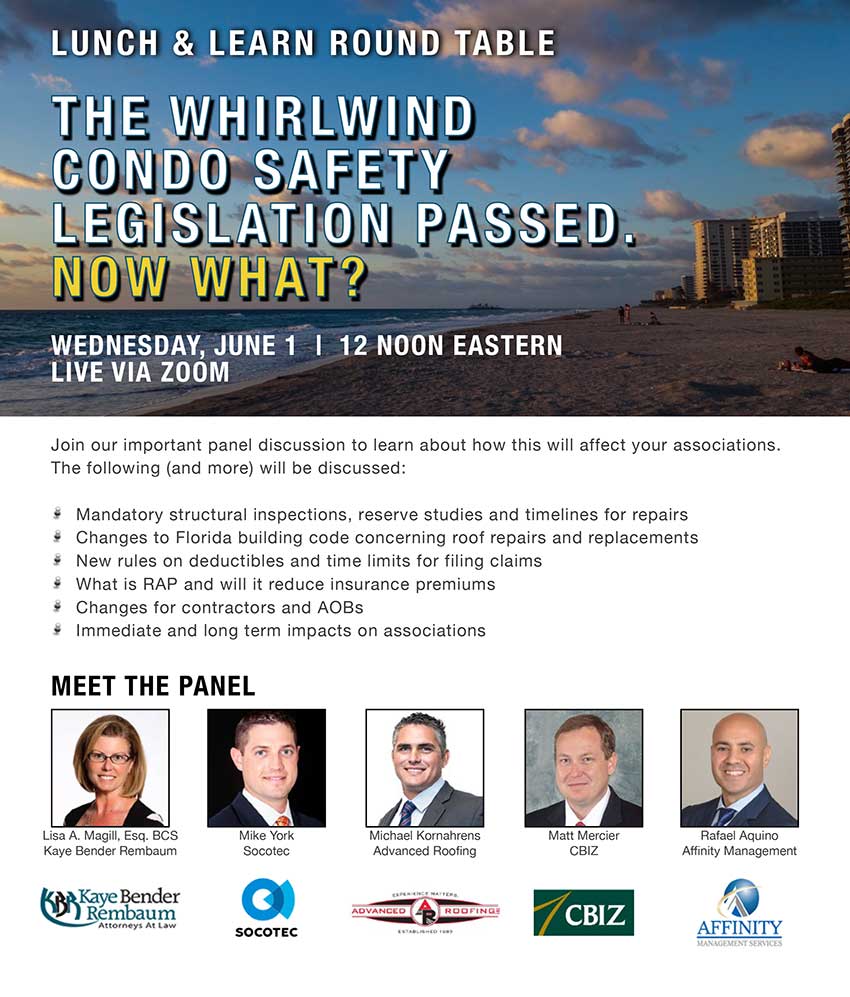
Now That Safety Reform Legislation Has Passed, Prepare!

Now That Safety Reform Legislation Has Passed, Prepare!

  • Posted: Jun 30, 2022
  • By:
  • Comments: Comments Off on Now That Safety Reform Legislation Has Passed, Prepare!

Now That Safety Reform Legislation Has Passed, Prepare!

Now That Safety Reform Legislation Has Passed, Prepare!

by Enrolled Agent Steven J. Weil, Ph.D., EA, LCAM, Royale Management Services, Inc.

The tragedy at Surfside was a wake-up call for many of Florida’s high-rise residents and legislators.

To recap, in a Special Session on May 26, 2022, the Florida Legislature unanimously passed Senate Bill 4-D. The Safety Reform Bill comes with a deadline of December 31, 2024.

This means that Florida has now imposed a state-wide structural inspection program for condominium and cooperative associations that are three (3) stories or more in height. Buildings with a certificate of occupancy that was issued on or before July 1, 1992 must have an initial milestone inspection performed before December 31, 2024.

What is a Milestone Inspection?

A milestone inspection is a structural inspection of a building’s load-bearing walls and primary structural members/systems. They must be performed by a Florida licensed engineer/architect who must attest to the life safety and adequacy of structural components of the building.

The inspection consists of two phases:

Phase one — Visual examination of habitable and uninhabitable areas of a building. If there are no signs of structural deterioration found, phase two is not required.

Phase two — If substantial deterioration is found during phase one, phase two may involve destructive or nondestructive testing at the inspector’s discretion. This additional inspection may be as extensive or limited as necessary to fully assess areas of distress.

Community association managers or management companies working with associations that are subject to this inspection must comply as directed by the board. Upon receiving notice from a local law enforcement agency, condominium/cooperative associations will have 180 days to complete phase one of the inspection.

What About Reserves?

Beyond that, also effective December 31, 2024, no unit owner-controlled condominium or cooperative will be permitted to vote to waive or partially fund their reserves.

Condominiums and cooperatives must adequately fund reserve accounts, and the amount is determined by the most recent structural integrity reserve study, also required.

Unanswered Questions Remain!

What are the definitions and requirements for certain items that will be hashed out in the coming months by state and local building departments and regulators?

What will the costs be for milestone inspections and required reserve studies?

Will there be enough Florida licensed Engineers and Architects to handle the number of statewide inspections?

How much will the new mandatory reserve items add to the cost of owning and or renting in a condominium or coop?

What provisions, if any, can be made for financing the necessary phase two required repairs?

What Does It All Mean for Boards and Residents?

Clearly, the short answer to the question “what now” is PREPARE.

Costs of materials are rising. The sooner the work gets done, the lower the cost is likely to be. It makes sense to start now to interview potential engineers and architects.

It makes sense for Boards to review association documents and to educate residents about how the new laws will affect them.

Deciding what repairs to make will surely be controversial.

Many associations have not been funding reserves or only partially funding them for years. The mandatory change to fully fund is sure to be a costly and unwelcome adjustment.

It does seem clear that based on the new law the cost of maintaining and living in an association will increase and that this will impact many of the residents.

Royale Management Services, a registered and licensed community association management corporation in Florida, works with association Boards of Directors throughout South Florida to oversee the daily activities required for proper management, helping to educate them on their responsibilities, duties, and obligations. Royale’s team members are highly trained in all aspects of community association management and customer service to ensure that proper procedures are followed that keep the association in compliance with all of the rules governing elections, budgeting, accounting, operation, collection and assessment. The firm and its president are members of the Community Association Institute (CAI) and the Fort Lauderdale Chamber of Commerce.