SFPMA

SFPMA Industry Articles | news, legal updates, events & education! 

Find Blog Articles for Florida’s Condo, HOA and the Management Industry. 

Is Your HOA or Condo Board Doing A Good Job?

Is Your HOA or Condo Board Doing A Good Job?

Is Your HOA or Condo Board Doing A Good Job?

How Can You Tell If Your Board is Doing a Good Job?

There’s a lot of talk in the media and online about bad Boards of Directors, including our recent article on how to tell if your Board is stealing from the association. But how do you tell if the Board of your Condo or HOA is doing a good job? Not all Boards are bad, right?

The truth is, most Board members are honest people that meant well when they campaigned for election and mean well when they attend and vote in each meeting. They have reasons for making the unpopular decision that the residents complain about. Oftentimes those reasons are valid and the unpopular decision was actually the lesser of two evils. But, how do you know for sure?

What Makes a Board of Directors “Good”?

To find out what HOA managers and management company executives thought was the ultimate sign of a good Board, we conducted a survey on LinkedIn. The survey responses were almost tied. It turns out, there isn’t one ultimate sign. Instead of one thing that makes your Board great, there’s a list of things that make your Board of Directors successful… or not.

Financial Responsibility

The most popular survey response with 33% of the vote, having a well-funded budget and reserves is a hallmark of a good Board. But other factors go into good financial management as well. A good Board is honest when spending HOA funds and uses them for the good of the community. They communicate with the membership about the reasons for budget increases, how they are using the money collected, and what the process is for paying vendors and for dealing with homeowners who aren’t paying on time. Big projects are well-researched and planned to limit unexpected expenses that make special assessments more likely. Speaking of special assessments, good boards know that regular dues increases that keep up with inflation are a better way to fund projects than special assessments.

Proactive Maintenance of Facilities

Coming in at 29% of the vote is proactive maintenance of the facilities. This means little to no deferred maintenance in the community. All buildings, parks, equipment, etc. are inspected often. Preventative maintenance is completed because the Board knows it will save money in the long run. When something needs repair or replacing, it’s completed as soon as possible, because the longer it waits, the more it costs. What good does it do to have a well-funded budget if money is never spent on maintaining the physical assets of the community?

Productive, Peaceful Meetings

Tied with maintenance at 29%, some managers and executives felt that the number one sign of a good board is how it feels to attend their meetings. Good Boards can disagree without slipping into childish or inappropriate behavior. They read the packets and reports that management provides them before the meeting and show up prepared to vote. Members feel comfortable attending meetings, and because the Board sets a good example of how to behave, most of the members follow it.

Good Boards Set Goals

Another sign of a good Board is goal setting. It’s hard to steer a ship if you don’t know where it’s headed. A Board that plans ahead and sets goals for the direction the community should head in is a Board that has a better chance of getting there. A Board that doesn’t plan is going to find itself spinning around in circles.

Fair Collections

People might not like to talk about it because it can be emotionally uncomfortable, but to be good at their job the Board must do something about owners that don’t pay their dues. It’s not fair to the owners that do pay to have to carry the burden of those that don’t. But a good Board is not overly aggressive when it comes to collections. They make sure that the collection solution they use is fair, not predatory, and advocates for the association to collect every possible penny.

The Good Board Checklist

Do you want to grade the Board of Directors for your community to see how good or bad of a job they’re doing? Using the following checklist, give your Board 5 points for every answer that you checked “yes”.

  • Increases to assessments are small and regular
  • The budget, reserve study, annual review, and other financial reports are accessible to the members for review
  • Reserve funding levels are above 80%
  • Special assessments are rare
  • The final cost for projects is usually in line with the projected cost
  • Components are inspected often and repaired as needed
  • When components fail, they are replaced and not abandoned or removed
  • The Board behaves like professionals at meetings even when they disagree
  • Meetings are business-oriented and not popularity contests or social hours
  • Members are welcome and feel comfortable attending meetings
  • A goal-setting discussion happens at least once a year
  • Experts are consulted and their advice is considered when making decisions
  • The number of owners that are late on their dues is less than 10%
  • Collection practices are fair and judgments and foreclosures are a last resort
  • The Board uses a professional collection solution instead of doing it themselves

Now, add up those scores and see how the Board did. A great score is 60-75, a good score is 45-60, an average score is 30-45, a Board that scores 15-30 needs improvement, and if the Board scored less than 15 points you might be in trouble.

Even good Boards of Directors sometimes find that their collections could be improved. Contact us today to find out why Axela Technologies is a better collection solution than your attorney, and learn more about our options for helping you recover late payments from delinquent  owners.


By, Dee A. Rowe, Guest Writer

Tags: ,
Beachfront is thrilled to be working with The Bridges, a luxe Delray Beach community surrounded by 299 acres of sparkling lakes, pristine landscapes, and cascading waterfalls.

Beachfront is thrilled to be working with The Bridges, a luxe Delray Beach community surrounded by 299 acres of sparkling lakes, pristine landscapes, and cascading waterfalls.

Beachfront is thrilled to be working with The Bridges, on all of their Painting needs, its a luxe Delray Beach community surrounded by 299 acres of sparkling lakes, pristine landscapes, and cascading waterfalls.

After completing a clubhouse refresh, we’re now offering homeowners a special group rate for exterior painting for its 590 single-family residences. Residents who wish to have their homes painted, or who would like more information about the project, can contact Jim Wolff,

Business Development Manager, at jim.wolff@beachfrontpainting.net or 772.789.7915.

Our team is honored to have been selected to help maintain the beauty and luxury expected at The Bridges. We have a lot of painting ahead of us. Stay tuned for “after” reveals in the coming months

Our Services:

 From single-family homes to shopping centers to high-rise condos, Beachfront combines quality workmanship with competitive pricing to give each client a meticulous paint job that lasts. Preparation is critical to our success and includes pressure washing, priming, and patching as needed.

Waterproofing

 At Beachfront, we make sure buildings are watertight. Our mastery of vertical and horizontal waterproofing extends to glazing and sealants, expansion joints and waterproof deck coatings.

Roofing

Through Beachfront Roofing, Inc, we repair, re-cover, and replace flat and sloped roofs no matter the material—metal, tile or shingle. We’re licensed applicators of Truco, Sika, PM, Karnak, Uniflex, Tropical, Henry and Gaco coatings. Our goal? To extend the useful life of your assets.

Restoration

We’re experts in concrete restoration and can quickly address issues like cracking, spalling and buckling. Whether surface repair or intricate strengthening project, clients count on us to keep their structures safe and sound.

Sealants

Beachfront specializes in sealant replacement and repair. Sealants are integral to the waterproofing process, serving as a water barrier in all types of exterior applications. We perform all of our sealant projects with precision using only the finest products available.

Pressure Cleaning

Regular pressure cleaning helps protect homes, hardscaping, decks and fences from damage and deterioration. Our low-pressure cleaning devices rid clients’ properties of dirt, oil, grease, algae, mold, rust and staining.


  Contact Us at

561.557.8534
info@beachfrontpainting.net

5840 Corporate Way, Suite 102
West Palm Beach, Florida 33407

[AdSense-B]
Tags: ,
Here at Commercial Fitness Products, our new medical and fitness products were designed to do just that!

Here at Commercial Fitness Products, our new medical and fitness products were designed to do just that!

Here at CFP, we feel passionately about restoring active lifestyles and able bodies with simple movement and strength training – and our new medical products were designed to do just that!


With thoughtful features that give therapists more control and opportunity to get their patients on the road to recovery, our equipment is easily integrated into client progression programs to get them back to living an injury-free life! Commercial Fitness Products has been a leading supplier of commercial fitness equipment for over 30 years. We have developed a high level of expertise in equipping all types of facilities. We pride ourselves on being able to serve large scale fitness facilities looking for top of the line commercial equipment, as well as smaller facilities looking for stay within budget and work with limited spaces.

Our years of work with various brand-name equipment manufacturers have helped us to build solid business relationships and connections for all types of product…resulting in lower costs for our customers. We are able to access a wide variety of equipment for the best prices, and we pass those benefits on to you.

Along with great prices, we place Customer Service at the top of our company’s priority list. Our staff is courteous, accessible, and qualified. Our goal is to exceed your expectations…before, during and after the sale. We know you are going to have a good experience in working with us…along with receiving quality equipment at a great price. We offer services that we feel are just part of the total package:

  • We provide facility design services to assist you in creating an organized, functional and aesthetically pleasing arrangement of your equipment that maximizes your space and facilitates an optimal fitness environment.
  • We offer in-service demonstrations for your staff so that they can learn how to correctly use each piece of equipment as well as derive the most benefit through proper form and operation. We emphasize safety measures that prevent unnecessary injuries or equipment malfunction.
  • We provide Preventative Maintenance Plans to keep your equipment running smoothly and reduce downtime.
  • We provide full service repairs for all types of equipment including parts and labor.
  • We offer professional Delivery & Assembly and moving services. Delivering large fitness equipment requires specialized knowledge and tools to prevent injury and maintain the integrity of the equipment.
  • We offer financing through local Leasing companies experienced in the fitness equipment industry.

Whether you’re looking for top of the line commercial equipment, lighter commercial-grade equipment, or something unique and innovative, we have it all. Take a look at our online commercial equipment section or call us today!

Commercial Fitness Products

5034 N. Hiatus Road
Sunrise, Florida 33351

(954)-747-5128


One of our recent Installs and Design.


We are grateful to have worked with D.R. Horton Homes on Promenade Estates on Palmer Ranch!

Reach out to us for all of your Fitness Rooms in Condo’s and HOA’s in Florida.

Tags:
CAN YOU REPEAT THAT?     Is Your Condominium in Compliance?

CAN YOU REPEAT THAT? Is Your Condominium in Compliance?

  • Posted: Feb 08, 2023
  • By:
  • Comments: Comments Off on CAN YOU REPEAT THAT? Is Your Condominium in Compliance?

CAN YOU REPEAT THAT?

Is Your Condominium in Compliance?

Additional Clarity Provided

If your condominium is greater than 75 feet tall, then you need to read this article (most especially due to a small but meaningful typo in the prior version which is now revised with the red text below).

It is essential for condominium associations to ensure that their buildings are in compliance with the requirements of the Florida Fire Prevention Code (the “Fire Code”). For the safety of all residents, associations must ensure they stay up to date with the latest and greatest in fire safety provisions. One of these essential safety features is a requirement that systems be built into new and existing buildings to ensure that first responders’ radios will work throughout buildings in an emergency situation. Pursuant to Section 11.10.1 of the Fire Code, “in all new and existing buildings, minimum radio signal strength for fire department communications shall be maintained at a level determined by the AJH [the authority having jurisdiction]. Additionally, Section 11.10.2. provides that where required by the authority having jurisdiction, two-way radio communication enhancement systems must comply with the requirements of the Fire Code.

When originally adopted, the requirements of Sections 11.10.1 and 11.10.2 of the Fire Code applied only to new buildings, so the requirement was not a burden on existing buildings. However, in 2013, the Fire Code was updated as set out above to provide that all new and existing buildings must maintain adequate fire department radio signal strength inside the building. This new requirement applied to all buildings and did not provide a grace period. This posed a significant problem for many high-rise condominiums, as the installation of the necessary equipment involves opening walls and ceilings and can be quite costly to the association. The cost of such installation was a substantial burden to condominiums, not expecting to be required to install same, and therefore never budgeted for the installation.

Recognizing the problem, in 2016 the Florida Legislature adopted section 633.202(18), Florida Statutes, which provided a grace period for high-rise buildings. Existing high-rise buildings were not required to comply with minimum radio strength for fire department communications until January 1, 2022. You may be thinking, “that date is passed”, but do not panic. If your condominium has not yet complied with the requirements, have no fear. The 2021 Florida Legislature amended section 633.202(18), Florida Statutes, to provide another extension for compliance.

In accordance with the newly amended statute, existing high-rise buildings now have until January 1, 2025 to come into compliance with the requirements. However, the association must apply for an appropriate permit for the required installation by January 1, 2024. More specifically, section 633.202(18), Florida Statutes, is amended to provide, in pertinent part, that:

(18) The authority having jurisdiction shall determine the minimum radio signal strength for fire department communications in all new high-rise and existing high-rise buildings. Existing buildings are not required to comply with minimum radio strength for fire department communications and two-way radio system enhancement communications as required by the Florida Fire Prevention Code until January 1, 2025. However, by January 1, 2024, an existing building that is not in compliance with the requirements for minimum radio strength for fire department communications must apply for an appropriate permit for the required installation with the local government agency having jurisdiction and must demonstrate that the building will become compliance by January 1, 2025. Existing apartment buildings are not required to comply until January 1, 2025…

Therefore, all existing high-rise buildings must come into compliance by January 1, 2025. It is important to note that this time extension applies only to high-rise buildings. By way of over simplification, it does not apply to buildings less than 75 feet tall (the measurement can be tricky, so if your building is close to 75 feet check with your association attorney regarding this measurement). In 2018, the Florida Department of Financial Services, Division of State Fire Marshal issued a Declaratory Statement finding that section 633.202(18), Florida Statutes does not apply to the enforcement of Section 11.10 of the Fire Code to buildings under 75 feet in height. Therefore, if your building is greater than 75 feet in height, it is required to comply with the radio signal strength required by the authority having jurisdiction at this time.

In light of the foregoing, it is essential that your association take action to determine whether sufficient fire department radio signal exists in your building. We recommend the association reach out to the local fire code official to determine the exact requirements for your jurisdiction. If sufficient signal does not exist in your building, it is essential to prepare a plan (including design, permits, financing, etc.) to ensure that your building will comply by the deadline of January 1, 2025.

Guide to Condo & HOA Financial Statements for Budget Season

Guide to Condo & HOA Financial Statements for Budget Season

  • Posted: Feb 08, 2023
  • By:
  • Comments: Comments Off on Guide to Condo & HOA Financial Statements for Budget Season

Guide to Condo & HOA Financial Statements for Budget Season.

Managing the finances of a community association is one of the most difficult, and most important, responsibilities of a board of directors. Preparing detailed  Financial Statements on a regular basis serves a multitude of purposes from providing insight for financial planning, promoting transparency between the board and residents, as well as being a requirement by law in some instances. The frequency of preparation may vary depending on state laws, community bylaws, and the size of the association.

If you are having trouble preparing community financial statements, the professionals at CSM are standing by to answer all your questions. We have years of experience working with thousands of residents across the United States.

What is an Condo & HOA Financial Statement?

Simply put, an Condo & HOA Financial Statements is an official record that details all the financial activities of the community association. Specific details that must be included depends on state regulations and community bylaws, but there are some basic details that should be included regardless of size or location: Read other articles on Topics below.

  • A balance sheet showing account balances
  • A statement of income
  • Receivables, including all money due to the association from sources like collections and credits from vendors or homeowner fees
  • Bank statements
  • A general ledger showing all account activity
  • Reserve fund balances

The most common mistake that people make when preparing financial statements is not adding enough detail. Every detail that can be added, no matter how small, can provide a more thorough insight and lead to better decision making. When in doubt, include it.

It should also be put into an easy to read format. These documents will be available to everyone in the community, most of which do not have advanced accounting degrees. For financial statement to be effective, it needs to be prepared so that anyone can understand the content. Making it too complicated alienates people and hinders community relations.


How Often Do Financial Statements Need to be Prepared?

There is no standard frequency that financial statements must be prepared. It will depend on state regulations, community goals, and the size of the community. Of course, the more frequently statements can be prepared, the more helpful they will be for the board of directors. Smaller Condo & HOA’s with simpler budgets can prepare monthly without much problem. Larger associations with more complicated budgets may opt to prepare statements quarterly or annually.

No matter what decision is made regarding frequency, it must be maintained. Straying from the regular schedule only causes issues between the board members and homeowners. It leads to a feeling of distrust. When dealing with financial information, it is best to be open and honest in as much detail as is appropriate.

For smaller, self-managed associations, if there is trouble getting financial statements completed on time, it is relatively inexpensive to hire an accountant as needed to prepare balance sheets. This ensures that all the information will be completed in a timely manner without taking time out of community volunteer’s busy schedules. It also means that the statements have been professionally checked and relieves some of that stress from the board members as well.

There are also a multitude of services available from CSM to help homeowner’s associations get organized and prepare their own financial statements. With the professional support of an experienced team along with state-of-the-art technology, even the most inexperienced association members will be able to navigate the complicated waters that is financial management with ease.


What is a Financial Statement Used For?

The obvious answer is that detailed HOA financial statements can be used by the community association board of directors to adjust budgets, dues, and allocate money for maintenance and projects. The more detailed the statement, the more effective the association.

It is a requirement for any sort of financial planning. For starters, if records are kept consistently, association directors can look back on previous financial years to identify patterns that could affect the current budget and adjust accordingly. It is also imperative to keep track of money owed. If detailed records are not kept, it can be near-impossible to keep track of delinquent dues or know how much money is available to budget for community maintenance and new projects.

In some states, it is a legal requirement for Condo & HOA’s to maintain and submit regular financial statements. Even if it is not required in your state, it is a good idea to keep detailed records anyways as they will be extremely beneficial for all other aspects of homeowner’s association management.

Most importantly, having detailed financial statements readily available to all members can promote transparency between the board and the community. If the homeowners can see what their money is going towards, they will be more agreeable and open with the board of directors. It promotes teamwork throughout the community.


Where Should the Financial Statements Go?

As with most things regarding financial statements, it depends on state laws and community bylaws. Generally, there are three places that they need to be turned in:

  1. The Board of Directors – the board of directors should receive a full, unedited report. They will need all available financial details in order to make informed decisions and plans regarding community maintenance and future projects.
  2. Community Members – to foster an open and transparent relationship, homeowners should also receive copies of financial statements. These statements, however, should be altered to exclude sensitive information such as delinquent accounts. There is a difference between being sensitive and being secretive. If it will not cause an issue between community members, it should be included in the documents sent to community members. All  financial statements should be available upon request.
  3. State Department – if a homeowner’s association is organized as non-profit, an annual report must be filed with the Secretary of State. Failure to do so could result in losing their “Good Standing” status. This may not be applicable to all Condo & HOA’s.

The more accessible financial statements are, the better. Some community associations even opt to put their financial information on their website to allow homeowners to view it at any time. Of course, not all information needs to be publicly accessible, but everything that can be included should be included. Transparent financial processes help to promote teamwork and positive community relations between homeowners and association board members.


Who Should Prepare Financial Statements?

This answer depends on the size of the community. Smaller, self-managed associations may have an elected treasurer, financial officer, or president that is responsible for compiling financial documents. In such cases, it is a good idea to use a professional accountant to ensure that  financial statements are prepared correctly before releasing them to board and community members. Remember, just because someone was elected treasurer, does not necessarily mean they have accounting experience. It is always best to hire a professional. Large homeowner’s associations have more complex budgets and will usually have a management company that handles all financial data.

If statements are self-prepared by an elected community member, make sure that there is a backup of all financial records. In the unfortunate event that something happens and the preparer is no longer able to maintain their responsibilities, it can be difficult for the next person to learn their accounting methods or sometimes even gain access to the records.

Whether an association is made up of ten units or ten thousand units, it could be beneficial to hire a management company to ensure that everything is being run as efficiently and effectively as possible. When looking into property management companies, it is important to look for a company with a strong financial background. If the finances are not well kept, the entire community association becomes ineffective. Hiring a company to provide financial management assistance not only makes life easier for the board of directors but can also give community members peace of mind knowing that all finances are being managed accurately and efficiently.


The Importance of HOA Financial Statements

To make a great plan, it is important to have all the information possible. Reliable, consistent, and transparent financial statements not only help the HOA board of directors make well-informed decisions but also support community health by allowing all community residents and stakeholders to be a part of the team. Keeping members in the dark only promotes mistrust and working with inadequate or no financial information can lead to dwindling reserves for community upkeep and new projects.

Creating an effective HOA is as simple as choosing an accounting process that works for your team, keeping detailed records, and communicating openly and freely with the community about all financial information.


[AdSense-A]


Tags:
Lake Experts Answer Top 10 FAQs by SOLitude

Lake Experts Answer Top 10 FAQs by SOLitude

Our top 10 FAQs blog breaks down common questions about lakes and management practices, including:


🐟 If a bunch of fish die, should I assume the water was poisoned?
❔ What is causing the lake’s shoreline to erode?
🌾 Why do the specialists spray some plants and not spray others?

Read all the answers from our experts…

Common Questions About Lake & Pond Management

10 FAQs About Lake Management

Lakes and ponds play a central role in our communities by collecting stormwater, creating recreational opportunities, providing drinking water, and allowing us to nurture our biological desire to spend time around the water. You deserve to have beautiful, clean water to enjoy, but achieving it can be difficult – where should you begin? When you have a better understanding of these complex ecosystems, you’re able to make more informed decisions about how yours is managed. Here are some frequently asked questions to help you get started.

1. Why is my pond turning green? Is it normal for my lake or pond to have algae?

Green can be an alarming color when it comes to any body of water, but it doesn’t always reflect unhealthy conditions; plants and algae are natural features in lakes and ponds that provide essential food and habitat to native beneficial species. However, they can get out of control when the aquatic environment becomes imbalanced.

The best way to detect imbalances and identify the plants and algae that are present is through professional water quality testing. The results can help inform your management choices.

2. Why does the pond across the street always look better than mine?

It’s crucial to remember that no two waterbodies are the same. There can be vast physical and chemical characteristics based on hundreds of surprising factors, including water depth, gardening and landscaping practices, the presence of pets or livestock, how the waterbody is used, and even the level of sunlight that penetrates the aquatic ecosystem each day. The contours of the surrounding land may allow pollutants to flow into one waterbody during rainstorms without impacting the other.

While it’s tempting to replicate the maintenance strategies used by the neighbor with the beautiful pond, this underscores the importance of customized management programs. A one-size-fits-all approach will rarely yield the long-term results you desire.

3. How is the pond behind my Florida home different from one in Michigan?

As you know, all aquatic ecosystems are unique, but the reasons can extend far beyond water depth or landscaping. Seasonal weather patterns, climate, rainfall, and other regional factors will have a powerful impact.

For instance, many lakes and ponds in Florida are exposed to brackish water, especially during flooding and hurricanes. The higher salinity (accumulation of salt) can significantly alter the chemical composition of the waterbody. Likewise, Florida waterbodies are now home to many invasive plants and animals, which pose unique challenges that require different solutions. Undesirable plant growth is further accelerated by the intense humidity in Florida, which leads to more frequent maintenance.

This is not to say that waterbodies are healthier in one state versus the other; they all face similar obstacles, but the strategies and management styles may differ dramatically.

4. If a bunch of fish die, should I assume the water was poisoned?

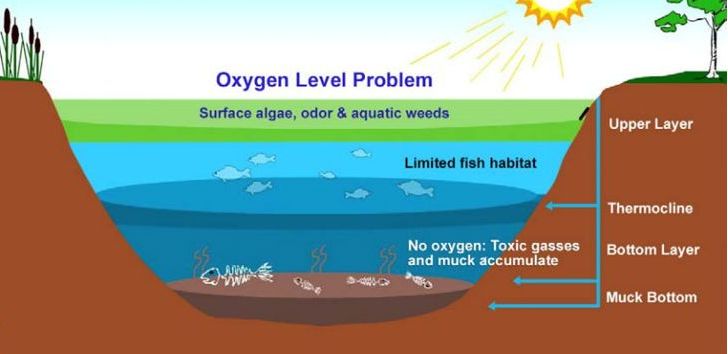
Fish kills are rare and are sometimes connected to poisoning, but many fish kills occur naturally due to insufficient dissolved oxygen levels. Oxygen can be impacted by the level of sunlight, recent rain storms or forceful weather events, excess vegetation growth, or the transition of the seasons. However, they are preventable.

Many aquatic experts recommend fountains and aeration systems to keep dissolved oxygen levels balanced throughout the entire water column through consistent mixing. Preventing the growth of aquatic weeds and filamentous algae will also free up the water column to maximize the benefits of circulation.

Finally, testing dissolved oxygen levels on a recurring basis will help you identify and get ahead of oxygen imbalances before the fish population is affected. If lab reports indicate that dissolved oxygen levels are sufficient, then it may be worth consulting with your professional about the possibility of pollution or poisoning.

5. What is a stormwater retention pond?

Stormwater facilities (also known as BMPs) are structures that play a vital and multifaceted role in the preservation of our surrounding wetland and aquatic ecosystems. These systems are typically constructed in relation to residential and commercial development infrastructure that increases impervious surfaces and overland stormwater flow. They provide the essential temporary collection of stormwater in order to allow for filtration and basic improvement of water quality (removal of sediment, organic debris, animal waste, fertilizers, and other contaminants/nutrients) before entering natural wetland systems.

For this reason, it is critical that these specially designed and constructed systems remain functioning as intended and maintain pond compliance with local, state, and federal stormwater regulations.

6. What is causing the lake’s shoreline to erode?

Erosion is natural. It gradually happens as rainwater flows into lakes and ponds and when wildlife interact with the ecosystem. But recreation, landscaping, and urban development also influence the rate at which erosion occurs. Gutter downspouts and pavement concentrate and accelerate the flow of runoff over the shoreline. As sediment accumulates at the bottom, it reduces depth and volume – increasing the risk of flooding. Stormwater runoff also picks up animal waste, trash, leaves, lawn clippings, and other organic materials that promote nuisance weeds, algae, toxic cyanobacteria, and other water quality issues.

Though shoreline erosion is inevitable, it can be slowed and even reversed with the right management tools and strategies. Professionals encourage the introduction of beneficial buffer plants that are native to your region. Flowering, deep-rooted species can help hold the shoreline in place and deter people and nuisance animals like geese from venturing too close to the water’s edge. Shorelines can also be bioengineered for improved stability and aesthetics using a patented mesh technology called SOX Solutions.

7. Why does the shallow area near the shoreline have plants growing in it? Are those plants invasive?

Emergent plant species generally grow in shallow water near shorelines. Your lake management professional can help you determine if the species is native or invasive, and walk you through maintenance options if undesirable growth is identified.

Some invasive weeds are aesthetically pleasing. Purple loosestrife, for example, is known for its gorgeous purple blooms. However, invasive plants are detrimental to the ecosystems they invade by crowding out native plants and displacing the wildlife that relies on them for food and shelter. Without intervention, exotic weeds can quickly repopulate and spread to other ecosystems nearby.

It’s important to have regular inspections of your waterbody and consult with your lake management professional if you suspect an invasive plant has taken root.

8. Why do the specialists spray some plants and not spray others?

Every plant species is unique. From their physical characteristics to their growth patterns to their methods of repopulation, plants vary widely – and so do the methods used to manage them. Spraying may be the most effective management style for some. Others may respond best to cutting, burning, or physically pulling.

Stakeholders also have different goals, budgets, and priorities. Some may prefer to swiftly manage undesirable plants using herbicides while others desire a more holistic approach that targets the “root cause” of the growth. This typically means addressing shoreline erosion and balancing water quality with nutrient mitigation products like AlumPhoslock, or EutroSORB.

9. Won’t the algae or weed products harm the fish and wildlife?

All herbicides and algaecides used by professional lake managers have gone through rigorous testing and are registered with the Environmental Protection Agency (EPA). Licensed aquatic experts also have access to advanced products that are designed to target the specific growth mechanisms in nuisance and invasive species without impacting desirable plants, wildlife, or people.

These products are considered very low risk when applied by licensed professionals. Furthermore, certain weeds and algae species can actually be detrimental to an aquatic ecosystem. Invasive plants are known to outcompete native growth and displace beneficial wildlife, threatening the biodiversity of our local ecosystems. And nuisance algae like cyanobacteria (also known as Harmful Algal Blooms or blue-green algae) can develop toxins that are fatal to fish and birds, as well as dogs, cats, horses, and livestock.

Your lake manager will be able to help you understand these intricate dynamics and weigh the management options that align best with your priorities.

10. Can’t we just let the pond take care of itself naturally?

Lakes and ponds have natural checks and balances that keep them in a healthy, functional state with a flourishing food chain. But the rise of urban development, pollution, deforestation, mass agriculture, and other human activities has created new challenges that may overwhelm the ecosystem. In unbalanced conditions, lakes and ponds are more likely to experience aquatic weeds, algae and toxic cyanobacteria, fish kills, bad odors, muck development, flooding, and other problems.

These human-caused factors will not go away, but proactive management can help reduce their influence on our aquatic ecosystems. Annual Management Programs provide ongoing, professional care to maintain a healthy waterbody and catch potential problems before they get out of hand. Over time, annual maintenance approaches are often more effective and affordable for many stakeholders.


Achieve the Water You Desire with SOLitude

You value your waterbody – and so do we. We’re committed to arming you with knowledge and resources to help you visualize your ideal lake or pond and understand how to achieve it. As your partner, we’ll guide you every step of the way, so you can have peace of mind that your waterbody is on the right track at all times.

Tags: , ,
What Are the Duties of Condominium Boards?

What Are the Duties of Condominium Boards?

What Are the Duties of Condominium Boards?

Condominium boards have complete management responsibility for their community. Even if they outsource some duties to a professional management company, boards still retain these responsibilities. Since individual homeowners, who may not be well-versed in real estate management and legal issues, serve on these boards, all members should understand their duties and responsibilities. Condominium boards should also retain experienced legal counsel and/or accountants to be information resources and advisers.

Condominium Association Bylaws

Board members must become intimately familiar with their condominium association bylaws. Management of all condominiums is governed by the association bylaws. Board members must understand all items addressed in the bylaws, often called the “condo docs.” Further, boards must learn all state statutes that relate to bylaw subjects and strictly follow the letter of state laws to avoid legal problems.

Common Areas and Building Exteriors

The condominium association board must maintain–and keep in good repair–all common areas and building exteriors. Common areas are those used by all unit owners who have deeded title to small percentages of these areas. These areas include building lobbies, open land or parks, tennis courts, pools and other amenities available to all residents. Whether a high-rise style, townhouses or cluster housing, building exteriors require maintenance and repair, particularly the siding and roofs.

Condominium Association Budget

Creating and managing the association budget is a critical duty for condominium boards. The most common reason for condominium problems is mismanagement or misuse of the budget. Association boards without an experienced accountant as a member should consider getting advice from an outside CPA to ensure that their budget is reasonable and complete. Condominium budgets should be built like those of nonprofit corporations. By estimating expenses, including insurance, landscaping, trash removal and similar operating costs for the coming year, the association board determines the amount of monthly individual homeowner assessments, commonly called “condo fees.”

Maintenance and Repair Reserves

Along with operating expenses, the association must carefully consider the funds needed as “reserves” for maintenance and repair. As part of the budgetary process, establishing realistic reserves is often overlooked by association boards, sometimes with dire consequences. For example, picture a 48-unit high-rise condominium, with each unit having a suspended wooden deck for relaxing and entertaining. Decks need periodic staining and water protection applications. Further, on older condominium projects, deck replacement would be needed at some point. Neglecting to build reserves into the annual budget for deck maintenance and replacement could result in “special homeowner assessments” of thousands of dollars. Condominium boards must diligently add these to annual budgets to build up cash to make these repairs.

Collecting Assessments

Monthly homeowner assessments–condo fees–must be collected by condominium boards. While most condominium bylaws permit boards to place liens on individual units for unpaid condo fees, liens do not equal money. Unit owners may not refinance or sell their homes for many years, leaving the condominium association short of funds to meet budget and reserve demands. Boards have a duty to establish an effective collection policy, much like a bank, to ensure consistent monthly cash flow into the association account to meet operating expenses.

Fiduciary Duty

Condominium associations must fulfill their fiduciary responsibility to manage the project in a businesslike and conservative manner. Depending on the size of the condominium project, association boards may manage many dollars and complex business issues. Fiduciary duty is typically measured by evaluating the actions of individuals or groups that “reasonably prudent” persons would take. For example, neglecting to collect condo fees, putting sufficient reserves in the budget or not completing necessary repairs is a breach of fiduciary responsibility. Condominium boards usually have individual and collective fiduciary responsibility and could be subject to serious lawsuits from unit owners for failing to act prudently.


Tags: , , ,
Pickleball and Tennis Courts Contractors for Florida Condo & HOA’s – Mor Sports Group

Pickleball and Tennis Courts Contractors for Florida Condo & HOA’s – Mor Sports Group

The State of Florida is widely regarded as the pickleball capital of the world, PickleBall is one of the fastest growing recreational sports in America. In Florida alone, there are over 10,000 PickleBall players. The sport is extremely popular with seniors ages 50 plus as an alternative to tennis and table tennis. 

Pickleball gives you a good aerobic workout without as much stress and strain on joints and muscles, as mentioned above. The endorphins and other bioamines that are released with all exercise are useful in elevating self-esteem and combating depression – both problems that can come with older age.


Do your Buildings have Pickleball Courts? If not you need to add this to one of the Amenities for all of your Owners in your Condo & HOA Associations.


MOR SPORTS GROUP

Contact Mor Sports Group

Gary Morton CHST SMS

Group Technical and Sales Manager

239-560-8613

Gary@morsportsgroup.com

16120 Lee Road, Suite 150, Fort Myers 33912

http://www.morsportsgroup.com


When you choose Mor Sports Group you will be given owner entry to our internal project management software which will give you access to all scheduling, daily logs, planning and much more. You will have constant communication with all our staff from our in house installers onsite performing works right through to our foreman and operation managers who are there to ensure your project vision is completed .

We are proud of the reputation we have created at Mor Sports and we will do everything to ensure that our reputation continues to grow, aiming to create long term Clients who always think first of Mor Sports for their repeat business.

We are ready to install Pickleball Courts for your buildings

Playing Surface installation

All of the installation of the cushion and playing system was undertaken by our own in house, trained and experienced employees.Firstly, the asphalt pavement was checked for irregularities. To check for isolated “bird baths”, the asphalt pavement was flooded with water to check for planarity levels and to identify any low isolated areas.

Any low areas were patched and levelled and minor irregularities were attended to. To correct these minor surface irregularities, a filler coat was applied. This coat is an acrylic binder mixed with Portland cement and a sand aggregate.


SFPMA keeps you up to date with everything from Legal Advances, Business Advances and Service advances in Florida’s Condo, HOA and Property Management Industry.  On our Members Directory everyone can find the Top Companies working in our industry. 

Tags: ,
Register for our upcoming webinar to discover how to repair shoreline erosion and enhance your lake’s bank with native buffer plants.

Register for our upcoming webinar to discover how to repair shoreline erosion and enhance your lake’s bank with native buffer plants.

Repair Your Shoreline with SOX Erosion Solutions & Native Plantings

Register for our upcoming webinar to discover how to repair shoreline erosion and enhance your lake’s bank with native buffer plants.

January 31, 2023 3:00 pm EST

Sign Up Now for the Webinar.


Don’t Miss This Exciting Webinar with Our Erosion Experts!

Erosion is a natural occurrence that can damage your shoreline over time. Eroded shorelines not only increase the likelihood of water quality issues, but they can have an economic impact on your property and can even lead to liability risks. Knowing when and how to repair erosion damage can be stressful and confusing…

Join our upcoming webinar to discover how erosion occurs, signs your shoreline has erosion damage, and how you can restore your bank with SOX Erosion Solutions and native buffer plantings. Experts Chase Morgan, Business Development Consultant for SOLitude Lake Management, and Casey Cittadino, National Sales Director for SOX Erosion Solutions, are excited to discuss the innovative erosion control solutions available.

This webinar is free and open to the public. Can’t make the live discussion? Register anyway and you’ll receive a follow-up email with the recording.

Having issues with the form on this page? Click here to register.


Tags: