What are the topics that you believe should dominate the condominium and HOA landscape? What are the issues that we may be missing or that simply deserve more coverage?
We want to hear from you! Feel free to share your questions before Sunday’s broadcast, join us with a call during the live show, or type them into the YouTube chat. The choice is entirely yours!
Stay in the loop with our live broadcasts! Click the link to visit our YouTube channel, hit the alert button, and be sure to subscribe for instant notifications.
As always, we’ll be taking your calls on whatever topic you need answers to or whatever you need to get off your chest. Call in with your question & comments or ask them in the live YouTube chat!
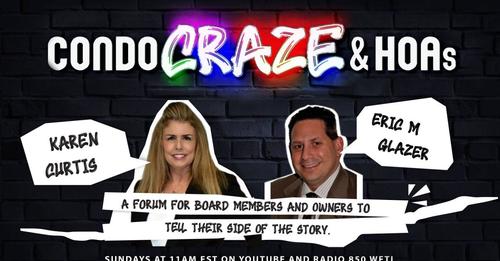
Glazer and Sachs presents a forum for board members and owners to tell their side of the story. Hosted by Eric Glazer, a recognized authority in community association law, Condo Craze and HOAs offers valuable insights and lively discussions, attracting a diverse audience of homeowners and board members.
Do you have questions about Florida’s building safety legislation, Senate Bill 4D? Just enter your query in the textbox below and click “Send Query”. For example, try asking, “What is the Florida Senate Bill 4D?”. This AI tool is experimental and provides no warranties regarding the accuracy of its results. Use at your own risk.
We recently published an article on how communities can speed up maintenance projects. In this article, we’ll look at how long some common maintenance jobs should take to complete.
HOAs have an obligation to maintain certain parts of the development. They must set aside a portion of the dues or fees collected from owners to pay for big and small maintenance projects. If the association fails to meet those obligations, it not only creates safety problems for members, but legal issues for the association as well.
If members feel that the board is not properly caring for the property, they can write official complaints, vote to remove board members, or even sue the HOA.
Maintenance must be taken seriously, but it is far easier to manage when you have a system or solution that enables you to organize components, schedule/assign work, and track tasks.
Defining maintenance obligations
The maintenance responsibilities of an association versus those assigned to individual owners depend primarily on whether the item or equipment is classified as part of a common area, exclusive use common area, or separate interest.
Common areas typically refer to shared spaces such as pools, sidewalks and roads. Exclusive use common areas are spaces or elements used by one or more, but fewer than all, of the owners. Separate interests are the separately owned lots belonging to members.
While some maintenance obligations are quite clear, others can be a little murky. This is especially true with exclusive common areas since they tend to be things like patios and windows. Roof maintenance may also be confusing; some HOAs cover roof repairs while others do not.
The association’s CC&Rs should detail maintenance obligations and define who is responsible for what. But if there is some uncertainty, boards are advised to refer to civil codes and/or consult with the HOA’s attorney.
Why timelines matter
There are several reasons why time matters when it comes to maintenance projects. The main one is so staff and management can plan for disruptions and costs. However, there are times when maintenance work will impact owners, and they will also need to know approximately how long the work will impact their day-to-day lives.
For example, if a parking lot is being repaved, owners will need to be informed of the work, they will need to move their vehicles before the work begins, and know how long they will have to find temporary parking.
Contractors can’t know for sure how long maintenance work will take to complete, but they should be able to provide an educated estimate. Tracking the time it takes for professionals to complete routine and unplanned maintenance is another good way to predict future repair timelines. Having this knowledge allows those responsible for setting up maintenance work to complete projects with more confidence (plus they’ll know if a vendor is taking too long to complete certain jobs).
How long should HOA repairs take?
There is no way to know for sure how long any maintenance project will take. Even a standard preventative maintenance job can become lengthy if a contractor discovers additional damage to an element. Other factors, including availability of materials, permit requirements, complexity of the project, size of the community, and weather will all impact the timeline of a project.
That being said, below are some estimates of how long common HOA maintenance work takes to complete.
To get a more accurate time estimate, speak with a contractor or repair expert. They will be able to look at the specific qualities of your community and provide you with a realistic timeline.
Pool repairs
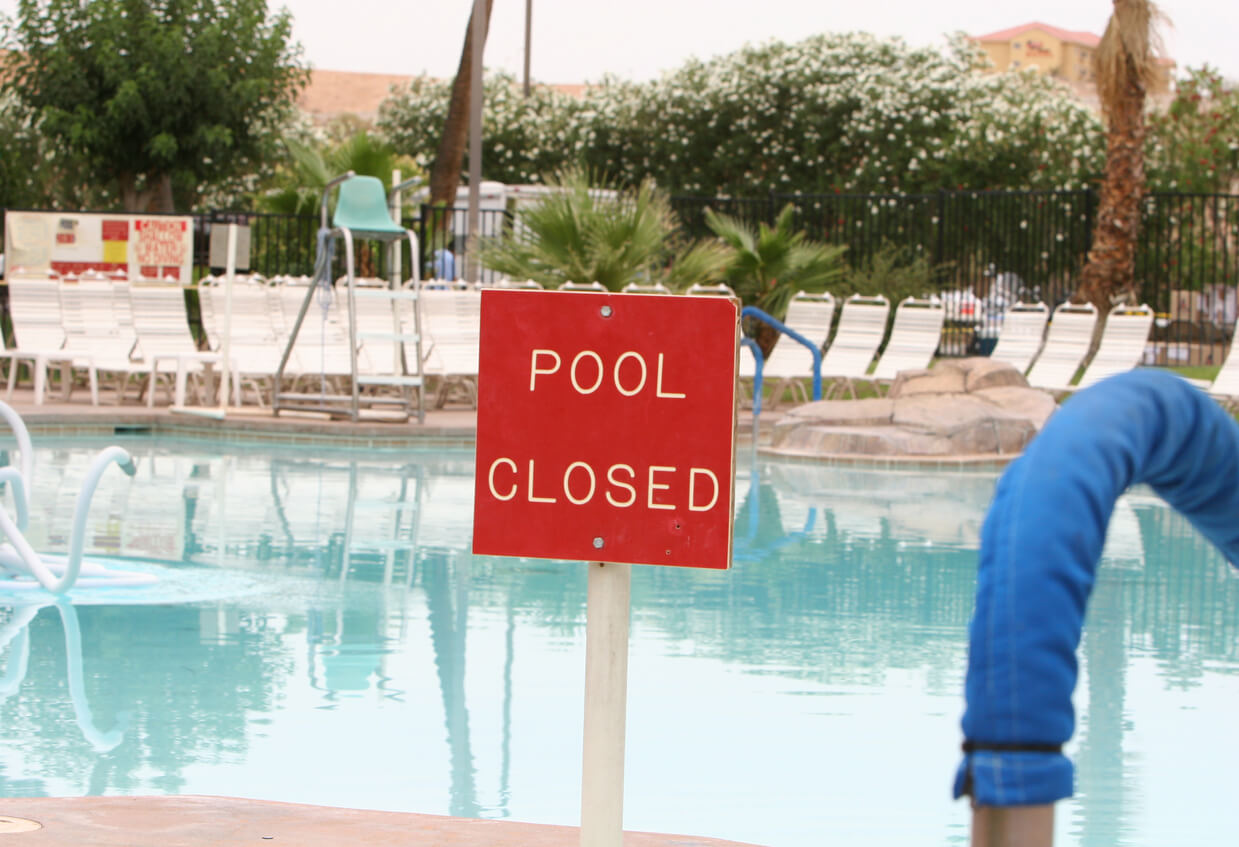
There are many different types of pool repairs. Some can be completed in a couple of hours while others will take several days.
A simple structural leak generally takes a day or two of work. Half a day is needed to complete the first step of a crack injection repair, and another half day is required to “staple” the cracks together and plaster the damaged area.
If your pool has a heater and the warming system breaks, the entire pool may be shut down for a week. The heater can be replaced in a day, but it could take longer. After the new pool heater is installed, it might be another three days before the pool is warm enough to use again.
Most plumbing leaks can be resolved in two days, but the time it takes to fix a pool leak from plumbing can vary according to the extent of the damage.
Pool resurfacing involves the removal and replacement of the top layer of the pool surface. This may be done to give the pool a clean fresh look, or to address several small cracks. In general, this renovation process takes one to three weeks.
Water/electricity lines
A water line is an underground pipe that transports water from a water source to a home’s or building’s service pipe. These pipes typically run beneath sidewalks and streets.
A water line pipe might crack, allowing water to spill out. This can cause many issues, including unsanitary water, higher water bills, low water pressure, and floods.
Due to the severity of this problem, a water main break needs immediate attention. Plumbing technicians will need to turn the water off while they repair the break. Once the pipe is in working order, they will flush it before reconnecting it to the plumbing system.
The good news is this type of repair only takes between four and eight hours.
If an electricity line goes out due to weather, it can generally be restored in a couple of hours. However, if an entire pole comes down, the outage could easily last a full day.
Roofs
In many cases, HOAs have delegated the responsibility of maintaining roofs to the individual owners. But if the association covers the costs of repairs, expect each home to take up 1-3 days of the contractors’ time. More complex designs and materials will add time to that estimate.
Gutters and downspouts
Routine maintenance of gutters and downspouts prevents more serious water damage from occurring. Like roofs, many HOAs have stated that owners are responsible for maintaining these items.
Minor gutter repairs can be completed in as little as one to two hours. Partial replacements can take two to four hours, and full replacements can take two to three days of work.
The timing is similar for downspout repairs and replacements.
Parking lots
Most HOAs can complete routine parking lot maintenance in two to three weeks, but timing will vary depending on the size of the lot and weather conditions.
Paving can take less than a week, but keep in mind that proper curing (letting the asphalt cool and settle) is an important part of the process as well. Depending on the size of the parking lot, thorough curing can take anywhere from one to two weeks.
General landscaping
While not a traditional repair, landscaping is a maintenance job that can be hard to plan for, at least the first couple of times. The size of the property, availability of materials, and weather conditions can greatly impact the time it takes to finish the job. Once you have found a landscaper that you like, you will become more familiar with the time it takes to do certain jobs.
From start to finish, most projects fall into the two- to three-week range, but cutting grass or trimming plans can take half a day.
Conclusion
HOAs have an obligation to maintain certain areas of the development. By scheduling routine maintenance, associations help prolong the useful life of elements and components, and keep the community safe and attractive too.
It’s important for staff, board members and management to have repair timelines so that they can budget for costs and time accordingly. While projects don’t always go according to plan, just having a guideline allows them to manage expectations more effectively.
Comments: Comments Off on Join Becker’s Jennifer Biletnikoff and David Muller on Wednesday, February 21 at 12PM EST for a webinar to learn the ins and outs,Are you ready to serve on your HOA or Condo Board?
Are you ready to serve on your HOA or Condo Board? If so, you must comply with Florida’s certification requirements.
Join Becker’s Jennifer Biletnikoff and David Muller on Wednesday, February 21 at 12PM EST for a webinar to learn the ins and outs, Are you ready to serve on your HOA or Condo Board?
and how to avoid potential liability associated with your new role. By attending this online class, you’ll earn CEU credits to satisfy the statutory requirement, so you are eligible to serve.
If you are planning to serve on your homeowner association board, you probably know that you will need to comply with Florida’s certification requirements within 90 days of being elected. Our HOA/Condo Board Certification class is designed to satisfy the statutory requirement so that you are eligible to serve. More importantly, it will provide the tools and information you need to perform your job well and to avoid any potential liability associated with your new role.
Topics Covered:
• Defining your fiduciary duty
• Analyzing association operations
• How to properly maintain the association’s books and records
• The pros and cons of alternative dispute resolution
• Avoiding common election pitfalls
• Preparing budgets and funding reserves
• Understanding financial reporting requirements
• Assessing insurance needs for common areas
• Defusing conflict within the community
_______________________________________
PLEASE NOTE: Instructions to receive certificate of completion or CEU credit will be emailed a few business days after the class has concluded.
________________________________________
This online class will be presented on Zoom! Full live viewing instructions will be sent to all registrants.
________________________________________
Shoreline erosion is one of the most difficult, if not impossible, problems for pond owners to control. And while a new shoreline can be engineered, proactive management is much easier and more cost-effective. To keep your shoreline healthy for as long as possible, it’s important to understand the signs of shoreline degradation – some more obvious than others.
Shrinking appearance
Imagine digging a small hole in your yard. What would it look like a month later? How about a year? Chances are, it will look indistinguishable from the surrounding earth because it has filled back in. Your pond undergoes the same process, though it may take decades before you notice that its capacity to hold water has decreased since the first time you saw it.
Steep drops, islands, and peninsulas
Deep ruts and steep, crumbling drop-offs are an obvious sign of erosion, but the appearance of “peninsulas” and irregular contours along the bank may be an early clue of degradation. The formation of islands, often covered in emergent plant growth, can also indicate that the waterbody is unevenly filling with sediment.
Muck and flooding
Once sediment has eroded into a waterbody, it tends to stay there. Over time, it will become incorporated with pollutants, animal waste, and decomposing plant matter, creating a thick muck on the bottom. As depth and volume slowly decrease due to the build-up, there is a greater risk of flooding during heavy rainstorms.
Exposed pipes or root systems
As water levels drop and shoreline deterioration worsens, it’s not uncommon for roots and stormwater pipes to become visible. In addition to being aesthetically displeasing, this could result in significant property damage and leave property owners liable for any injuries that occur as a result.
Cloudy water
Even if the shoreline appears to be in good condition, solids suspended in the water column could be a sign of erosion. Though this is common after it rains, as stormwater picks up sediment when it flows into the water, prolonged cloudiness may be cause for concern.
Burrowing animals and sinking earth
Burrowing animals like muskrats, Norway rats, invasive armored catfish, and some mole species are both a sign and a cause of shoreline erosion. Not only do the channels they dig weaken the shore and increase the risk of collapse, but they also make it easier for water to escape.
Monitoring for Erosion Damage
Erosion is a natural phenomenon that occurs in every waterbody, but human activity can significantly speed up the process. Partnering with an aquatic expert to implement proactive solutions is essential to maintain a stable shoreline.
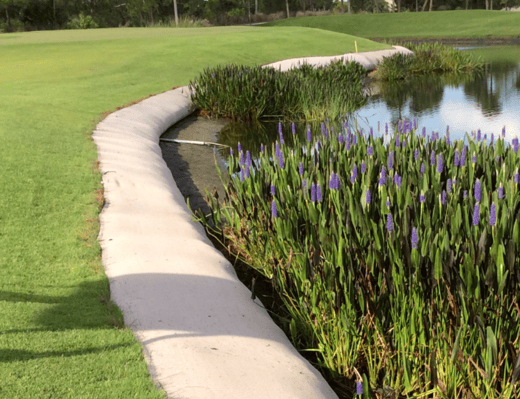
In addition to regular monitoring, professionals recommend cultivating a buffer of native vegetation around the entire perimeter of a waterbody, allowing them to grow approximately knee-high to lessen the force of rainwater as it washes over the shoreline. Beneficial buffers also have complex root systems that help hold soil in place.
Eric Glazer graduated from the University of Miami School of Law in 1992 after receiving a B.A. from NYU. He has practiced community association law for more than 2 decades and is the owner of Glazer and Sachs, P.A. a five attorney law firm with offices in Fort Lauderdale and Orlando.
Eric is Board certified by The Florida Bar in Condominium and Planned Development Law and the first attorney in the State that designed a course that certifies both condominium and HOA residents as eligible to serve on a Board of Directors and has now certified more than 20,000 Floridians all across the state.
Mr. Glazer is certified as a Circuit Court Mediator by The Florida Supreme Court and has mediated dozens of disputes between associations and unit owners. Eric also devotes significant time to advancing legislation in the best interest of Florida community association members.
Comments: Comments Off on Elevate Your HOA and Condo Collections with Axela!
Discover why Axela stands out as the ultimate choice for managing your community’s finances and collections.
Axela is here to revolutionize your HOA experience from streamlined processes to advanced features.
HOW THE FUTURE COLLECTS
Axela Technologies is dedicated to helping create streamlined accounts receivable and collections tools for management companies, condo and homeowners associations and others in the real estate industry.
Our proven collection tools help community associations realize higher returns and lower delinquency ratings.
Axela is not a debt collector. But, our team understands collections and has expertise in the real estate accounts receivable space. Axela licenses its software to specially-selected third-party collection agencies who emphasize a culture of debtor choice and empowerment and compliance with applicable law, including the Fair Debt Collection Practices Act (FDCPA), Fair Credit Reporting Act (FCRA), Telephone Consumer Protection Act (TCPA).
Our focus is on building tools that assist community association capital recovery. Our team of developers is constantly working to build new and improved technologies to ease and speed up the collections process.
Integrates with your Accounting Platform
In order for Condo and HOA collections to be successful, action must be taken quickly, and information must be accurate. Our tools integrate with various accounting software to gather the data required to begin a collections file.
Accurate, Up to the Minute Records
Using Axela’s software, you can effortlessly gather thousands of data points from our integration partners to have a complete picture of what position a delinquent unit and its owner are in.
The tools available in Axela’s toolbox range from calculating the value of a property, to determining if it’s in an equity position, to assistance in locating a unit owner and determining their financial position.
Respectful Treatment of Homeowners
We empower the engagement of your HOA members in a respectful manner to resolve your cash flow issues. When owners are not paying their assessments you need a HOA collection solution NOT a lawyer.
Committed to Condo & HOA Collections Technology and Advancement
An HOA collection agency must use an FDCPA-compliant process, first and foremost. But our exclusive focus on Community Associations and Management Companies makes us go deeper than the basic requirements when designing collections tools.
Our team has years of experience in the industry, from directly managing condos and HOAs, to serving on boards, to working with other industry vendors.
We work constantly to cultivate relationships in the industry so you can benefit from technologies built to suit your specific needs.
Axela’s platform can easily review your delinquency issues and provide a customized collections plan.
We help recover funds utilizing information acquired from your association, third-party data aggregators, and credit reporting agencies.
We will refer you to highly trained and accredited collectors who work respectfully with your association members to resolve delinquencies as quickly as possible.
Comments: Comments Off on Deep Dive on Insurance Deductibles – by Cohen Law Group
In almost every homeowner’s insurance contract, there is a deductible that the homeowner is
required to pay before insurance proceeds become due and owing. Many times, the amount of the
deductible is dependent on whether the claim is a hurricane loss or a non-hurricane loss. Although
homeowners can obtain lower deductible amounts, usually by paying higher premiums, a vast
number of policies in Florida contain higher deductibles for hurricane losses than non-hurricane losses.
A very basic way of looking at the deductible, if the homeowner has a deductible of $5,000 on a
hurricane claim, the loss must have a value of more than that $5,000 before the insurance company is
required to pay any funds for the loss. If the value of the claim is below $5,000 that is typically referred
to as being below deductible. If the claim is valued at $6,000 then the insurance company will reduce
the payment by the $5,000 deductible, as the homeowner is responsible for paying this for the repairs,
and will make a payment to the homeowner for $1,000.
I often speak with homeowners who will receive a small payment for their damages that was
reduced by the deductible. Many homeowners are under the impression that because the amount paid
was reduced by the amount of the deductible, that the deductible has been paid. This is not the case. In
its simplest form, if the homeowner needs $20,000 for the damages and there is a $5,000 deductible,
then the homeowner will receive $15,000 and will be required to pay out of pocket the $5,000
deductible.
Florida statute 489.147 (2023) addresses prohibited property insurance practices. The statute
states that the “consumer is responsible for payment of any insurance deductible.” Subsection (3) states
that it is a felony of the third degree to pay, waive, or rebate any part of the insurance deductible with
the intent to injure, defraud, or deceive.
It is important for homeowners to understand how their policy works and specifically, what type
of costs the homeowner could be liable for when shopping for insurance. Many times, I believe, it is
better to pay a little extra in premium for a lower deductible than to be subject to much larger hurricane
deductibles.
Comments: Comments Off on Now is the perfect time to start planning for the upcoming construction season!
Now is the perfect time to start planning for the upcoming construction season!
At Falcon, we understand the challenges communities face when it comes to site improvements. That’s why we offer comprehensive engineering services to help you tackle these projects effectively.
Contact us today for a free consultation and proposal and let us help you transform your community into a better place to live.
Are you tired of the deteriorating condition of the roadways in your community?
Is drainage becoming a major concern during heavy rains?
Are the retaining walls in your neighborhood showing signs of wear and tear?
If so, it’s time to take action!
Planning and executing site improvement projects can be a complex process. From roadway resurfacing to tennis court replacement, these projects require careful planning and development.
Now is the perfect time to start planning for the upcoming construction season.
At Falcon, we understand the challenges communities face when it comes to site improvements. That’s why we offer comprehensive engineering services to help you tackle these projects effectively.
Our team can assist you with feasibility studies, design plans, construction documents, bidding, and even construction management services.
Don’t wait until it’s too late. Take advantage of the construction off-season to plan your site improvement project.
Tax planning is one of the best ways we know to reduce your tax bill, and at RMS Accounting we take a proactive approach to helping clients pay the lowest amount of tax allowed by law.
We do this through a two-step process. Step 1 requires us to keep up to date with the latest changes to the tax laws, and tax savings strategies. Step 2 is all about you our clients, it requires us to keep you updated on just what steps you can take to ensure that you can take advantage of ever tax saving strategy that will help you.
Since everyone’s situation is different the only way, we can assist you is to be available when you have questions and prior to year-end to review your situation with you, so that you can take the steps required to maximize your tax savings.
That is why every tax preparation engagement includes year-round access to our tax professionals and year-end tax planning, free when we have prepared your tax return for the prior year.
Below are links to this year’s tax planning letter which is mailed to all our clients along with links to planning worksheets for individuals and business. You can use these documents to help you get the most out of your tax planning consultation.








 Eric Glazer graduated from the University of Miami School of Law in 1992 after receiving a B.A. from NYU. He has practiced community association law for more than 2 decades and is the owner of Glazer and Sachs, P.A. a five attorney law firm with offices in Fort Lauderdale and Orlando.
 Axela’s platform can easily review your delinquency issues and provide a customized collections plan.



 Tax planning is one of the best ways we know to reduce your tax bill, and at RMS Accounting we take a proactive approach to helping clients pay the lowest amount of tax allowed by law.