SFPMA

SFPMA Industry Articles | news, legal updates, events & education! 

Find Blog Articles for Florida’s Condo, HOA and the Management Industry. 

“What To Do In The Aftermath Of a Hurricane” by Cohen Law Group

“What To Do In The Aftermath Of a Hurricane” by Cohen Law Group

Cohen Law Group would like to remind all Property Managers and CAMs that our firm has handled thousands and thousands of property damage insurance claims in Florida. We have decades of experience handling hurricane claims that have been denied, delayed, or reduced.
If you are unsure if your property sustained damage as a result of a Hurricane you should ask for an inspection by a qualified contractor, estimator or building inspector to assess whether hurricane-force winds damaged or compromised the roofing system and building envelope. Many companies offer this initial inspection free of charge. Given the complexities of a large loss claim, consider consulting with an attorney experienced in handling commercial insurance claims for condominiums and homeowner’s associations.
We can connect you with top professionals in the industry to evaluate hurricane damage and we can assist you with handling an insurance claim the right way– today.
Here’s more information on how we can help you:
Cohen Law Group is certified through the state of Florida for Property Manager and CAM Continuing Education Credits/Classes. We have a one to three-hour CE class called “A CAMs/Property Managers Guide to Property Damage Insurance Claims” 
· Planning for Success
· Knowing What’s in Your Insurance Policy
· After the Storm
We can schedule a free lunch and learn with your CAMs and will provide an overview of our suggestions and strategies as well as some examples of our vast experience with Residential Property Damage and Commercial Large Loss.
If you’re residential, commercial, or industrial properties have property damage, our Insurance Claims Attorneys can help with everything from A-Z on hurricane claims.

Please call us today at (407)702-3125 or email us at Devan@itsaboutjustice.law

At Cohen Law Group, It’s About Justice!

It’s more than a slogan, it’s our firm’s mantra. We are zealous in protecting your rights. We offer 24-hour availability through our answering service. Call us today.

(407) 478-4878

Harvey V. Cohen, President


Storm Damage Claims for your property:

SFPMA & Members are ready to Handle Storm Damage & Claims for Condo and HOA Properties!

These Trusted Members are; Legal Firms, Public Adjusters, Roofing Engineering & Service Companies that work with you on Solutions to Storm Related Damage.


Has your Home, Condo or HOA Sustained Property Damage?

SFPMA has a team of Legal Experts, adjusters, estimators and claim specialists for the benefit of the Condo and HOA’s who sustained damage from the storms and fire, water or mold.

With the know-how and experience to analyze, evaluate, and negotiate the best settlement for your Insurance Claim!

“Get the maximum settlement for your damage claim!”


Did you know? Transactional law involves drafting and negotiating contracts to protect your interests. Learn more about this essential legal service at Katzman Chandler.

Did you know? Transactional law involves drafting and negotiating contracts to protect your interests. Learn more about this essential legal service at Katzman Chandler.

  • Posted: Aug 22, 2023
  • By:
  • Comments: Comments Off on Did you know? Transactional law involves drafting and negotiating contracts to protect your interests. Learn more about this essential legal service at Katzman Chandler.

Transactional Services with Katzman Chandler

The team’s decades of combined legal experience provide the Katzman Chandler family of clients with cutting edge solutions to routine issues, as well as novel and/or complex legal matters faced by our Community Association clients and their voluntary Boards of Directors.


Our Transactional Attorneys are often relied upon by the media, as well as public policy makers, to sort out issues relating to the Community Association lifestyle. Each member of the Transactional Team brings a unique skill set and perspective to this diverse practice and understands how best to assist Boards in functioning in an age of ever growing state regulation and changing legal requirements.

Our Transactional Legal Services for Associations involve a combination of several specialty areas including, but not limited to, Real Property Law, Corporate Law, Litigation, Contract Law, and Insurance Law. Whether we are reviewing your contracts, amending your documents, rendering a bank loan opinion or enforcing your Community’s covenants against violators; our ultimate goal remains the same – to deliver information, counsel and answers in an easy to understand format with personalized service and attention to detail that you can rely on time and again.

Tags: , ,
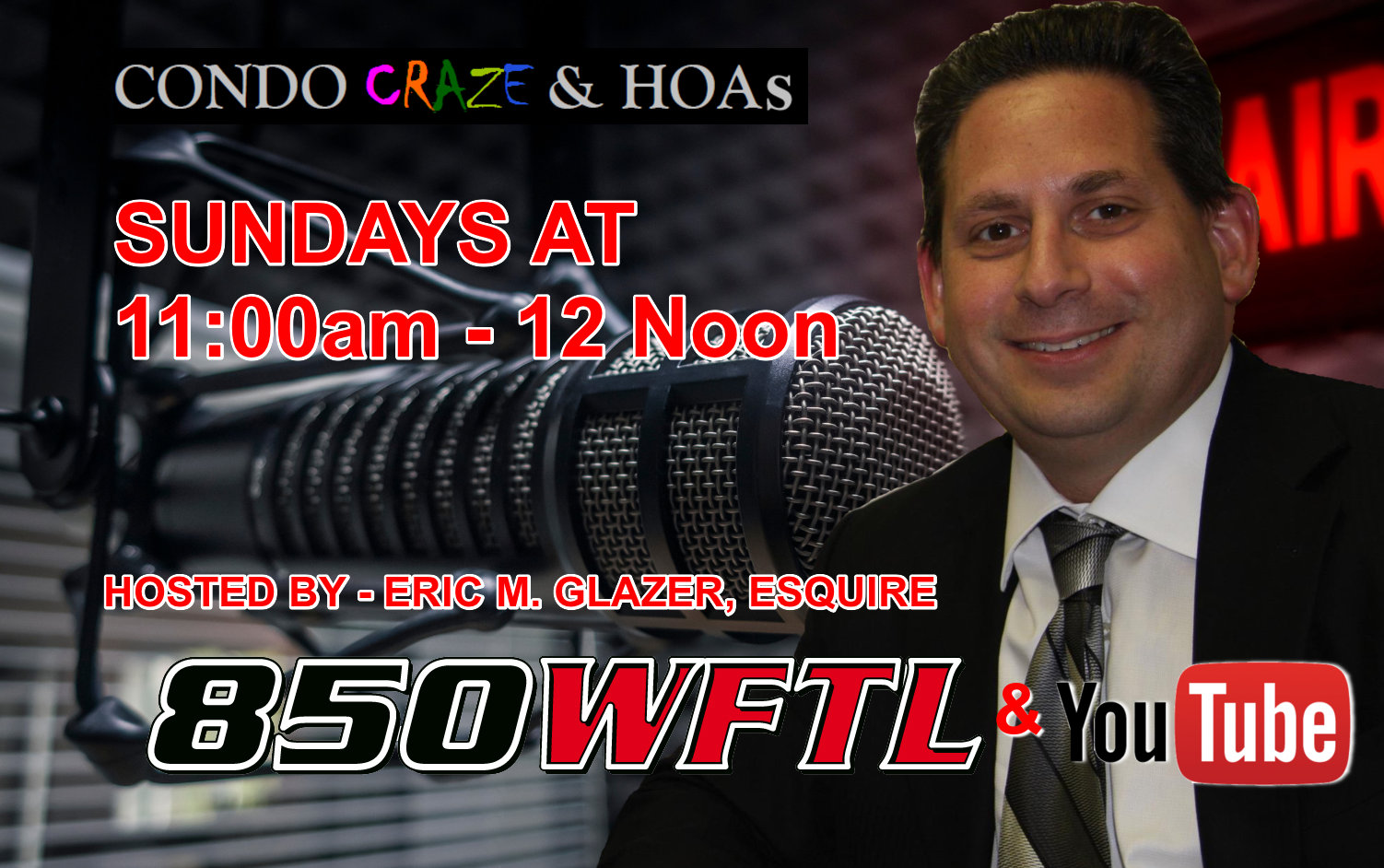
BOARD MEMBERS BETTER BE CAREFUL  By Eric Glazer, Esq.

BOARD MEMBERS BETTER BE CAREFUL By Eric Glazer, Esq.

  • Posted: Aug 22, 2023
  • By:
  • Comments: Comments Off on BOARD MEMBERS BETTER BE CAREFUL By Eric Glazer, Esq.

BOARD MEMBERS BETTER BE CAREFUL

By Eric Glazer, Esq.

Board members I’m telling you now……..be careful.  I’m seeing it already.  Unit owners are starting to freak out over the passage of huge assessments to cover the costs of mandatory inspections, mandatory repairs and massive increases in insurance rates.

As we know, we’re not talking about pesky increases to the monthly cost of living in your home.  We are talking about increases that will cause many to no longer be able to afford to live in their home at all.  We are talking about increases that will force people to sell and no longer live in the condominium that they have lived in for perhaps decades.

Notwithstanding the fact that none of these increases are the result of anything the Board members did or didn’t do, board members know who is likely to be blamed for this financial disaster many unit owners find themselves in ——the Board members.  So what else is new?

Board members are used to being blamed when things go wrong even though it’s not their fault.  That comes with the territory.  They get yelled and screamed at, the meeting ends and then it’s usually over.  Maybe there’s some nasty e-mail that float around the community.  This time it’s different.

Even if unit owners come to the realization and accept that they can’t afford to live in the condo any longer, the question is….so where can they go?  Every condo seems to be in the same shape.  Or if owners choose to move to a place that’s simply newer and not yet required to perform these inspections and repairs, you can bet they cost a lot more money than where they currently live.  There’s simply no place to turn to.

When there is desperation and fear, people become irrational and often times violent and that is why I honestly fear for the safety of condominium board members throughout the state.  This is not a knock on the millions of law abiding condominium owners throughout the state.  They  were thrown into this position because The Florida Legislature failed all of you.  Instead of always requiring condominium owners to put away money for a rainy day, The Florida Legislature cow-towed to the whims of developers, law firms and other special interest groups who always lobbied against mandatory reserves.  The only reason why mandatory reserves are now required is because 98 innocent men, women and children died at The Champlain Towers in Surfside as a result of not having nearly enough money on hand to make obviously needed structural repairs in their condominium.

So Board members……….you didn’t volunteer in your community to get punched out or worse at your board meetings.  My advice is….when you know you’re about to pass a special assessment at a meeting, and at that meeting people are going to be going crazy……protect yourselves.  Make sure there are police or at least security at the meeting.  Better be safe than sorry.


WE WILL TAKE YOUR CALLS AND ANSWER YOUR CONDO AND HOA QUESTIONS THROUGHOUT THE HOUR. CALL US AT 877-850-8585 DURING THE SHOW.


Tags: , , ,
REMBAUM’S ASSOCIATION ROUNDUP | The Community Association Legal News You Can Use

REMBAUM’S ASSOCIATION ROUNDUP | The Community Association Legal News You Can Use

  • Posted: Aug 14, 2023
  • By:
  • Comments: Comments Off on REMBAUM’S ASSOCIATION ROUNDUP | The Community Association Legal News You Can Use

Jeffrey Rembaum, Esq. is a  Board Certified Specialist in Condominium and Planned Development Law and a community association lawyer with the law firm Kaye Bender Rembaum, in its Palm Beach Gardens office. His law practice consists of representing condominium, homeowners, and cooperative associations, developers and unit owners throughout Florida. He can be reached by email at JRembaum@KBRLegal.com or by calling 561-241-4462.

Guns in the Clubhouse: What Can a Community Association Do?

The right of the people to carry and bear arms without governmental infringement is a right which stems from both the United States Constitution and the Constitution of the State of Florida. The State of Florida recently adopted new gun legislation, effective July 1, 2023, which allows the everyday citizen to carry a concealed weapon without first obtaining a concealed weapons permit. This raises interesting questions for community associations such as, is the right to carry a concealed weapon absolute? Can a community association adopt a rule that prohibits the carrying of concealed weapons in the clubhouse or other common area facilities?

Before we get too far in our analysis, it is important to point out that the intent of this article is not to advocate for gun control or the right to carry. Rather, the intent of this article is to examine the rulemaking authority of a board of directors of a community association to prohibit concealed weapons in the clubhouse and other common areas. In short, is it possible for a community association to adopt such a rule? Yes, subject to the cautions and explanations explained below. Is the adoption of such a rule risk free? No!

As the starting point, in order for a board-made rule of this nature to have validity, we must examine whether it violates either the United States Constitution or the Constitution of the State of Florida. As to when constitutional protections apply within a community association, this is an interesting question. In prior cases, courts have found that recorded covenants restricting home ownership based on race will subject the covenants to a constitutional examination, and in the end, such covenants were deemed to violate the equal protection clause of the Fourteenth Amendment to the United States Constitution.

Another method by which courts may find application of constitutional protections to community associations is if there is significant governmental action associated with the community association. For example, an argument would exist that if a community association were built with federal monies, the covenants of such a community association would be subject to all the protections afforded by both the United States Constitution and the Constitution of the State of Florida. Often, multiple community associations that exist within a sprawling master association are built in community development districts (CDD). The CDD is a quasi-governmental entity established to govern and control what would otherwise be the common areas of the master association. The creation of the CDD allows many of the hard costs associated with the community’s build-out, such as the roads and drainage systems, to be immediately passed on to the first-time home buyers. By utilizing a CDD, long-term bonds can be issued, which are paid back through ad valorem tax obligations allowing the costs to spread out over a significantly longer period of time. As quasi-governmental entities, constitutional protections which limit powers of government would likely apply to CDDs. Therefore, should a CDD adopt rules to prohibit concealed weapons in the common areas, such a rule would likely be found to violate constitutional protections. However, the same analysis is not applicable if the community association itself adopted such a rule.

It should be remembered that courts have long held that owners give up certain individual rights and liberties when living in a community controlled by a community association. In 2002 the Florida Supreme Court held, in Woodside Village v. Jahren, 806 So. 2d 452 (Fla. 2002), that certain individual rights must be compromised when one chooses to live in a condominium association (and by analogy, in a homeowners’ association, too). But, on occasion courts have found that certain constitutional protections apply within a community association; however, such application is somewhat rare.

Thankfully, we do have some limited guidance. In 1989 the Florida Supreme Court held, in Quail Creek POA v. Hunter, 538 So. 2d 1288 (Fla. 2d DCA 1989), that neither a homeowners’ association’s recording of its covenants in the public records, nor the enforcement of its covenants in state court, created a sufficient nexus to evidence “state action” such that the First Amendment and the Fourteenth Amendment of the United States Constitution would apply. By analogy, such logic could be applied to defending the right of a community association to adopt a rule prohibiting concealed weapons in the clubhouse. Thus, there is no reason to believe that such arguments would not also apply to the application of the Second Amendment of the United States Constitution within community associations. That said, it would not at all be surprising for an owner to challenge such a rule; so, any association that adopts such a rule should be prepared to be a possible test case, which could have national implications associated with it.

Let us assume that the board understands and accepts such a risk and is ready to move forward to adopt a rule prohibiting the carry of concealed weapons in the clubhouse. Certainly, we recommend that counsel for the association be consulted prior to adopting these types of rules. For the purposes of our analysis, let us also assume that the community association at issue does not have a sufficient nexus to the federal or state governments that would, in and of itself, render such a rule unconstitutional. Under these circumstances, the analysis can then shift to the ordinary rulemaking criteria necessary to withstand judicial challenge, as follows:

      1. Does the board have the necessary rulemaking authority set out in the governing documents or by statute to adopt such a rule?
      2. Does the rule conflict with any rights afforded by governing documents of higher priority, whether they are considered express or implied rights?
      3. Is the rule reasonable? Reasonableness is difficult to define, but case law provides that the rule must be rationally related to a legitimate association objective. The rule cannot be arbitrary or capricious.
      4. Does the rule contravene existing laws or compelling public policies?
      5. Was the rule adopted in a procedurally correct manner that is provided by both the governing documents and existing law?

Of course, even if the association adopts such a rule, enforceability is an entirely different issue. Assuming the association is not using some type of full body scanner, then so long as the possessor of the concealed weapon does not brandish the weapon, and thus it remains fully concealed, no one will be the wiser. In addition, such a rule would not apply to certain individuals who have an absolute right to carry a concealed weapon, subject to very few limitations, such as an off-duty police officer.

As an aside, just because a person may not need to have a concealed weapon permit to carry a concealed weapon, this does not mean that the still-available concealed weapon permit does not have value. It certainly does when it comes to traveling outside the State of Florida to one of the many states, over 26, that have reciprocity with Florida, meaning that the other states recognize Florida’s concealed weapons permit. With that in mind, obtaining a concealed weapons permit may still make sense.

While a properly drafted rule prohibiting guns in the clubhouse stands a decent chance of validity, remember that even if your association

i) fully analyzes whether it has any type of federal governmental nexus which would provide for clear application of constitutional protections and such analysis is answered in the negative, ii) meets the rule adoption criteria listed above, and iii) consults with the association’s lawyer who helps draft such a rule, the association could still find itself as a defendant in a lawsuit seeking to have such a rule invalidated by the court.

DON’T LET THIRD PARTIES OFF THE HOOK!  MAKE SURE YOUR GOVERNING DOCS DON’T THROW AWAY MONEY.

DON’T LET THIRD PARTIES OFF THE HOOK! MAKE SURE YOUR GOVERNING DOCS DON’T THROW AWAY MONEY.

DON’T LET THIRD PARTIES OFF THE HOOK!

MAKE SURE YOUR GOVERNING DOCS DON’T THROW AWAY MONEY.

Last week was a primer on how foreclosures generally work and how banks get off the hook when they get back a unit when they foreclose on an owner’s unit or home.  We learned that the banks are protected by the law because they only owe a few bucks to the association when they get title to the unit or home despite the fact that the owner owes a fortune to the association. That’s called a “safe harbor” and it’s provided to the banks because the banks claim that if you make them responsible for paying unpaid assessments, they simply won’t loan money to buy a condo or a home in an HOA.

But there is some good news……….suppose the bank does not buy the unit at their foreclosure sale and a third party winds up becoming the successful bidder and the owner?  What does that new owner owe the association if that unit owes thousands to the association in unpaid assessments?  And the answer under the law is EVERYTHING!  They owe it all.  Florida Statute 718.116 states:

Additionally, a unit owner is jointly and severally liable with the previous owner for all unpaid assessments that came due up to the time of transfer of title.

So, when a bank forecloses on a unit, or when the association forecloses on a unit, the association hopes and prays that a third party purchases the property at foreclosure sale because that guy owes everything to the association.  UNLESS………………….

Remember last week that I said that some of you have language in your governing documents that allows the bank to get off the hook even though they would owe money to the association if they wind up foreclosing and owning the property?  Well…..some of you have language in your governing documents that allow third party purchasers off the hook if they buy the property at a foreclosure sale.  So…..even though the association gets lucky and a third party purchases the property at foreclosure sale, your own docs kill you and lets the third party purchaser off the hook.  They owe nothing.  Disaster.

So……over the past two weeks we learned that it is vital for the board to check their governing documents to make sure that neither the bank nor a third party purchaser is let off the hook should they purchase a unit or home in your community.  Make sure your docs don’t kill you.  If they do, amend them immediately!!!!!!

1099-K Confusion on the Horizon

1099-K Confusion on the Horizon

The American Rescue Plan Act of 2021 lowered the filing threshold for payment processors and credit card companies from 200 transactions or $20,000 to just $600 for 2022 — but the IRS delayed the effective date until 2023.
Because of this taxpayers that use credit card processors PayPal, Venmo and Zelle are going to be receiving a 1099-K for 2023 — even if they only have a few transactions. Worse yet, the IRS is going to be looking to match the income reported on these 1099-Ks to the tax returns filed by these taxpayers.

What can taxpayers do?

What can taxpayers do?
Start by letting the payment originators know to mark the payments that are not business related (should not be income and subject to tax) as personal on the chosen platform. If you end up picking up the lunch tab and being reimbursed through Venmo or Zelle be sure to remind your friends to mark the transaction as non-business. This also holds true for gifts, reimbursements, and other non-taxable payments.

At tax time be sure to share these documents, like all tax forms you receive, with your tax professional, so they can see that income reported on 1099-Ks is properly reported on your tax return.

One thing we as tax professionals are sure of is that these 1099-ks are going to generate a lot of confusion for taxpayers in addition to a lot of IRS notices that will need to be delt with long after the 2023 returns are filed.

Learn more on this week’s blog post:

https://www.rmsaccounting.com/2023/08/08/1099-k/


Find other fantastic articles and Accounting information:


Tags: ,
International Subsea Services LLC – Lake Bank and Pond Stabilization Contractors !

International Subsea Services LLC – Lake Bank and Pond Stabilization Contractors !

Lake Bank and Pond Stabilization Contractors !

It is indeed sad to see beautiful water bodies being turned into a natural disaster due to pollution and natural occurrences. With our services, you can restore them to a beautiful, normal condition, thus experiencing the happiness and healthiness of a healthy environment that has been evading you for so long. Over the past decades, we have gained extensive knowledge and skills in shoreline and hillside water bodies restoration and preservation. We have more than 20 years of local experience in the commercial industry and we have gained experience and expertise that can give considerable assistance to clients, according to their specific needs.
Here is a look at what we offer for lake bank and pond stabilization and installation:
~Specialized knowledge in various types of subsea solutions.
~Licenced dealer in Dredge Sox products.
~Solutions for environmental assets maintenance like shoreline restoration, wetland mitigation, debris removal, etc.
~Use high-quality and latest equipment by expert staff when implementing a solution.
~High Quality inspection services that report on the result of measures set in place to protect the lake bank and pond environment.
Call today to schedule a free onsite estimate !
(832) 257-0813
Tags:
6 Community Association Management Trends to Watch in 2023

6 Community Association Management Trends to Watch in 2023

  • Posted: Aug 09, 2023
  • By:
  • Comments: Comments Off on 6 Community Association Management Trends to Watch in 2023

Interesting research on the community association industry. Especially, given that seventy-eight percent of new homes for sale are located in community associations. There are 358,000 associations across the country, and it’s estimated that 5,000 more will be formed in 2023. Here presented are six trends that CAMs and boards are likely to see, including the absence of new board members. However, I think it is less to do with apathy than before Surfside and more to do with risk associated with a voluntary, unpaid, thankless job.


As part of our cross communications with other groups we are posting this for our industry – SFPMA


Wondering what 2023 holds for the community association management industry?

We were, too. That’s why Buildium asked 240 community association managers and board members about the challenges and opportunities they foresee for the industry this year.

They told us the community association sector is more popular than ever among developers, residents, and management companies—but there are several key challenges that community association managers and leaders need to address head-on, so they continue to thrive.

From shortages of team members, vendors, and volunteers to increasing competition among management firms, here are the six trends community association management companies should be aware of in 2023.


1. Staffing is a top priority as the labor shortage continues to strain teams’ resources.

Smaller community association management companies are competing with larger companies and developers for full-time team members and high-quality contractors, leading to higher staffing costs and smaller teams.

According to Buildium’s research, this is a leading challenge for the 85% of companies that plan to expand their portfolios throughout 2023 and 2024, prompting community association management companies to name staffing as their second-highest priority for the coming year.


2. Efficiency is a primary area of focus as teams search for ways to do more with less. 

Technology is the X factor that allows community association management teams to take on more clients, even as their teams remain smaller than in the past. Streamlining processes like payments, communications, and accounting frees up time for the most impactful areas of the business, such as customer service and business development.

More than half of community association management companies told Buildium that leveraging technology to drive efficiency is a key aspect of their revenue generation strategy for 2023.


3. Competition for clients highlights the importance of high-quality customer service.

The Foundation for Community Association Research estimates there are 8,000 to 9,000 community association management companies in the U.S. In certain areas, smaller companies feel they’re being edged out by larger firms that can charge less for their service due to economies of scale.

Association board members told us they can feel the difference between customer service that’s personalized to their needs, and service that’s one-size-fits-all. This is where smaller companies have a competitive edge.


4. New development means new potential clients for community association managers.

Seventy-eight percent of new homes for sale are located in community associations. There are 358,000 associations across the country, and it’s estimated that 5,000 more will be formed in 2023.

This creates new opportunities for 88% of community association management companies that plan to recruit new clients over the next two years, with growth named as companies’ third-highest priority for 2023, according to Buildium’s survey.


5. Profitability is a challenge as companies balance the pressure to increase prices with the need to stay competitive.

Inflation has increased the cost of running associations across the board, from materials and labor (on the management side) to insurance and taxes (on the association side). Association boards are feeling the strain of pulling together sufficient reserves and funding for capital projects without raising dues or requiring special assessments.

Association management companies are under pressure to keep prices low to stay competitive—but 70% of companies feel it’s necessary to raise prices to cover their costs in 2023 and 2024. Our research found 43% of companies plan to expand the services they provide, potentially opening new revenue streams.


6. Community associations are struggling to recruit engaged, knowledgeable board members.

According to Buildium’s research, 38% of association board members said finding the people and resources necessary to keep their community running as a primary source of stress in 2023.

Current board members—80% of whom are 60 and older—feel frustrated with the lack of participation from newer homeowners; and boards that experience frequent turnover struggle to find members who have the knowledge to make important decisions for the community.

Overall, association boards and management companies feel more involvement in the community from homeowners is needed, in addition to greater awareness of their responsibilities as residents of an association.

These are some of the challenges and opportunities that association managers and leaders will face in 2023. For a deeper dive into 2023 community association management trends, download our 13-page report, which shares additional data and quotes from real community association management professionals and board members. Download your free copy now.

Tags: , ,
Simplify Your Accounts Receivable with These Proven Tips! by Condo Control

Simplify Your Accounts Receivable with These Proven Tips! by Condo Control

  • Posted: Aug 09, 2023
  • By:
  • Comments: Comments Off on Simplify Your Accounts Receivable with These Proven Tips! by Condo Control

We help condominiums and HOAs establish better processes so that they can operate more efficiently and effectively.

Simplify Your Accounts Receivable with These Proven Tips!

Struggling with managing accounts receivable in your condo or HOA? We’ve got you covered! Discover effective strategies to streamline your financial processes and ensure timely payments.
We’ve seen it for ourselves. We harnessed the best of technology to create software that streamlines and automates almost every aspect of community operations.
…………………………………………

There would be no Condo Control without Brian Bosscher. Brian had no professional property management experience, but he did understand the frustrations that plague condo communities after purchasing a unit in 2006. Looking to help improve operations, Brian joined his building’s finance committee immediately. He started volunteering on the Board of Directors as Treasurer the following year, and then became the Board President.

It was through volunteering that he learned about the challenges and roadblocks that property managers encounter on a day-to-day basis, and witnessed the inefficiencies that prevented them from reaching their goals. It was this experience that inspired Brian to build a long-term solution, and Condo Control was born.


How to simplify accounts receivable for your condo/HOA

When residents pay their fees or fines, these payments are documented under accounts receivable (AR). Vendor credits are also logged under AR. This element of accounting tracks the money coming into the corporation or association.

But like most things related to community finances, it’s much easier to talk about accounts receivable than manage them. Collecting payments is always a challenge because they come in at different times, and in different formats. Documenting this information is equally tedious and time consuming.

While we can’t eliminate this responsibility for you, we can suggest some ways to simplify the AR workflow for you and your team.

Table of contents

Regulate billing practices

Without structure, rules, or established expectations, anything goes. But spontaneity isn’t exactly ideal when you’re trying to get money from 200 owners. That’s why it is so important to implement consistent billing practices. Not only does this create a routine for you and/or your staff, but residents aren’t left wondering when they might receive their invoices or how they should make payments.

By creating a sustainable AR workflow, condos and HOAs will find that late payments become less common. By sending billing statements in the same format, at the same time each month, your residents become familiar with a routine. As a result, they’ll become more accustomed to making payments the same way at the same time.

Use electronic billing and online payments

Online banking has become almost ubiquitous in North America. Mobile apps make this option accessible to all age demographics, and the convenience cannot be overstated. So doesn’t it make good sense to offer online payment options to residents?

Not only does it make the payment process far easier for the people who live in the community, but it creates less work for you.

Teams that are still documenting accounts receivable payments manually are more prone to making mistakes. Between writing down payments, updating balances, and creating receipts, it’s understandable why someone might forget to fill in a field or add an extra “0.”

But even a small mistake can lead to bigger problems, and can even create conflict between residents and staff. Furthermore, time is wasted when someone has to go back and review the numbers.

Then there’s the issue of storing and locating physical records. Paper can easily be misplaced or lost, and aside from the obvious problems associated with losing documents, missing information can lead to costly compliance violations.

Electronic billing and online payments reduce manual data entry work for staff, and create records automatically. If you decide to use a cloud-based system, you’ll have the ability to access records from any computer. That way, you aren’t tied to the office.

It’s important to note that not every resident will want to make online payments. Your condo or HOA could install a secure lockbox so that you don’t have to arrange a meeting with these individuals to receive a payment on time.

Set up automations

With a digital AR system, you can also create automations to bypass some of the most tedious AR tasks. This typically includes email automation (late payment reminders, confirmation of payment) as well as sending out invoices.

Remove “information silos”

A cloud-based AR system ensures that anyone who needs access to accounts receivable information can get it, no matter where they are working from. Conversely, when team members have to wait for information because it is siloed off, it slows down the entire process.

Follow the process when collecting late payments

Inevitably, there will be residents who are consistently late with payments, or who avoid them altogether. Instead of having to figure out what to do next each time this happens, follow the condo or HOA’s rules/ procedures laid out in the governing documents.

Make sure all actions are in accordance with local laws. For example, you are probably required to give residents written notices and a reasonable amount of time to pay fees before more severe actions are taken.

Corporations/associations do have the power to pursue residents for unpaid fees, and to recover any legal expenses incurred while trying to collect money owed from delinquent owners.

These are some of the actions that communities are permitted to take while trying to secure outstanding fees:

  • Send the resident a notice of arrears
  • Apply interest to outstanding arrears after a certain amount of time has passed
  • Revoke the owner’s right to vote
  • Revoke a resident’s access to shared facilities
  • Contact collections
  • Contact legal counsel
  • File a Notice of Lien
  • Register lien

Conclusion

Accounts receivable is an ongoing responsibility that requires a great deal of time and resources. The less you and your team have to do by hand, the happier you’ll be.

It is recommended that condos and HOAs look into AR software to simplify and speed up workflows. The money you invest in this solution will be less than the costs associated with conducting this process manually. Not only can it help keep processes more consistent, but you will probably find that you make fewer errors.

Your time is valuable; spend it wisely.


Tags: , ,